
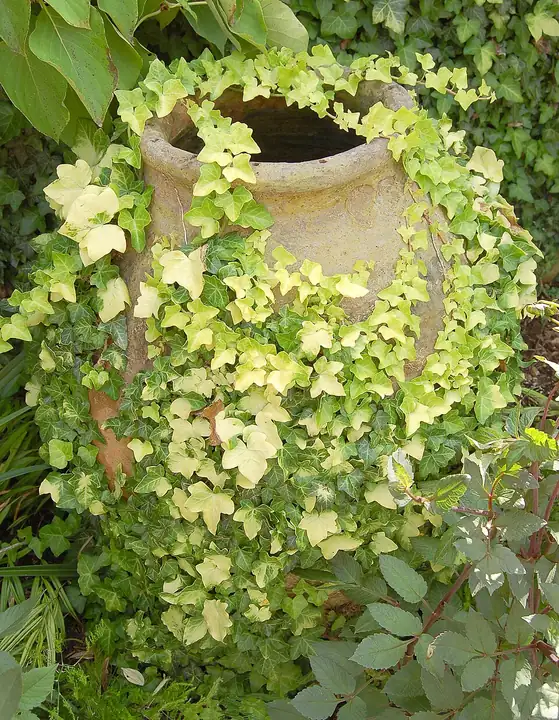
English ivy (houseplant)
Hedera helix (Atlantic ivy, H. hibernica, is a close relative often sold as 'Hibernica') · Ginseng family (Araliaceae)
| Hardiness zones | 4 to 13 |
|---|---|
| Sun | part shade |
| Water | moderate |
| Life cycle | perennial |
| Frost | Hardy: takes frost |
About English ivy (houseplant)
English ivy is the evergreen European vine with lobed, glossy leaves that trails from a pot, climbs a hoop or clips into a topiary, and comes in hundreds of cultivars from needle-leaved miniatures to cream- and gold-edged forms (Clemson, NC State). Indoors it likes cool rooms, bright indirect light and a regular shower, which also keeps spider mites down. Outdoors it is a serious invasive across much of the U.S.: it smothers the ground, climbs and kills trees and is nearly impossible to get rid of once established, so NC State says the safe way to grow it is as a houseplant, and Oregon and Washington ban its sale (NC State, Oregon ODA, Washington Noxious Weed Board).
Hardy outdoors in zones 4-13 (NC State), which is exactly the problem: it is grown indoors everywhere as a houseplant, can summer outdoors in shade in its pot once nights stay above about 50 F, and should never be planted in the ground or allowed to root out of the pot (Clemson).
When to plant
Timing is counted from your average last spring frost (and first fall frost). Sow & Tell works out the actual dates for your ZIP code.
Usually bought as a nursery plant or started from a stem or tip cutting, which most kinds root easily in water (Clemson).
Growing it indoors
- Light: Bright indirect light near a north, east or west window is best; it tolerates low to medium light, but growth slows and variegated kinds turn plain green (Clemson).
- Water: Water thoroughly, then wait until the top half inch of mix is dry to the touch, and never let the pot stand in water (Clemson); MU Extension's table says keep it evenly moist. Water less in winter and in a cool room, since slow-draining mix or watering too often is the usual cause of root rot.
- Humidity: It prefers moderate humidity but tolerates ordinary dry rooms; a tray of wet pebbles helps, and a regular shower in the sink washes off the spider mites that thrive in warm, dry air (Clemson).
- Temperature: It likes it cool: 50-70 F by day and 5-10 degrees cooler at night (Clemson), with MU Extension giving 50 F nights; keep it away from heat vents and hot, dry rooms.
- Feeding: Feed monthly with a foliage houseplant fertilizer by the label while it is actively growing, and not at all when growth stops in summer heat or in cool winter weather (Clemson).
- Repotting: Repot when it is top-heavy, root-bound or drying out too fast, into a pot no more than 1 in wider, since an oversized pot stays wet and rots the roots (Clemson).
Soil
A rich commercial houseplant potting mix in a pot with good drainage (Clemson).
Pot in a rich commercial houseplant potting mix in a container with good drainage, no more than 1 in wider than the root ball (Clemson).
Feeding
- Spring and fall, whenever new shoots are growing: foliage houseplant fertilizer. Clemson feeds monthly by the label while the plant is actively growing, watering first.
- Summer heat and cool winter weather, when growth stops: none. Skip feeding whenever the plant isn't putting out new leaves (Clemson, MU Extension).
An oversized pot and frequent watering rot the roots; keep ivy snug in its pot and let the top half inch dry between drinks (Clemson).
Varieties (15)
| Variety | Type | Days | Notes |
|---|---|---|---|
| Needlepoint | Bird's foot miniature | A miniature with narrow, pointed lobes; often used in topiaries. | |
| Buttercup | Colored leaf | Slow-growing with butter-yellow leaves. | |
| Ivalace | Curly | Dark, shiny five-lobed leaves with wavy, curled edges. | |
| Manda Crested | Curly | Large, very curly leaves on a fast-growing vine. | |
| Triton | Fan-shaped | Fan-shaped leaves on a non-climbing plant. | |
| Gnome | Miniature | Petite and slow-growing with dark maroon stems. | |
| Arborescens | Oddity | The adult, non-vining shrub form about 3 ft tall with oval, unlobed leaves. | |
| Congesta | Oddity | Dark green leaves on an upright, bushy, non-trailing plant. | |
| Baltica | Typical | Smaller leaves, extra hardy; sold outdoors for erosion control. | |
| Bulgaria | Typical | Hardy and drought resistant. | |
| Green California | Typical | Deep green, unvariegated foliage. | |
| Hibernica (Atlantic ivy) | Typical | Larger, shiny leaves; a popular outdoor form, now treated as the species Hedera hibernica. | |
| Glacier | Variegated | Triangular gray-green leaves with creamy white margins; a classic houseplant ivy. | |
| Gold Child | Variegated | Mottled gray-green leaves edged with bright gold to cream-yellow. | |
| Midas Touch | Variegated | Green leaves variegated with gold; about 8 in tall and 8 ft wide outdoors and less invasive than the species. |
Pests to watch for
Twospotted spider mite, Mealybugs, Aphids, Whiteflies, Scale insects
Diseases and problems
Root and crown rot, Bacterial leaf spot, Powdery mildew
In the kitchen
Safety: Medium-severity poison (NC State): the leaves contain triterpenoid saponins and polyacetylenes, and eating them can cause burning in the throat, vomiting, stomach pain, drooling, diarrhea, fever, rash and even delirium or convulsions; the berries burn the throat, and the leaves are more toxic than the berries. The sap gives sensitive people a red, itchy, blistering rash, so wear gloves and long sleeves when pruning or pulling it (NC State, Clemson). Keep it well away from children.
Pets: Toxic to dogs, cats and horses (ASPCA): triterpenoid saponins (hederagenin) cause vomiting, abdominal pain, heavy drooling and diarrhea; the foliage is more toxic than the berries.
Sources
- plants.ces.ncsu.edu
- hgic.clemson.edu
- hgic.clemson.edu
- extension.illinois.edu
- extension.missouri.edu
- aspca.org
- law.cornell.edu
- nwcb.wa.gov
Photo: Photo: Derek Ramsey (Ram-Man), CC BY-SA 3.0, via Wikimedia Commons (CC BY-SA 3.0). Photo resized for the web.

Planting dates and advice are general guidance; check with your local Cooperative Extension office for your area.