
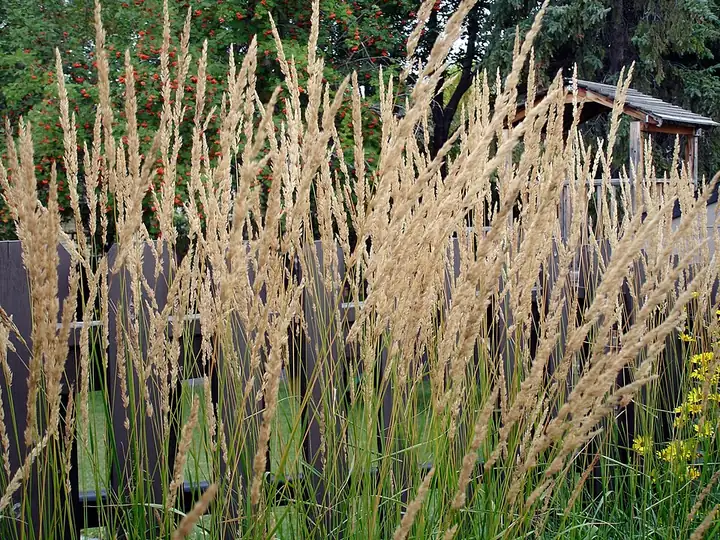
Feather reed grass
Calamagrostis x acutiflora (also Korean feather reed grass, C. brachytricha) · Grass family (Poaceae)
| Hardiness zones | 4 to 9 |
|---|---|
| Sun | full sun |
| Water | moderate |
| Life cycle | perennial |
| Frost | Hardy: takes frost |
About Feather reed grass
Feather reed grass is a cool-season grass that stands bolt upright, with narrow plumes in early summer that start purplish and fade to wheat-tan. 'Karl Foerster' is the best-known kind and sets no viable seed, so it won't spread (NC State). Korean feather reed grass has pink fall plumes and takes heat better (Clemson).
NC State lists zones 4-11 for the hybrid; Clemson rates 'Karl Foerster' zones 4-7 and Korean feather reed grass zones 4-9. It grows best where summers aren't too hot.
When to plant
Timing is counted from your average last spring frost (and first fall frost). Sow & Tell works out the actual dates for your ZIP code.
Cool-season grasses can be planted in fall as well as spring (Clemson). Divide cool-season grasses in early fall. It blooms best with a little afternoon shade but flops in real shade (NC State).
Soil
Grows best in soil that doesn't dry out, but takes heavy clay, poor soil and dry to wet sites (NC State).
No special prep; it takes heavy clay (NC State).
Feeding
- Spring, only if a soil test shows a need: fertilizer only as a soil test recommends. Most ornamental grasses need very little fertilizer; base any feeding on a soil test (Clemson).
Too much nitrogen makes grasses weak, floppy and prone to disease (Clemson). Water thoroughly after planting and watch closely the first few weeks; established clumps want about 1 inch of water a week from rain or irrigation.
Varieties (4)
NC State and Clemson document these 4 kinds.
| Variety | Type | Days | Notes |
|---|---|---|---|
| Korean feather reed grass | C. brachytricha | 3-4 ft; pink plumes in fall; handles heat better; light or part shade. | |
| Avalanche | C. x acutiflora | 3-5 ft; green and white variegated; medium to wet soil. | |
| Karl Foerster | C. x acutiflora | 3-5 ft, very upright; pinkish-purple plumes turn tan; sterile, so it doesn't seed around. | |
| Overdam | C. x acutiflora | 2.5-3 ft; white-striped leaves turn pink in cool weather; likes part shade and moist soil. |
Diseases and problems
Rust
In the kitchen
Pets: Not listed as toxic by the ASPCA.
Sources
Photo: Photo: Daryl Mitchell / Wikimedia Commons, CC BY-SA 2.0 (CC BY-SA 2.0). Photo resized for the web.

Planting dates and advice are general guidance; check with your local Cooperative Extension office for your area.