
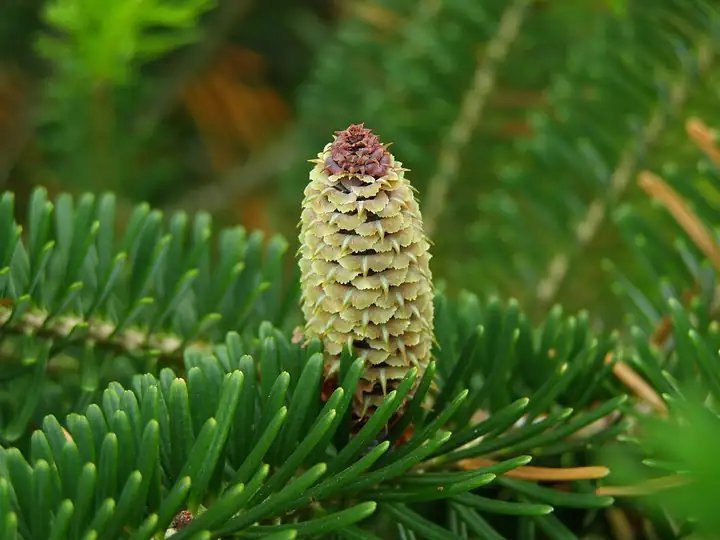
Fir
Abies fraseri (Fraser fir), A. balsamea (balsam fir), A. concolor (white or concolor fir) and A. nordmanniana (Nordmann fir) · Pine family (Pinaceae)
| Hardiness zones | 3 to 7 |
|---|---|
| Sun | full sun to part shade |
| Water | moderate |
| Life cycle | perennial |
| Frost | Hardy: takes frost |
About Fir
Firs are cone-shaped evergreens with soft, flat, fragrant needles and cones that sit upright on the branches, and they are favorite Christmas trees. Fraser fir is native only to the high mountains of Virginia, North Carolina, Tennessee and Georgia; balsam fir to the Northeast and Upper Midwest, south through the mountains to Virginia and West Virginia; white fir to the mountains of the West; and Nordmann fir comes from the Caucasus and Turkey (NC State, wildflower.org). As yard trees they want cool summers and good drainage: most do poorly in hot, humid southern summers, and white fir handles heat and drought best (NC State, Morton Arboretum). In the wild, Fraser and balsam firs are being hurt by the balsam woolly adelgid, an insect from Europe (wildflower.org, NC State).
Balsam and white fir are hardy in zones 3-7, Fraser fir in 4-7 and Nordmann fir in 4-6 (NC State). Fraser, balsam and Nordmann firs dislike heat, and NC State says even white fir isn't suited to the Southeast.
When to plant
Timing is counted from your average last spring frost (and first fall frost). Sow & Tell works out the actual dates for your ZIP code.
Plant container-grown or balled-and-burlapped trees; Morton suggests pruning white fir, if needed, in spring. A living (potted or balled) Christmas tree should stay indoors only 7-10 days; afterward keep it in an unheated garage or shed, roots moist, and plant it in spring once the soil thaws and dries (UNH Extension). Check the mature size first: these trees reach 30-70 ft.
Soil
Moist, well-drained, acidic soil (pH below 6.0) rich in organic matter; avoid heavy clay and wet spots. White fir also takes drier, sandy or alkaline soil (NC State, Morton Arboretum).
Test the soil first; firs want acidic, well-drained soil (pH below 6.0) rich in organic matter. Mix 10-20 percent compost into the native soil over a wide area, and don't plant in heavy clay or wet spots (Clemson, NC State, Morton Arboretum).
Feeding
- Spring, after the tree is established, and only if a soil test or pale needles and weak growth show a need: slow-release nitrogen fertilizer with a ratio near 3-1-1 or 3-1-2 (3-0-1 or 3-0-2 if the soil test shows enough phosphorus). Spread it from just outside the trunk to the dripline and water it in. Clemson cites 2-4 lb of slow-release nitrogen per 1,000 sq ft per year, split into smaller feedings between budbreak and late summer; follow your soil test and skip it in a summer drought.
Water daily for the first 1-2 weeks, every 2-3 days until week 12, then weekly, giving about 1-1.5 gallons per inch of trunk width, until established (roughly 1.5 years per inch of trunk); only skip after more than an inch of rain (UMN). Wet, poorly drained soil leads to root rot, and hot summers stress all but white fir (NC State).
Harvest
For a cut Christmas tree, saw about 1/4-1/2 inch straight across the base if more than a day has passed since it was cut, set it in a stand that holds at least a gallon (about a quart per inch of trunk width), and keep the stand full of plain water (NC State, Oregon State Extension).
Varieties (11)
NC State and Morton Arboretum document these; most Christmas trees are sold as the species, not named cultivars.
| Variety | Type | Days | Notes |
|---|---|---|---|
| Nana | Balsam fir (dwarf) | Dwarf balsam fir. | |
| Canaan fir | Fir (listed by NC State with Fraser fir) | NC State lists it as a natural hybrid or seed variant (spelled 'Caanan' on its page). | |
| Klein's Nest | Fraser fir | Narrow, pyramidal form up to about 50 ft. | |
| Fastigiata Compacta | Fraser fir (dwarf) | Slow-growing, narrow, columnar form. | |
| Prostrata | Fraser fir (dwarf) | Very low, spreading dwarf form, listed at up to 6 inches tall. | |
| Golden Spreader | Nordmann fir (dwarf) | Low, spreading form with yellow needles. | |
| Blue Cloak | White fir | Powder-blue needles on drooping branches. | |
| Candicans | White fir | Intensely silvery-blue needles; pale green cones with a purplish cast. | |
| Glenmore | White fir | More compact, about 30 ft, with longer blue-gray needles. | |
| Wintergold | White fir | Needles turn yellow in winter and spring, then dark green in summer. | |
| Compacta | White fir (dwarf) | Dwarf form with blue-green needles. |
Pests to watch for
Aphids, Spruce spider mite, Twospotted spider mite, Eriophyid mites (rust, bud, blister and gall mites), Bagworm, Scale insects
Diseases and problems
Root rot, Canker, Needle rust, Twig blight, Heart rot
In the kitchen
Keeping it: For a cut tree, saw about 1/4-1/2 inch off the base if it was cut more than a day ago, stand it in about a quart of water per inch of trunk width, and top up daily; plain water works best (Oregon State, NC State). A potted or balled living tree should come indoors for only 7-10 days (UNH).
Safety: No poison listing for firs in the sources we used. A dry cut tree can catch fire: keep it watered and away from heaters, fireplaces, stoves and sunny windows, and turn the lights off at night (NC State). White fir is rated highly flammable as a landscape tree (NC State).
Pets: Not listed by the ASPCA. Pets may drink from the Christmas tree stand (Oregon State Extension), so use plain water with no additives.
Sources
- plants.ces.ncsu.edu
- plants.ces.ncsu.edu
- plants.ces.ncsu.edu
- plants.ces.ncsu.edu
- wildflower.org
- wildflower.org
- wildflower.org
- mortonarb.org
- christmastrees.ces.ncsu.edu
- news.oregonstate.edu
- extension.unh.edu
- aspca.org
- aspca.org
- aspca.org
- aspca.org
- aspca.org
- extension.rutgers.edu
- extension.rutgers.edu
- extension.rutgers.edu
- hgic.clemson.edu
- hgic.clemson.edu
- extension.umn.edu
Photo: Photo: Nemuri / Wikimedia Commons, CC BY-SA 3.0 (CC BY-SA 3.0). Photo resized for the web.

Planting dates and advice are general guidance; check with your local Cooperative Extension office for your area.