
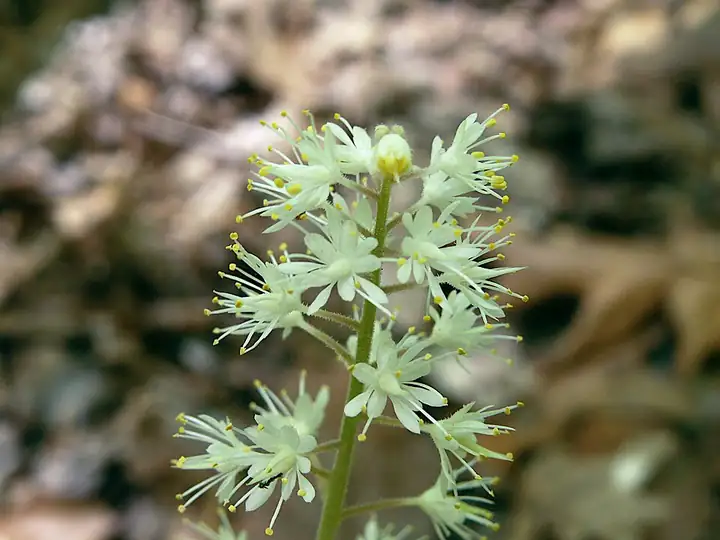
Foamflower
Tiarella cordifolia · Saxifrage family (Saxifragaceae)
| Hardiness zones | 3 to 8 |
|---|---|
| Sun | part shade |
| Water | moderate |
| Life cycle | perennial |
| Frost | Hardy: takes frost |
About Foamflower
Foamflower is a native woodland perennial with maple-shaped leaves, often marked with burgundy, and frothy spikes of white to pink flowers in spring. It spreads by runners into a soft groundcover in shade and draws bees and butterflies (NC State).
Hardy in zones 3-8 (NC State); native from Nova Scotia down the Appalachians to Alabama and west to Minnesota.
When to plant
Timing is counted from your average last spring frost (and first fall frost). Sow & Tell works out the actual dates for your ZIP code.
Plant in spring or fall in dappled to full shade. Separate the little plants at the ends of runners once they've rooted, usually after two seasons (NC State).
Soil
Moist, humus-rich, neutral to slightly acidic soil with good drainage (NC State).
Moist, humus-rich, well-drained soil (NC State).
Feeding
Keep the soil moist the first season; don't let it dry out (NC State).
Harvest
Blooms April to June (NC State). Cut off spent flower spikes to tidy the clumps.
Varieties (7)
NC State documents these 7 cultivars.
| Variety | Type | Days | Notes |
|---|---|---|---|
| Cutting Edge | Deeply cut leaves with burgundy centers. | ||
| Dunvegan | Deeply cut leaves; purple new growth; light pink flowers. | ||
| Eco Eyed Glossy | Glossy leaves. | ||
| George Shenk Pink | Light pink flowers. | ||
| Oconee Spreader | Vigorous spreader; silvery leaf highlights. | ||
| Running Tapestry | Leaves turn bronze-red and last through winter. | ||
| Slickrock | Very small leaves; vigorous spreader. |
In the kitchen
Pets: Not listed as toxic by the ASPCA.
Sources
Photo: Photo: Cbaile19 / Wikimedia Commons, CC0 (CC0). Photo resized for the web.

Planting dates and advice are general guidance; check with your local Cooperative Extension office for your area.