
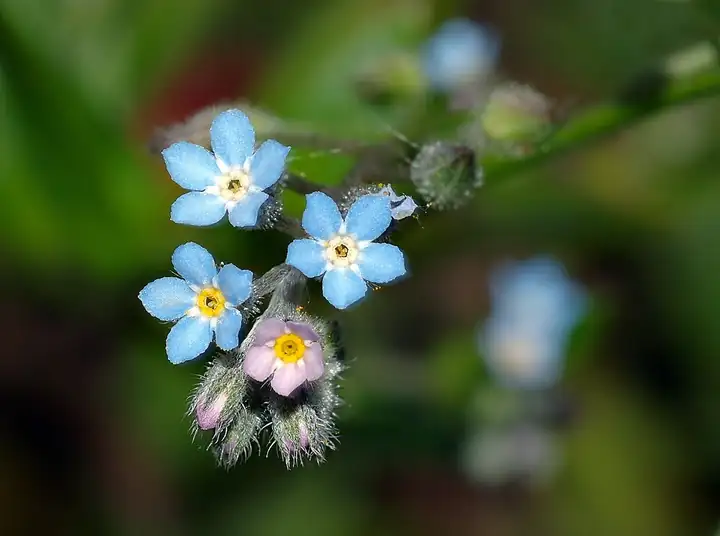
Forget-me-not
Myosotis sylvatica (woodland or garden forget-me-not); also M. scorpioides (water or true forget-me-not) · Borage family (Boraginaceae)
| Hardiness zones | 3 to 8 |
|---|---|
| Sun | full sun to part shade |
| Water | high |
| Life cycle | biennial |
| Frost | Hardy: takes frost |
About Forget-me-not
Forget-me-nots carpet spring beds with tiny sky-blue flowers with yellow or white eyes, and also come in pink and white (NC State). Garden forget-me-not is a short-lived plant grown as an annual or biennial that reseeds so freely a patch can last for years; water forget-me-not creeps along wet ground and pond edges. Both have escaped into the wild: Wisconsin regulates both as restricted invasive plants, and Connecticut bans water forget-me-not.
Garden forget-me-not is hardy in zones 3-8 and water forget-me-not in 5-9 (NC State). Invasive: Wisconsin's NR 40 rule lists both species as restricted (no moving, giving away or planting them without a permit), and Connecticut prohibits selling or planting M. scorpioides; check your state's rules, and keep it away from woods and streams.
When to plant
Timing is counted from your average last spring frost (and first fall frost). Sow & Tell works out the actual dates for your ZIP code.
- Start seeds indoors: 8 to 10 weeks before the last frost
For flowers the same year, start seed indoors 8-10 weeks before the last spring frost. To grow it as a biennial, sow outdoors in midsummer for flowers the next spring (NC State). After that, dropped seed usually keeps a patch going. We found no sourced day count to first bloom.
Soil
Rich, consistently moist, well-drained soil; it handles clay loam and even shallow standing water, and water forget-me-not grows in up to 3 inches of water (NC State). Give it afternoon shade where summers are hot.
Plant in organically rich soil that stays moist (NC State).
Feeding
Don't let the soil dry out, and give afternoon shade where summers are hot (NC State). We found no extension feeding schedule for forget-me-nots.
Harvest
Blooms in spring (April-May), with a few flowers into summer (NC State). Deadhead promptly to stretch the bloom and limit seeding. Cut stems for little bouquets when about half the flowers are open (Oklahoma State).
Varieties (10)
NC State documents these 10 cultivars. Water forget-me-not (M. scorpioides) types are regulated in some states; see the invasive file.
| Variety | Type | Days | Notes |
|---|---|---|---|
| Blue Basket | Garden forget-me-not (M. sylvatica) | Taller plants with deep blue flowers. | |
| Music | Garden forget-me-not (M. sylvatica) | Upright, with larger flowers. | |
| Pompadour | Garden forget-me-not (M. sylvatica) | Compact, ball-shaped plants with large pink flowers. | |
| Snowball | Garden forget-me-not (M. sylvatica) | White flowers. | |
| Ultramarine | Garden forget-me-not (M. sylvatica) | Dwarf, with blue flowers. | |
| Victoria Blue | Garden forget-me-not (M. sylvatica) | Bushy, compact mound 6-8 in tall with deep blue flowers. | |
| Victoria Rose | Garden forget-me-not (M. sylvatica) | Bushy and compact with pink flowers. | |
| Alba | Water forget-me-not (M. scorpioides) | Dainty white flowers in summer. | |
| Mermaid | Water forget-me-not (M. scorpioides) | Lots of blue flowers on branching stems. | |
| Semperflorens | Water forget-me-not (M. scorpioides) | Dwarf, 6-8 in, with more flowers over a longer season. |
Diseases and problems
Powdery mildew, Rust
In the kitchen
Safety: We found no extension source listing forget-me-not as poisonous or as an edible flower, so treat it as an ornamental only.
Pets: Not listed by the ASPCA (we found no forget-me-not entry). The ASPCA does list hound's tongue (Cynoglossum amabile), a forget-me-not look-alike in the same family, as toxic to horses.
Sources
- plants.ces.ncsu.edu
- plants.ces.ncsu.edu
- forestrynews.blogs.govdelivery.com
- dnr.wisconsin.gov
- dnr.wisconsin.gov
- cipwg.media.uconn.edu
- hgic.clemson.edu
- extension.okstate.edu
- aspca.org
- aspca.org
- aspca.org
- extension.rutgers.edu
Photo: Photo: André Karwath / Wikimedia Commons, CC BY-SA 2.5 (CC BY-SA 2.5). Photo resized for the web.

Planting dates and advice are general guidance; check with your local Cooperative Extension office for your area.