
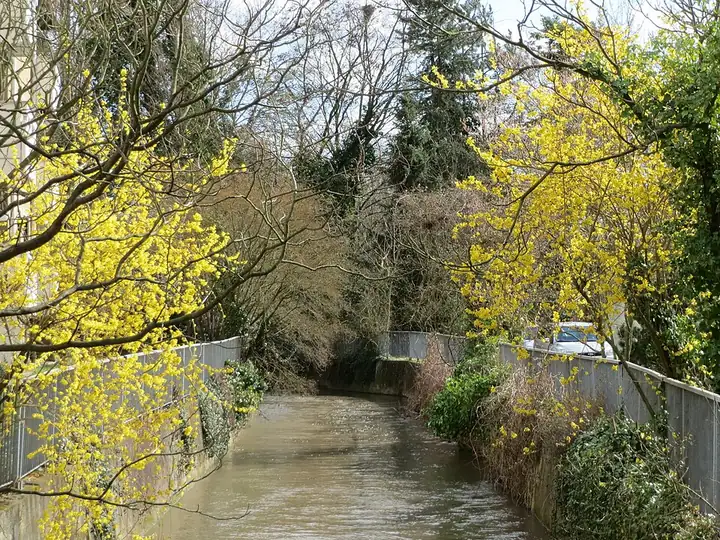
Forsythia
Forsythia x intermedia (border forsythia) · Olive family (Oleaceae)
| Hardiness zones | 5 to 8 |
|---|---|
| Sun | full sun to part shade |
| Water | moderate |
| Life cycle | perennial |
| Frost | Hardy: takes frost |
| Spacing | 36 to 48 inches |
About Forsythia
Forsythia is a fast-growing, fountain-shaped shrub that lights up early spring with yellow bells before its leaves come out. It is a hybrid of two Chinese species; it tolerates poor soil, drought and city conditions and is easy to transplant (NC State, Clemson). Give it room: full-size plants reach 8-10 ft tall and 10-12 ft wide.
Hardy in zones 5-8; temperatures below about -5 F or a late freeze can kill the flower buds (NC State). 'Northern Sun' is hardy to zone 4 (Clemson).
When to plant
Timing is counted from your average last spring frost (and first fall frost). Sow & Tell works out the actual dates for your ZIP code.
For a hedge, space plants 3-4 ft apart (Clemson). Skip foundation beds unless you pick a compact cultivar.
Soil
Loose, well-drained soil is best, but it grows in almost any soil; wet soil invites Phytophthora root rot (Clemson, NC State).
Test the soil before planting; mature shrubs in decent soil need little or no fertilizer (Clemson).
Feeding
- Spring to early summer after new growth starts, only if a soil test shows a need: slow-release complete fertilizer in a 3:1:2 ratio, or what the soil test calls for. Spread evenly from the trunk out to the drip line and water it in; a typical soil-test rate for shrubs is about 2 lb of 12-6-6 per 100 sq ft (Clemson). Follow a soil test.
Water is what new shrubs need most: daily for the first 2 weeks, every 2-3 days through week 12, then weekly until the roots spread (at least two growing seasons), using about a quarter to a third of the nursery pot's volume each time (UMN). Water weekly in long droughts to lower the risk of Botryosphaeria canker (Clemson).
Harvest
Blooms late February to March for 2-3 weeks, before the leaves. Prune right after flowering by cutting the oldest stems to the ground; pruning after mid-July removes next spring's buds. Cut branches in January-February and bring them indoors to bloom in about 10 days (Clemson, NC State).
Varieties (15)
| Variety | Type | Days | Notes |
|---|---|---|---|
| Beatrix Farrand | Border forsythia | 8-10 ft; vivid golden flowers; strong flower size, vigor and habit. | |
| Karl Sax | Border forsythia | Up to 6 ft, bushy; blooms about 2 weeks later than others. | |
| Show Off ('Mindor') | Border forsythia | 5-6 ft; heavy bloom on stems good for cutting. | |
| Spectabilis | Border forsythia | About 10 ft tall and wide; bright yellow; the standard new cultivars are compared to. | |
| Spring Glory | Border forsythia | Strong grower to 10 ft; deep yellow flowers. | |
| Lynwood (Lynwood Gold) | Border forsythia (F. x intermedia) | Upright, 8-10 ft tall and 6-8 ft wide; heavy bloom. | |
| Gold Tide | Dwarf | 24-30 in tall, 4 ft wide; lemon-yellow flowers. | |
| Golden Peep | Dwarf | 18-30 in tall, 36 in wide. | |
| Goldilocks | Dwarf | 24-36 in tall and wide. | |
| Happy Centennial | Dwarf | 24-30 in tall, 3-5 ft wide; can serve as a groundcover. | |
| Show Off Starlet | Dwarf | 2-3 ft tall, 3-4 ft wide; deep yellow; maroon fall color. | |
| Arnold Giant | Hybrid | About 5 ft, upright, with larger, darker leaves. | |
| Northern Gold | Hybrid | 6-8 ft tall, 5-7 ft wide; golden flowers. | |
| Sunrise | Hybrid | Mounding, about 5 ft; maroon fall color. | |
| Northern Sun | Hybrid (F. ovata x F. europaea) | About 10 ft tall and 9 ft wide; very cold hardy. |
Pests to watch for
Twospotted spider mite, Aphids, Four-lined plant bug, Root-knot nematodes
Diseases and problems
Phytophthora root rot, Botryosphaeria canker, Phomopsis gall, Leaf spot, Crown gall, Winter injury
In the kitchen
Safety: No toxicity is listed in the extension sources we used; NC State tags forsythia as non-toxic to cats, dogs and horses.
Pets: Not on the ASPCA toxic plant lists; NC State tags it non-toxic to cats, dogs and horses.
Sources
- hgic.clemson.edu
- plants.ces.ncsu.edu
- aspca.org
- aspca.org
- extension.rutgers.edu
- hgic.clemson.edu
- extension.umn.edu
Photo: Photo: AnRo0002 / Wikimedia Commons, CC0 (CC0). Photo resized for the web.

Planting dates and advice are general guidance; check with your local Cooperative Extension office for your area.