
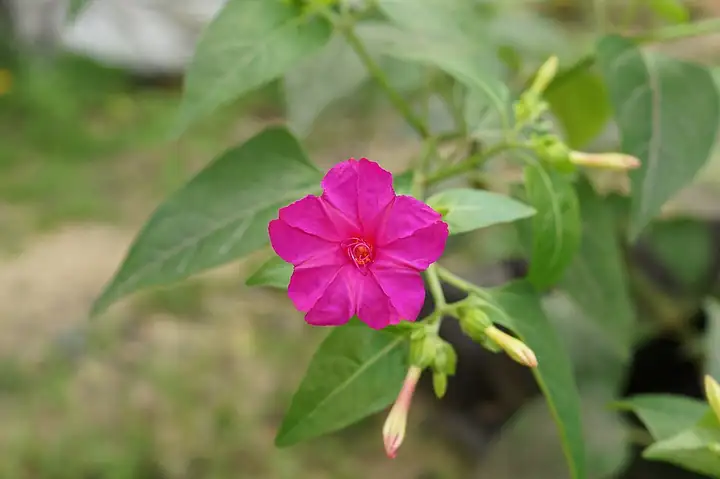
Four o'clock
Mirabilis jalapa · Four o'clock family (Nyctaginaceae)
| Hardiness zones | 9 to 10 |
|---|---|
| Sun | full sun to part shade |
| Water | moderate |
| Life cycle | tender perennial (grown as an annual) |
| Frost | Tender: killed by frost |
| Spacing | 12 to 24 inches |
About Four o'clock
Four o'clocks (marvel of Peru) are bushy, old-fashioned plants whose trumpet flowers open in late afternoon and evening, often sweetly scented, in white, yellow, pink, magenta and red, sometimes several colors on one plant. Sphinx moths and hummingbirds visit them. They grow from big tuberous roots, self-sow freely and can turn weedy, and the seeds and roots are poisonous.
Perennial in zones 9-10 (NC State); in zone 8 the tuberous roots often survive in the ground, and elsewhere it's a summer annual. It has naturalized in parts of the southern US (Wisconsin) but isn't on federal or state noxious weed lists (USDA PLANTS).
When to plant
Timing is counted from your average last spring frost (and first fall frost). Sow & Tell works out the actual dates for your ZIP code.
- Set out plants: up to 2 weeks after the last frost
- Sow seeds outdoors: up to 2 weeks after the last frost
No sourced days-to-bloom. Soak seed overnight (or nick it) and sow about 1/4 inch deep outdoors after frost danger has passed, or indoors up to 8 weeks earlier; seed sprouts in 5-7 days at 68-70 F (Wisconsin, NC State). Set plants out about when tomatoes go in and thin to 12-24 inches. North of zone 8, dig the tuberous roots before the first fall freeze, shake off the soil, store them cool, dry and frost-free like dahlias, and replant after the last spring frost (NC State, Wisconsin).
Soil
Grows in most soils; best in humus-rich, moist but well-drained soil (NC State, Wisconsin).
Any soil works; humus-rich, well-drained soil in full sun is best (Wisconsin, NC State).
Feeding
- Now and then during the growing season: general garden fertilizer. Wisconsin suggests periodic feeding with moderate moisture; no set rate is given, so go light and follow the label.
Letting seeds drop leads to lots of volunteers; the seeds and roots are poisonous, so keep them away from kids and pets (NC State).
Harvest
Blooms from summer to frost; each flower opens in late afternoon or evening (earlier on cloudy days) and wilts by the next morning, staying on the plant (Wisconsin). Pick off the black seeds before they drop if you don't want volunteers.
Varieties (5)
Extension sources document 5 named cultivars; many plants are sold simply as 'Four O'Clocks'.
| Variety | Type | Days | Notes |
|---|---|---|---|
| Broken Colors | Bicolor flowers striped, splashed or marbled in pink, red, white and yellow. | ||
| Jingles | Series with small, multicolored flowers. | ||
| Limelight | Chartreuse leaves with vivid neon-pink flowers. | ||
| Marbles | Series of streaked bicolors: white-red, white-yellow, yellow-red and tricolor. | ||
| Salmon Sunset | Unusual pinkish-orange flowers. |
In the kitchen
Safety: The seeds and roots are poisonous: eating them can cause stomach pain, nausea, vomiting and diarrhea (NC State, UC). Handling the roots can irritate the skin of sensitive people, so wear gloves (NC State, Wisconsin).
Pets: Not listed by the ASPCA. NC State and UC list the seeds and roots as poisonous, so keep pets from chewing them.
Sources
- plants.ces.ncsu.edu
- hort.extension.wisc.edu
- ucanr.edu
- plantsservices.sc.egov.usda.gov
- warcapps.usgs.gov
- aspca.org
- aspca.org
Photo: Photo: Prenn / Wikimedia Commons, CC BY-SA 3.0 (CC BY-SA 3.0). Photo resized for the web.

Planting dates and advice are general guidance; check with your local Cooperative Extension office for your area.