
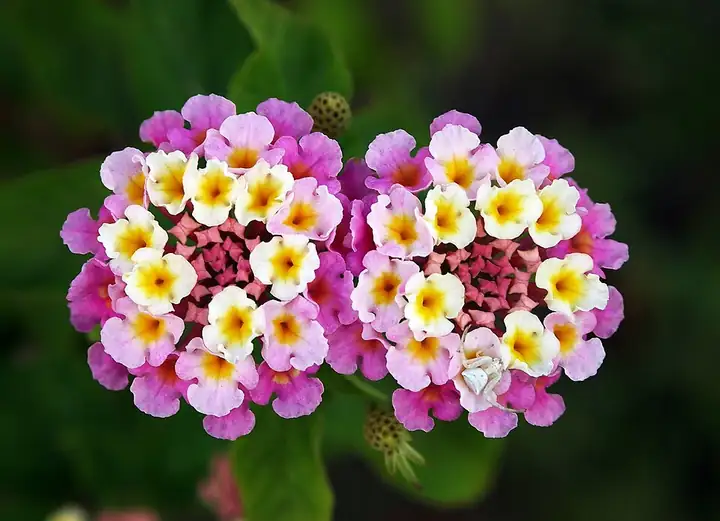
Lantana (garden)
Lantana camara and hybrids · Verbena family (Verbenaceae)
| Hardiness zones | 7 to 11 |
|---|---|
| Sun | full sun |
| Water | low |
| Life cycle | perennial |
| Frost | Tender: killed by frost |
About Lantana (garden)
Lantana is a woody, heat-loving shrub with round clusters of small flowers that often change color as they age, in yellow, orange, red, pink, purple and white. Butterflies, hummingbirds and bees visit it from midsummer to frost, and in cold areas it's grown as an annual. Be careful: the leaves and green berries are poisonous to people, pets and livestock, and common lantana is invasive in Florida (UF/IFAS Category I) and Hawaii, so choose sterile cultivars where it can spread.
Hardy in zones 7-11 (NC State) and an annual elsewhere. Invasive: UF/IFAS lists Lantana camara as a Category I invasive in Florida because it spreads and crosses with the rare native L. depressa; in Hawaii it covers over 400,000 acres of pasture and forest (UH CTAHR), and it's a weedy pest in many tropical regions (NC State).
When to plant
Timing is counted from your average last spring frost (and first fall frost). Sow & Tell works out the actual dates for your ZIP code.
- Set out plants: 2 weeks after the last frost
Plant in spring at least 2 weeks after the last frost (Clemson), and keep new plants moist for several weeks. In South Carolina, 'Miss Huff' and 'Athens Rose' come back reliably, and 'Chapel Hill Yellow' and 'Chapel Hill Gold' are hardy to zone 7b; most others are grown as annuals.
Soil
Well-drained, slightly acid soil (Clemson); tolerates sandy, rocky, clay and salty soils.
Plant in well-drained, slightly acid soil; lantana needs little feeding, so follow a soil test before adding fertilizer.
Feeding
- Spring, as new growth starts: slow-release fertilizer. Clemson suggests a light feeding in spring; UF/IFAS recommends slow- or controlled-release fertilizer to limit runoff.
- Midsummer, only for vigorous plants in heavy bloom: slow-release fertilizer. A second light feeding is optional (Clemson).
Too much water or fertilizer leads to root rot and fewer flowers; avoid overhead watering.
Harvest
Blooms from midsummer until frost (spring to frost in warm areas). Lightly shear plants in summer to spur a new round of blooms; cut perennial plants back to 6-12 inches in early spring, not in fall (Clemson).
Varieties (20)
| Variety | Type | Days | Notes |
|---|---|---|---|
| Bandana series | Compact L. camara | ||
| Bandito series | Compact L. camara | ||
| Lucky series | Compact L. camara | ||
| Patriot Cowboy | Dwarf (Patriot series) | About 12 in tall and 12-15 in wide. | |
| Patriot Rainbow | Dwarf (Patriot series) | About 12 in tall and 12-15 in wide. | |
| New Gold | Hybrid (L. x hybrida) | Golden yellow; about 2 ft tall and 4 ft wide; blooms spring to frost. | |
| Bloomify Red | Infertile L. camara (UF/IFAS) | Mounding, about 10 in tall and 11 in wide; bright yellow flowers turn red. | |
| Bloomify Rose | Infertile L. camara (UF/IFAS) | Mounding, about 9 in tall and 11 in wide; yellow-orange flowers turn magenta. | |
| Luscious Royale Red Zone | Infertile L. camara (UF/IFAS) | Large flower clusters of up to 30 flowers each. | |
| UF-T3 and UF-T4 | Infertile L. camara (UF/IFAS) | ||
| Athens Rose | L. camara | ||
| Chapel Hill Gold | L. camara | ||
| Chapel Hill Yellow | L. camara | ||
| Dallas Red | L. camara | ||
| Ham and Eggs | L. camara | ||
| Landmark series | L. camara | ||
| Miss Huff | L. camara | ||
| Mozelle | L. camara | ||
| Radiation | L. camara | ||
| Trailing (weeping) lantana | Lantana montevidensis | Low, spreading plant 8-12 in tall and 4 ft or more wide; purple or white flowers. |
Pests to watch for
Whiteflies, Twospotted spider mite
Diseases and problems
Powdery mildew, Root rot, Sooty mold
In the kitchen
Safety: Poisonous: the leaves and unripe green berries (and other parts) contain lantadenes that can cause vomiting, diarrhea, weakness, breathing trouble and liver damage in children, adults and livestock, and the sap can irritate skin (NC State). Keep children away from the berries; Clemson notes sterile cultivars set little or no fruit.
Pets: Toxic to dogs, cats and horses (ASPCA): its triterpenoids can cause vomiting, diarrhea, labored breathing and weakness, and liver failure (more common in livestock)
Sources
- plants.ces.ncsu.edu
- hgic.clemson.edu
- gardeningsolutions.ifas.ufl.edu
- ask.ifas.ufl.edu
- www3.ctahr.hawaii.edu
- agrilifetoday.tamu.edu
- aspca.org
Photo: Photo: Joaquim Alves Gaspar, CC BY 2.5, via Wikimedia Commons (CC BY 2.5). Photo resized for the web.

Planting dates and advice are general guidance; check with your local Cooperative Extension office for your area.