
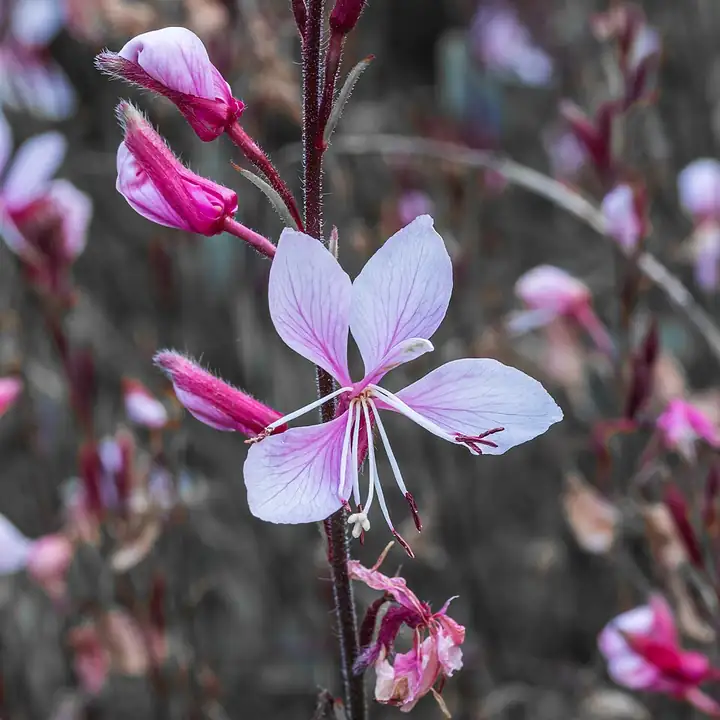
Gaura (whirling butterflies)
Oenothera lindheimeri (formerly Gaura lindheimeri) · Evening primrose family (Onagraceae)
| Hardiness zones | 5 to 9 |
|---|---|
| Sun | full sun |
| Water | low |
| Life cycle | perennial |
| Frost | Hardy: takes frost |
About Gaura (whirling butterflies)
Gaura is a wildflower native to Louisiana, Texas and Mexico that sends up long, wiry wands of small four-petaled flowers that seem to flutter like butterflies above the plant (NC State, Wildflower Center). Pink buds open white and fade to pink from early summer until hard frost, and bees, butterflies and hummingbirds visit. A deep taproot makes it tough in heat and drought, but plants can be short-lived and often don't survive cold, wet winters, so northern gardeners frequently grow it as an annual (Wisconsin Extension).
Hardy in about zones 5-9 (NC State: 5a-9b; Wisconsin Extension: 5b-9a), but it overwinters unreliably in cold, wet soil. Hawaii's seed law lists Gaura species as prohibited noxious weed seeds.
When to plant
Timing is counted from your average last spring frost (and first fall frost). Sow & Tell works out the actual dates for your ZIP code.
Grow the species and some cultivars from seed sown in spring or fall; plants started from seed in early spring can bloom the first year (Wisconsin Extension, Wildflower Center). Many named cultivars are grown only from cuttings, and the big taproot makes division hard. No sourced count from sowing to first bloom.
Soil
Light, well-drained sandy or loamy soil; it tolerates clay if drainage is good, but rich soil makes floppy stems and wet soil brings root rot (Wisconsin Extension, NC State).
Loosen the soil well so it drains; skip rich amendments, since rich soil makes tall, floppy stems (Wisconsin Extension, NC State).
Feeding
Too much water, fertilizer or shade gives leggy, floppy plants, and heavy, wet soil causes root rot (Wisconsin Extension).
Harvest
Blooms from early summer until hard frost. Deadheading isn't needed, but cutting some spent spikes keeps it tidy, brings more flowers and means fewer seedlings; if you cut every spike at once, new flowers follow in about 2-3 weeks (Wisconsin Extension). The Wildflower Center adds that cutting it back in midsummer brings a fresh flush in fall.
Varieties (15)
| Variety | Type | Days | Notes |
|---|---|---|---|
| Belleza series | Compact | Upright plants spreading to about 2 ft; Compact Light Pink is 10-16 in; also dark pink and white. | |
| Karalee Petite Pink ('Star Pink') | Compact | About 2 ft tall with deep pink flowers. | |
| Passionate Blush | Compact | Heavy-blooming compact plant with pink flowers. | |
| Passionate Pink | Compact | About 30 in tall and 18 in wide with hot pink flowers. | |
| Ballerina series | Compact hybrid | 12-18 in tall, spreading to 3 ft; White, Blush and Rose. Sterile, so no seedlings. | |
| Butterflies series | Compact, Australian-bred | Bred from 'Siskiyou Pink'; Crimson, Blushing and Sunny Butterflies. | |
| Pretty in Pink | Species selection | Dark pink flowers. | |
| Siskiyou Pink | Species selection | 2.5-3 ft with bright pink flowers; introduced in 1994 and reported not to self-seed. | |
| Snowstorm | Species selection | Released by the University of Minnesota in 2007. | |
| Sparkle White | Species selection | White flowers. | |
| Summer Breeze | Species selection | White flowers on a more cold-hardy plant. | |
| Whirling Butterflies | Species selection | Heavy bloomer with large white flowers on 2-ft plants; NC State says the flowers are sterile. | |
| Dauphine | Tall | Extra large, 5-7 ft, with green leaves and white to pink flowers. | |
| Corrie's Gold | Variegated | Leaves edged creamy yellow; less vigorous, about 18 in, with pink-tinged white flowers. | |
| Passionate Rainbow | Variegated, compact | Pink flowers over dark leaves edged pink, cream and gold. |
Pests to watch for
Aphids, Whiteflies, Flea beetles
Diseases and problems
Root rot, Rust, Powdery mildew, Leaf spots
In the kitchen
Safety: We found no reports of gaura being poisonous, and NC State doesn't list it as toxic. It isn't a food plant, so don't eat it.
Pets: Not listed by the ASPCA.
Sources
Photo: Photo: Agnes Monkelbaan, CC BY-SA 4.0, via Wikimedia Commons (CC BY-SA 4.0). Photo resized for the web.

Planting dates and advice are general guidance; check with your local Cooperative Extension office for your area.