
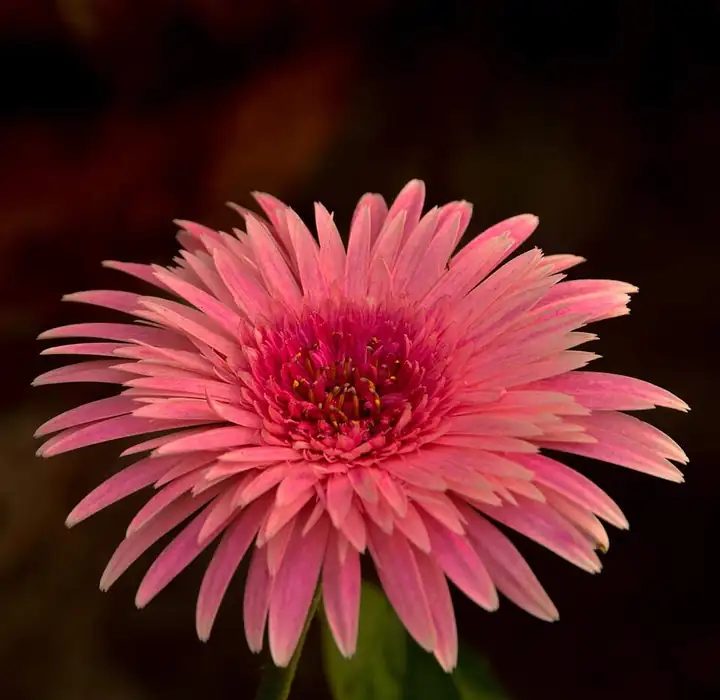
Gerbera daisy
Gerbera jamesonii and hybrids · Daisy family (Asteraceae)
| Hardiness zones | 8 to 10 |
|---|---|
| Sun | full sun to part shade |
| Water | moderate |
| Life cycle | tender perennial (grown as an annual) |
| Frost | Tender: killed by frost |
| Spacing | 12 to 18 inches |
About Gerbera daisy
Gerbera daisies are South African perennials with big, bright daisies, 3-5 inches across, held on bare stems above a clump of long leaves. They are a favorite for pots, borders and the vase. Grow them as annuals in cold areas, as perennials in mild-winter areas like Florida, and keep the crown high and dry to avoid rot.
NC State lists zones 8-10 (perennial to zone 11); where winters freeze hard, grow it as a summer annual or overwinter it indoors (UF).
When to plant
Timing is counted from your average last spring frost (and first fall frost). Sow & Tell works out the actual dates for your ZIP code.
Most gardeners buy plants; they also grow from seed or divisions (UF, NC State). Set the crown (where leaves meet roots) level with or a little above the soil, never buried, and space plants 12-18 inches apart (UF, NC State). To overwinter in cold areas, grow it in a pot sunk to the rim in the garden, then lift the pot in fall and keep it in a cool, bright, frost-free room until spring; the deep roots make digging up in-ground plants hard (NC State). In Florida, divide in spring or summer (central and north) or any time (south) (UF).
Soil
Rich, well-drained soil with organic matter mixed in (UF suggests an inch or two of compost or peat in sandy soil); use raised beds, mounds or pots where drainage is poor, since wet soil rots the crown (UF, NC State).
Mix an inch or two of compost, peat or similar organic matter into sandy soil; make sure the spot drains well or use a raised bed or pot (UF).
Feeding
- Monthly through the growing season: complete (balanced) fertilizer, or a controlled-release fertilizer 2-3 times a season. Feed lightly (NC State), following the label; choose a product with iron and manganese, since gerberas often run short of them (UF).
Don't bury the crown or keep it wet: let it dry between waterings and keep mulch off it to prevent crown rot (UF).
Harvest
Blooms from spring into fall, heaviest in the milder weather of spring and fall, and nearly year-round in Florida (NC State, UF). Deadhead spent flowers to keep new ones coming (NC State); for bouquets cut whole stems of open flowers, which last well indoors (UF).
Varieties (19)
| Variety | Type | Days | Notes |
|---|---|---|---|
| Louisville | Multi-flora cut-flower type | Large plants; few flowers and heavy powdery mildew in UF bed trials. | |
| Revolution | Seed-grown pot type | Usually grown in 5-in pots; in UF beds it nearly stopped flowering by November and was heavily hit by powdery mildew. | |
| Funtastic Canary | UF Funtastic series | Earlier Funtastic release used as a check in UF trials; flowered more than Golden Eye in most tests. | |
| Funtastic Fire Orange | UF Funtastic series | Earlier Funtastic release used as a check in UF trials; flowered more than Golden Eye in most tests. | |
| Funtastic Golden Eye | UF Funtastic series | Single flowers, yellow at the base and orange at the tips; plants about 21 in tall; moderate powdery mildew resistance. | |
| Funtastic Tangerine Eye | UF Funtastic series | Single orange-red flowers 4-5 in across on plants about 20 in tall; high powdery mildew resistance. | |
| UF Multi-flora Peach | UF garden/landscape type | Semi-double, 3.5-in orange-red flowers fading to yellow; about 25 flowers per plant in beds; intermediate powdery mildew resistance. | |
| UF Multi-flora Pink Frost | UF garden/landscape type | Semi-double, 3.5-in flowers, red-purple with white tips; about 22 flowers per plant in beds. | |
| Deep Pink Cupid | Compact plant with pink daisies. | ||
| Green Kermit | Layered petals in shades of green; a good cut flower. | ||
| Mardi Gras | Clump-forming. | ||
| Orange Capraia | Single orange flowers with contrasting petal edges. | ||
| Orange Palmaria | Orange petals with black centers; long-lasting. | ||
| Pink and White Linosa | Large pink-and-white bicolor flowers on plants 12-18 in tall. | ||
| Pink Kimsey | Semi-double pink flowers with green centers. | ||
| Pink Whisper | Pink daisies on sturdy stems. | ||
| Rainbow | Mix of red, orange, yellow, pink and white flowers. | ||
| Red Rafinee | Large red flowers on sturdy stems. | ||
| Yellow Lampione | Intense yellow flowers. |
Pests to watch for
Thrips, Leafminers, Twospotted spider mite, Aphids, Whiteflies
Diseases and problems
Crown rot, Root rot, Powdery mildew, Gray mold, Anthracnose
In the kitchen
Safety: NC State lists gerbera as non-toxic.
Pets: Non-toxic to dogs, cats and horses (ASPCA, 'Gerber Daisy').
Sources
- plants.ces.ncsu.edu
- gardeningsolutions.ifas.ufl.edu
- ojs.test.flvc.org
- journals.flvc.org
- aspca.org
- aspca.org
- extension.rutgers.edu
Photo: Photo: Sohom Datta / Wikimedia Commons, CC BY 4.0 (CC BY 4.0). Photo resized for the web.

Planting dates and advice are general guidance; check with your local Cooperative Extension office for your area.