
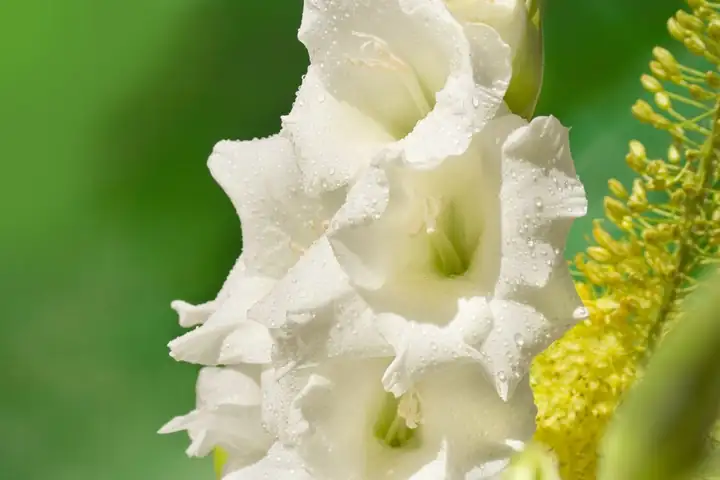
Gladiolus
Gladiolus x hortulanus (garden hybrids) and other Gladiolus species · Iris family (Iridaceae)
| Hardiness zones | 7 to 10 |
|---|---|
| Sun | full sun |
| Water | moderate |
| Life cycle | tender perennial (grown as an annual) |
| Frost | Tender: killed by frost |
| Spacing | 2 to 4 inches |
| Soil temperature to plant | at least 55°F |
About Gladiolus
Gladiolus (glads) grow from corms and send up tall spikes of funnel-shaped flowers that open from the bottom up in late summer. They are a classic cut flower, and planting a batch of corms every week or two gives a long run of blooms. Bees visit the flowers (NC State), and the hardier Byzantine gladiolus draws butterflies and hummingbirds.
NC State lists zones 7-10, and glads overwinter under mulch in most of South Carolina (Clemson); farther north, dig and store the corms each fall. Byzantine gladiolus is hardy to zone 6 and naturalizes in old home sites and ditch banks (NC State).
When to plant
Timing is counted from your average last spring frost (and first fall frost). Sow & Tell works out the actual dates for your ZIP code.
- Sow seeds outdoors: around the last frost
Plant corms after the last frost when the soil is at least 55 F, 3-6 inches deep (2-3 inches for small corms), pointed tip up, and plant again every 1-2 weeks for steady bloom (Clemson, Penn State). In cold areas, dig corms in fall after the leaves yellow and before a hard freeze, cure them about 3 weeks in an airy spot, then store in mesh bags at about 35-45 F (Clemson, NC State, UMN).
Soil
Rich, well-drained sandy or loamy soil with organic matter; they dislike heavy clay. Keep evenly moist (NC State, Penn State).
Rich, well-drained sandy or loamy soil with organic matter (NC State, Penn State).
Feeding
- When plants are 6-8 inches tall: low-nitrogen fertilizer such as 5-10-10. Clemson suggests 3-4 lb per 100 sq ft, spread beside the plants and watered in. Follow a soil test.
- When the flower spike appears: fertilizer such as 5-10-10. Repeat at the same rate (Clemson).
Soak the ground deeply instead of sprinkling lightly every day (Clemson), and leave at least four leaves when cutting spikes so the corm can recharge (Penn State).
Harvest
Glads bloom in late summer into fall. Cut spikes in early morning or evening when the first florets show color, and leave at least four leaves on the plant to feed the corm (Penn State). Stake or hill soil around tall stems (Clemson).
Varieties (7)
Extension sources we could open document 7 gladiolus cultivars and species.
| Variety | Type | Days | Notes |
|---|---|---|---|
| Carolina Primrose | Hybrid gladiolus | Cold-hardy glad about 3 feet tall. | |
| Sapporo | Hybrid gladiolus | Pink and yellow flowers with a red heart, 3-4 inches across; 3-3 1/2 feet tall. | |
| Flevo Jive | Hybrid gladiolus (compact) | White and yellow flowers on 12-24 inch stems that don't need staking. | |
| Zwanenburg | Peacock orchid (Gladiolus murielae) | Fragrant white star-shaped flowers with a deep maroon center on long stems. | |
| Caribbean | Small-flowered hybrid gladiolus | Lavender-edged flowers with light yellow centers; about 3 feet. | |
| Peacock orchid | Species (Gladiolus murielae, formerly Acidanthera) | Fragrant white flowers with maroon throats that open one after another on nodding 2-3 foot stems. | |
| Byzantine gladiolus | Species hybrid (Gladiolus x byzantinus) | Pink, purple or burgundy-red flowers on 1-3 foot stems; naturalizes readily in old gardens; butterflies and hummingbirds may visit. |
Pests to watch for
Thrips, Aphids, Twospotted spider mite, Mealybugs, Grasshoppers, Cucumber beetles, Iris borer
Diseases and problems
Gray mold (Botrytis), Rust, Mosaic viruses, Southern blight, Root and crown rot, Corm rot
In the kitchen
Safety: The corms hold the most toxin; eating plant parts can cause drooling, vomiting and diarrhea (NC State).
Pets: Toxic to dogs, cats and horses (ASPCA): can cause drooling, vomiting, diarrhea and lethargy, and the corms are the most toxic part.
Sources
- plants.ces.ncsu.edu
- plants.ces.ncsu.edu
- plants.ces.ncsu.edu
- hgic.clemson.edu
- extension.psu.edu
- extension.umn.edu
- aspca.org
Photo: Photo: Takkk, CC BY-SA 3.0, via Wikimedia Commons (CC BY-SA 3.0). Photo resized for the web.
Planting dates and advice are general guidance; check with your local Cooperative Extension office for your area.