
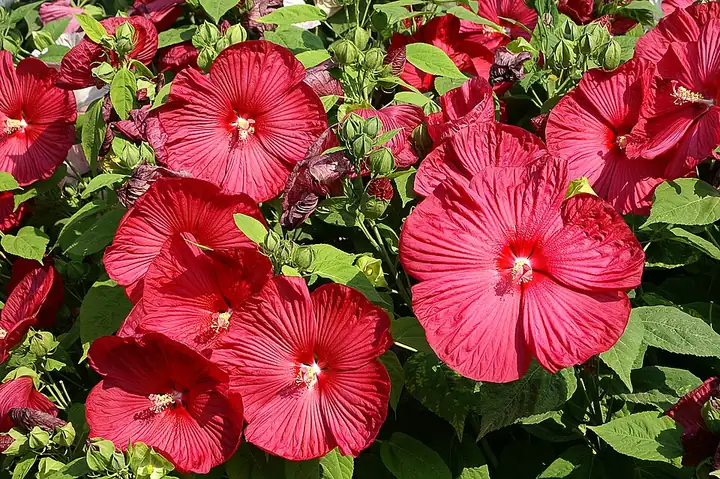
Hardy hibiscus (rose mallow)
Hibiscus moscheutos and hybrids · Mallow family (Malvaceae)
| Hardiness zones | 4 to 9 |
|---|---|
| Sun | full sun to part shade |
| Water | high |
| Life cycle | perennial |
| Frost | Hardy: takes frost |
About Hardy hibiscus (rose mallow)
Hardy hibiscus is a native perennial of southeastern wetlands with dinner-plate flowers up to 8-10 inches across in white, pink, red and burgundy. It dies to the ground each winter and comes back late the next spring. Bumble bees, a specialist rose-mallow bee, hummingbirds and butterflies use it, and its caterpillar-feeding leaves support many moths.
Hardy in zones 4-9; stems freeze to the ground each winter and new shoots may not appear until late May or June up north.
When to plant
Timing is counted from your average last spring frost (and first fall frost). Sow & Tell works out the actual dates for your ZIP code.
Plant in spring. Mark the spot, because shoots emerge very late (March to mid-May in south Alabama, late May to early June in Chicago). It grows easily from seed and roots from early-July tip cuttings (Wildflower Center).
Soil
Rich, moist to occasionally wet soil high in organic matter; it tolerates heavy clay and short spells of standing water but not drought.
Work compost or aged manure into the bed; keep the soil moist.
Feeding
- After shoots emerge in late spring: Water-soluble fertilizer. Feed per the label, following a soil test (Alabama Extension); Chicago Botanic Garden's trial plants grew well with no fertilizer, only a yearly leaf-compost mulch.
Don't give up on it in spring: shoots can appear as late as mid-May to early June.
Harvest
Blooms midsummer to early fall. Most modern types drop spent flowers on their own in dry weather, so deadheading isn't needed. Cut old stems to 2-6 inch stubs in late fall or late winter.
Varieties (23)
| Variety | Type | Days | Notes |
|---|---|---|---|
| Anne Arundel | Pink 9-inch flowers; about 5 ft. | ||
| Berry Awesome | Magenta 8-inch flowers that drop cleanly; silvery leaves and purple-red stems; about 52 in tall. Top-rated in Chicago Botanic Garden's trial. | ||
| Berrylicious | Light pink-purple 8-inch ruffled flowers; about 50 in tall with a tidy habit. | ||
| Cherry Cheesecake | White-and-pink 7-inch flowers; green cut leaves; about 63 in tall. | ||
| Cranberry Crush | Deep scarlet-red 8-inch flowers over bronze-green leaves; about 50 in tall. | ||
| Dark Mystery | White flowers blushed pink with a starburst eye; burgundy-chocolate leaves; about 52 in tall. | ||
| Disco Belle series | Semi-dwarf, 3-4 ft, with large pink, rose, red or white flowers with a red eye. | ||
| Evening Rose | Hot magenta-pink ruffled flowers; burgundy cut leaves; about 53 in tall. | ||
| Head Over Heels Adore | Pink 8-inch flowers; velvety silvery leaves resisted flea beetles in trials; about 60 in tall. | ||
| Heartthrob | Deep blood-red 9-inch flowers with a black-red eye; about 60 in tall. | ||
| Holy Grail | Deep red 9-inch flowers over deep burgundy cut leaves; about 48 in tall. | ||
| Lady Baltimore | Pink flowers with red centers; about 5 ft. | ||
| Lord Baltimore | Crimson-red flowers and deeply cut leaves. | ||
| Luna series | Dwarf, good in containers; white, blush, pink, rose, red or pink-swirl flowers. | ||
| Mars Madness | Deep red 9-inch flowers; burgundy spring leaves; big plant about 57 in tall and 80 in wide. | ||
| Midnight Marvel | Deep scarlet-red flowers over dark burgundy cut leaves; about 56 in tall. | ||
| Mocha Moon | White 8-9 inch flowers with a red eye; bronze-green leaves; about 60 in tall. | ||
| Perfect Storm (Summerific) | Pink-blushed white flowers with a big red eye; dark purple leaves; compact, about 48 in tall. | ||
| Robert Fleming | Compact plant with 10-inch velvety red flowers. | ||
| Starry Starry Night | Pink 8-inch flowers over near-black cut leaves; about 48 in tall. | ||
| Sultry Kiss | Magenta-red 10-inch flowers, the largest in Chicago's trial; about 60 in tall. | ||
| Summer Spice Bleu Brulee | The first lilac-blue flowered hardy hibiscus. | ||
| Vintage Wine | Scarlet-red 8-inch flowers; purple-tipped leaves; about 55 in tall. |
Pests to watch for
Japanese beetle, Flea beetles, Aphids, Whiteflies, Scale insects, Sawflies (garden sawflies)
Diseases and problems
Leaf spot, Rust
In the kitchen
Pets: Not listed separately by the ASPCA; its hibiscus entry (rose of sharon, H. syriacus) is non-toxic to dogs, cats and horses
Sources
- plants.ces.ncsu.edu
- hgic.clemson.edu
- aces.edu
- wildflower.org
- chicagobotanic.org
- chicagobotanic.org
- mgnv.org
- aspca.org
Photo: Photo: André Alliot, CC0, via Wikimedia Commons (CC0). Photo resized for the web.

Planting dates and advice are general guidance; check with your local Cooperative Extension office for your area.