
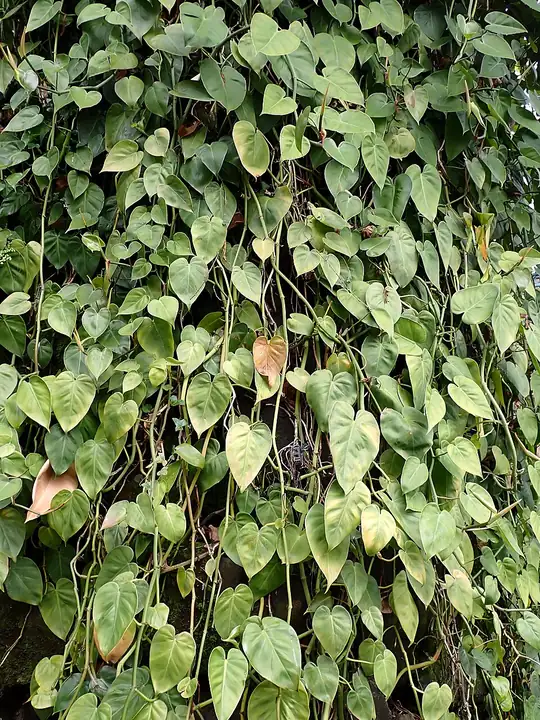
Heartleaf philodendron
Philodendron hederaceum (syn. P. scandens, P. oxycardium, P. micans) · Arum family (Araceae)
| Hardiness zones | 11 to 12 |
|---|---|
| Sun | shade |
| Water | moderate |
| Life cycle | perennial |
| Frost | Tender: killed by frost |
About Heartleaf philodendron
The heartleaf philodendron is a fast, slender vine from Mexico, the Caribbean and tropical South America with glossy heart-shaped leaves that open bronze and turn deep green (NC State). It trails from a basket or climbs a moss pole, puts up with very low light and dry rooms, and roots from a cutting in any season, which is why it has been a parlor plant for a century. It looks a lot like pothos; the giveaway is the papery sheath (stipule) on each new leaf and smooth, ungrooved leaf stalks.
Hardy outdoors only in zones 11-12 (NC State); it is grown indoors everywhere and can summer outdoors in shade once nights stay above about 65 F.
When to plant
Timing is counted from your average last spring frost (and first fall frost). Sow & Tell works out the actual dates for your ZIP code.
Usually bought as a nursery plant or started from a stem cutting, which roots at any season (Clemson).
Growing it indoors
- Light: Tolerates very low light, even ordinary room light, but grows best near a north, east or west window with indirect or curtain-filtered sun (Clemson, NC State).
- Water: Water often enough to keep the mix evenly moist but never soggy, and never let the pot stand in water (Clemson). Cut back in winter when growth slows (NC State), and let the surface dry a little between waterings in a dim room.
- Humidity: Tolerates the dry air of most homes but prefers medium to high humidity; misting or a pebble tray is appreciated (NC State, Clemson).
- Temperature: Clemson gives 70-85 F days and 65-75 F nights; keep it away from cold drafts and cold window glass.
- Feeding: Feed regularly with a dilute water-soluble houseplant fertilizer, or use a time-release fertilizer (Clemson); MU Extension's general rule is about once a month while new leaves are coming and none in winter. Too much fertilizer curls and browns the leaf tips (Clemson).
- Repotting: Repot overcrowded plants in any season into general-purpose potting soil, one pot size up (Clemson).
Soil
General-purpose potting soil with good drainage, kept slightly moist (Clemson, NC State).
Pot in general-purpose potting soil with good drainage (Clemson).
Feeding
- Spring through early fall, while vines are growing: dilute water-soluble houseplant fertilizer, or a time-release fertilizer. Clemson says feed regularly with a dilute solution or apply a time-release product per its label; MU Extension's general rule is about once a month at label strength (or 20-20-20 at 1.5 teaspoons per gallon).
- Winter: none. Skip fertilizer while no new growth appears (MU Extension); too much fertilizer curls and browns the leaf tips (Clemson).
Over-feeding browns and curls the leaf tips (Clemson); flush the pot with plain water now and then to wash out salts.
Varieties (8)
NC State and Clemson Extension name 8 forms and cultivars.
| Variety | Type | Days | Notes |
|---|---|---|---|
| Aureum | Chartreuse | An older chartreuse-leaved selection of the common heartleaf (Clemson). | |
| Lemon Lime | Chartreuse | Bright yellow to chartreuse leaves. | |
| Brasil | Variegated | Dark green leaves with a yellow to light green stripe down the center. | |
| Cream Splash | Variegated | Light green and cream centers with dark green borders. | |
| Gabby | Variegated | Light green and cream leaves that may turn almost entirely cream. | |
| Rio | Variegated | Silver and cream center with dark green edges. | |
| Silver Stripe | Variegated | Cream to light green leaves with a dark green border and a silver stripe. | |
| Micans (velvet-leaf philodendron) | Velvet | Velvety leaves with a red-purple underside; Clemson lists the selections 'Miduhoi' (Jumbo Velvet Hearts) and 'Silver Sheen'. |
Pests to watch for
Aphids, Twospotted spider mite, Mealybugs, Scale insects, Thrips
Diseases and problems
Root and crown rot, Leaf spots
In the kitchen
Safety: All parts contain calcium oxalate crystals: eating it burns the mouth, lips and tongue and causes drooling, vomiting and trouble swallowing, and the sap can irritate skin (NC State rates it low severity; Clemson). Keep it away from young children.
Pets: Toxic to dogs, cats and horses (ASPCA): insoluble calcium oxalates cause mouth irritation and pain, swelling of the mouth, tongue and lips, heavy drooling, vomiting (not in horses) and trouble swallowing.
Sources
Photo: Photo: Krzysztof Ziarnek, Kenraiz, CC BY-SA 4.0, via Wikimedia Commons (CC BY-SA 4.0). Photo resized for the web.

Planting dates and advice are general guidance; check with your local Cooperative Extension office for your area.