
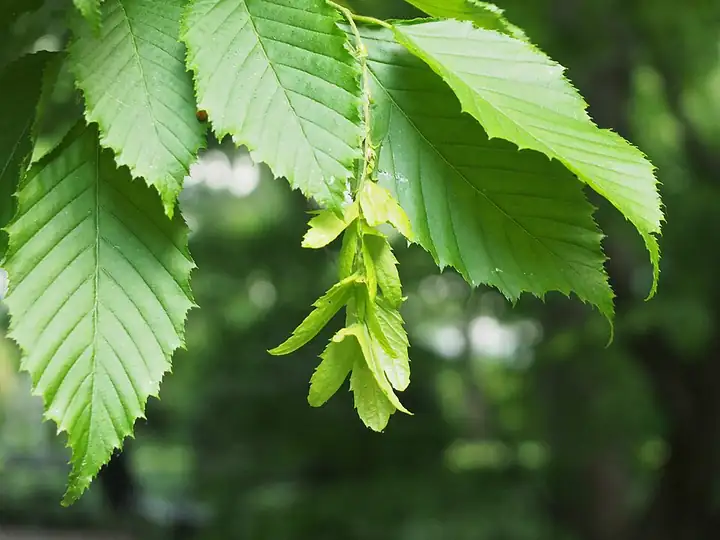
Hornbeam
Carpinus caroliniana (American hornbeam, musclewood, ironwood, blue beech) and C. betulus (European hornbeam) · Birch family (Betulaceae)
| Hardiness zones | 3 to 9 |
|---|---|
| Sun | full sun to part shade |
| Water | moderate |
| Life cycle | perennial |
| Frost | Hardy: takes frost |
About Hornbeam
American hornbeam is a small, slow-growing native understory tree whose smooth blue-gray bark ripples like flexed muscle, which is why it's called musclewood. It is native across the eastern U.S. from Maine and Minnesota to Florida and Texas, in moist woods and along streams, and its leaves turn orange to red in fall (NC State, wildflower.org). European hornbeam, from Europe to Iran, is larger and tougher, takes heavy pruning for hedges, and its narrow forms make good screens (NC State, Morton Arboretum). American hop-hornbeam (Ostrya virginiana) is a birch-family cousin with shaggy bark and hop-like fruit that is often confused with it (NC State).
American hornbeam is hardy in zones 3-9 and European hornbeam in 4-8 (NC State, Morton Arboretum).
When to plant
Timing is counted from your average last spring frost (and first fall frost). Sow & Tell works out the actual dates for your ZIP code.
American hornbeam is hard to transplant because of its deep, spreading roots, so plant a young container-grown tree in spring (NC State, Morton Arboretum). European hornbeam moves more easily and tolerates heavy pruning, so it can be clipped into a hedge (NC State, Morton Arboretum).
Soil
Moist, rich, slightly acidic to neutral soil. American hornbeam takes occasional flooding and suits rain gardens and stream banks but dislikes drought, heat and compacted soil; European hornbeam handles dry and alkaline soil and city conditions (NC State, Morton Arboretum).
Test the soil first. Loosen a wide area and mix 10-20 percent compost into the native soil; American hornbeam likes moist soil rich in organic matter (Clemson, NC State).
Feeding
- Spring, after the tree is established, and only if a soil test or pale leaves and weak twig growth show a need: slow-release nitrogen fertilizer with a ratio near 3-1-1 or 3-1-2 (3-0-1 or 3-0-2 if the soil test shows enough phosphorus). Spread it from just outside the trunk to the dripline and water it in. Clemson cites 2-4 lb of slow-release nitrogen per 1,000 sq ft per year, split into smaller feedings between budbreak and late summer; follow your soil test and skip it in a summer drought.
Water daily for the first 1-2 weeks, every 2-3 days until week 12, then weekly, giving about 1-1.5 gallons per inch of trunk width, until established (roughly 1.5 years per inch of trunk); only skip after more than an inch of rain (UMN). American hornbeam is sensitive to drought, heat and compacted soil, so keep it mulched and watered in dry spells (NC State).
Harvest
Catkins in early spring aren't showy. In fall, papery three-lobed bracts holding small nutlets turn from green to yellow or brown (NC State, Morton Arboretum). Prune hedges and wayward branches as needed; European hornbeam branches may droop with age (NC State).
Varieties (11)
NC State and Morton Arboretum document these American and European hornbeam cultivars; the European ones are non-native.
| Variety | Type | Days | Notes |
|---|---|---|---|
| Firespire (J.N. Upright) | American hornbeam (native) | Narrow, upright tree about 20 ft tall and 10 ft wide with improved red-orange fall color. | |
| Native Flame | American hornbeam (native) | Upright, about 30 ft tall and 20 ft wide, with bright red fall color. | |
| Palisade | American hornbeam (native) | Upright oval, 20-30 ft tall and 15-20 ft wide, with yellow-orange fall color. | |
| Walter | American hornbeam (native) | Small, slow-growing tree with smooth, gray, sinewy bark. | |
| Columnaris | European hornbeam (non-native) | Narrow, dense growth habit. | |
| Emerald Avenue | European hornbeam (non-native) | Broadly pyramidal, about 40 ft tall and 30 ft wide, with good heat tolerance. | |
| Fastigiata | European hornbeam (non-native) | Dense, upright oval 30-40 ft tall and 20-30 ft wide; used as a wind-tolerant screen. | |
| Frans Fontaine | European hornbeam (non-native) | Narrow, about 35 ft tall and 15 ft wide; keeps its upright shape longer than Fastigiata. | |
| Globosa | European hornbeam (non-native) | Rounded habit. | |
| Pendula | European hornbeam (non-native) | Weeping habit. | |
| Purpurea | European hornbeam (non-native) | Purplish leaves. |
Diseases and problems
Leaf spot, Canker, Twig blight
In the kitchen
Safety: No poison listing in the sources we used.
Pets: Not listed by the ASPCA.
Sources
- plants.ces.ncsu.edu
- plants.ces.ncsu.edu
- plants.ces.ncsu.edu
- wildflower.org
- mortonarb.org
- mortonarb.org
- aspca.org
- aspca.org
- hgic.clemson.edu
- hgic.clemson.edu
- extension.umn.edu
Photo: Photo: Agnieszka Kwiecień, Nova / Wikimedia Commons, CC BY-SA 4.0 (CC BY-SA 4.0). Photo resized for the web.

Planting dates and advice are general guidance; check with your local Cooperative Extension office for your area.