
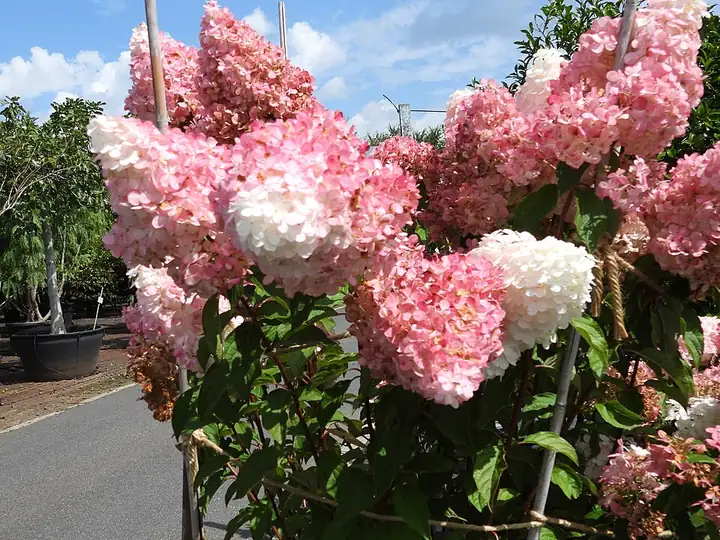
Hydrangea tree (panicle hydrangea)
Hydrangea paniculata · Hydrangea family (Hydrangeaceae)
| Hardiness zones | 3 to 8 |
|---|---|
| Sun | full sun to part shade |
| Water | moderate |
| Life cycle | perennial |
| Frost | Hardy: takes frost |
About Hydrangea tree (panicle hydrangea)
Panicle hydrangea is a tough, fast-growing shrub from China and Japan with cone-shaped flower clusters that open white or lime green in midsummer and age to pink, red or burgundy into fall. It is the hardiest hydrangea and is often sold trained as a single-trunk "hydrangea tree." Popular kinds include 'Vanilla Strawberry' (also sold as 'Vanille Fraise' or 'Renhy', and sometimes called Strawberry Vanilla), 'Limelight', 'Quick Fire' and the old 'Grandiflora' (PeeGee). Flower color does not depend on soil pH.
NC State and Chicago Botanic Garden list zones 3-8; it is the most cold-hardy hydrangea.
When to plant
Timing is counted from your average last spring frost (and first fall frost). Sow & Tell works out the actual dates for your ZIP code.
Tree forms: stems are brittle and break in wind (NC State), and heavy flower heads weigh branches down, so a young standard often comes with a stake; extension experts say the only way to know if it can stand alone is to remove the stake and watch. Many hydrangea trees are grafted, and shoots from the roots are the rootstock, which may flower differently; remove sprouts from the base and trunk while small, cutting flush where they start (Ask Extension, Iowa State). Never spray herbicide on suckers.
Soil
Organically rich, moist, well-drained soil; the roots are shallow, so steady moisture and mulch matter, and alkaline soil can cause yellow leaves (NC State, Chicago Botanic Garden). It handles city conditions and salt.
Plant in organically rich, moist, well-drained soil; the roots are shallow, so mulch to keep moisture steady (NC State, Chicago Botanic Garden).
Feeding
- Late winter to early spring, before leaves emerge: pruning (no fertilizer needed). Cut last year's stems back to just above a fat bud; remove suckers from the roots and sprouts along the trunk, cutting flush where they start (UMN, Chicago Botanic Garden, Iowa State).
In a 20-year Chicago Botanic Garden trial, panicle hydrangeas needed no fertilizer, deadheading or winter protection. Alkaline soil can cause yellow leaves. Don't spray herbicide on suckers; it can hurt the tree (Iowa State).
Harvest
Blooms from about July into October on this year's growth. Prune in late winter or early spring, cutting stems back to just above a fat bud; it blooms on new growth, so this does not cost you flowers (UMN, Missouri Botanical Garden). Leave dried heads for winter interest, and cut fresh or dried flowers for vases.
Varieties (21)
| Variety | Type | Days | Notes |
|---|---|---|---|
| Angel's Blush ('Ruby') | Panicle hydrangea (H. paniculata) | White florets blush pink and darken to red; deep red stems; about 6 ft. | |
| Big Ben | Panicle hydrangea (H. paniculata) | Creamy white cones deepen to magenta; red stems hold 10-inch heads upright; about 6 ft. | |
| Bobo ('ILVOBO') | Panicle hydrangea (H. paniculata) | Dwarf, about 2.5-3 ft; white flowers age to pink. | |
| Dharuma | Panicle hydrangea (H. paniculata) | Compact (about 2.5 ft), early, with small lacy white flowers aging pink. | |
| Fire and Ice ('Wims Red') | Panicle hydrangea (H. paniculata) | White to pink to red cones on dark red stems; 3-6 ft. | |
| Fire Light ('SMHPFL') | Panicle hydrangea (H. paniculata) | Big mophead-style cones up to about 11 inches turn from white to magenta-pink; 6-8 ft. | |
| Grandiflora (PeeGee) | Panicle hydrangea (H. paniculata) | Large white flowers aging to pink; 10-25 ft if unpruned, usually kept at 6-10 ft; branches arch under full bloom. | |
| Great Star ('Le Vasterival') | Panicle hydrangea (H. paniculata) | Big star-shaped white florets that stay white; 6-7 ft. | |
| Honeycomb ('Revival') | Panicle hydrangea (H. paniculata) | Very large (12-inch) creamy heads that brown without a pink stage; about 10 ft; lots of fertile florets that draw bees. | |
| Limelight ('Zwijnenburg') | Panicle hydrangea (H. paniculata) | Chartreuse flowers turn creamy white, then green with a pink tinge; 6-8 ft tall and wide. | |
| Little Lamb | Panicle hydrangea (H. paniculata) | Plump heads of tiny florets, white to pink; 4-6 ft. | |
| Little Lime ('Jane') | Panicle hydrangea (H. paniculata) | Compact Limelight, 3-5 ft; lime-green flowers fade to cream with a pink blush. | |
| Little Quick Fire ('SMHPLQF') | Panicle hydrangea (H. paniculata) | Compact Quick Fire, 3-5 ft; lacy flowers go white to pink-purple to deep magenta; red stems. | |
| Phantom | Panicle hydrangea (H. paniculata) | Large creamy white mopheads age to deep pink in fall; 6-8 ft. | |
| Pink Diamond ('Interhydia') | Panicle hydrangea (H. paniculata) | White flowers turn rich pink; 6-8 ft. | |
| Pinky Winky ('Dvppinky') | Panicle hydrangea (H. paniculata) | Two-tone cones that turn dark pink from the bottom up while the tips stay white; sturdy red stems hold them upright; 6-8 ft. | |
| Quick Fire ('Bulk') | Panicle hydrangea (H. paniculata) | Early bloomer; white flowers turn dusky rose quickly; red stems; best orange fall leaf color in the trial; 6-8 ft. | |
| Tardiva | Panicle hydrangea (H. paniculata) | Late-blooming lacecap type, white aging to pink; 8-12 ft. | |
| Unique | Panicle hydrangea (H. paniculata) | Very large (about 13-inch) lacy heads that age from white to pink; tall and vigorous. | |
| Vanilla Strawberry ('Renhy'; also sold as Vanille Fraise, sometimes called Strawberry Vanilla) | Panicle hydrangea (H. paniculata) | Flowers open creamy white, turn pink after about two weeks, then strawberry red, holding red 3-4 weeks before browning; all-sterile florets. Upright early, then arching or cascading under the weight of the blooms by late summer; about 6-8 ft tall and 4-5 ft wide (MOBOT; the patent gives about 8 ft by 5 ft). | |
| White Diamonds ('HYPMAD I') | Panicle hydrangea (H. paniculata) | Big white sterile florets that age rosy pink; heat and drought tolerant; about 4-8 ft. |
Pests to watch for
Aphids, Twospotted spider mite, Scale insects
Diseases and problems
Bud blight, Bacterial wilt, Leaf spot, Rust, Powdery mildew, Hydrangea leaf spot
In the kitchen
Keeping it: Fresh panicles wilt fast out of water: keep a bucket handy while cutting, change vase water every couple of days, and recut stems. Dried heads keep for months away from sun and damp.
Safety: NC State lists panicle hydrangea as poisonous to people; don't eat any part.
Pets: Toxic to dogs, cats and horses (ASPCA hydrangea entry: a cyanogenic glycoside causes vomiting, diarrhea and depression); NC State flags panicle hydrangea as a problem for cats, dogs and horses.
Sources
- plants.ces.ncsu.edu
- chicagobotanic.org
- chicagobotanic.org
- missouribotanicalgarden.org
- missouribotanicalgarden.org
- patents.google.com
- extension.umn.edu
- extension.umd.edu
- ask.extension.org
- ask.extension.org
- ask.extension.org
- yardandgarden.extension.iastate.edu
- aspca.org
Photo: Photo: Homoarborea, CC0, via Wikimedia Commons (CC0). Photo resized for the web.

Planting dates and advice are general guidance; check with your local Cooperative Extension office for your area.