
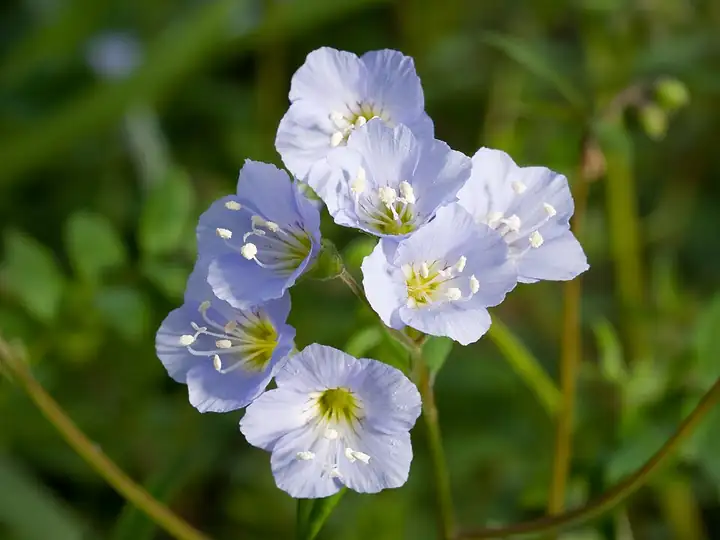
Jacob's ladder
Polemonium reptans (Greek valerian, native Jacob's ladder) and P. caeruleum (European Jacob's ladder), plus hybrids such as 'Heaven Scent' · Phlox family (Polemoniaceae)
| Hardiness zones | 3 to 8 |
|---|---|
| Sun | part shade |
| Water | moderate |
| Life cycle | perennial |
| Frost | Hardy: takes frost |
| Soil pH | 6.8–7.2 |
| Spacing | 12 to 36 inches |
About Jacob's ladder
Jacob's ladder is named for its leaves: pairs of small leaflets lined up like the rungs of a ladder. In spring it carries loose clusters of nodding, bell-shaped flowers in soft blue, sometimes white, that native bees and bumblebees visit (NC State, Wildflower Center). P. reptans is native to moist woods and stream banks from New York to Minnesota and south to Georgia and Arkansas; P. caeruleum, the taller European species, comes from Europe and Asia (Wildflower Center, Cornell). Both are easy, tidy plants for a shady, moist bed.
P. reptans is hardy in zones 3-8 (NC State, Mt. Cuba); Cornell rates P. caeruleum zones 3-9 and Michigan State to zone 2. It dislikes hot, humid summers and is often short-lived in warm areas (NC State, Cornell).
When to plant
Timing is counted from your average last spring frost (and first fall frost). Sow & Tell works out the actual dates for your ZIP code.
Set out nursery plants in spring or divide clumps in early spring or late summer (Wildflower Center, Cornell). Sow seed as soon as it ripens or very early in spring (Wildflower Center). We found no sourced day count to first bloom.
Soil
Moist, humus-rich, well-drained soil; it has little drought tolerance and goes dormant if the soil dries out (Wildflower Center, NC State).
Mix compost or leaf mold into the bed for the moist, humus-rich soil it grows in naturally (Wildflower Center, NC State).
Feeding
- Early spring, just before new growth starts: complete slow-release fertilizer such as 12-6-6. Without a soil test, Clemson suggests 1-2 lb per 100 sq ft for perennials, watered in. Follow a soil test.
Dry soil and hot afternoon sun scorch it; water at the base rather than over the leaves to limit fungal problems (Ohio State, Mt. Cuba).
Harvest
P. reptans blooms in April and May, and P. caeruleum from late spring into midsummer (Wildflower Center, Cornell). Cut faded flower stalks back to the base to tidy the plant, cut down on seedlings and sometimes get a second, smaller bloom (Cornell, Ohio State).
Varieties (8)
Cornell, Mt. Cuba Center, Chicago Botanic Garden and Purdue Arboretum document these 8; 'Blue Pearl' is named without details.
| Variety | Type | Days | Notes |
|---|---|---|---|
| Album | European Jacob's ladder (P. caeruleum) | White flowers. | |
| Apricot Delight | European Jacob's ladder (P. caeruleum) | Blue-purple flowers with peachy orange centers. | |
| Blue Bell | European Jacob's ladder (P. caeruleum) | Pastel blue flowers. | |
| Brise d'Anjou | European Jacob's ladder (P. caeruleum) | Grown for its leaves: medium green leaflets edged in creamy white. | |
| Sapphire | European Jacob's ladder (P. caeruleum) | Compact, about 1-1.5 ft tall, with pale blue flowers. | |
| Heaven Scent | Hybrid of native P. reptans and a Japanese Polemonium | Bluish-purple flowers that smell of grapes, on stalks about 2 ft tall; leaves reddish in spring, then green. May rebloom in fall. | |
| Blue Pearl | Native Jacob's ladder (P. reptans) | ||
| Stairway to Heaven | Native Jacob's ladder (P. reptans) | Variegated leaves with blue spring flowers; best in part shade and moist soil. |
Diseases and problems
Fungal leaf diseases
In the kitchen
Safety: NC State lists no toxicity for Jacob's ladder, and we found no poisoning reports. It isn't a food plant, so don't eat it; old root remedies (see history) are not advice.
Pets: Not listed by the ASPCA. Note that the ASPCA's 'Jacob's Ladder' entry is a different plant, carrion flower (Smilax herbacea), which it lists as non-toxic; Polemonium itself isn't on its lists, so discourage pets from chewing it.
Sources
- wildflower.org
- plants.ces.ncsu.edu
- gardening.cornell.edu
- plantpath.osu.edu
- mtcubacenter.org
- archive.lib.msu.edu
- aspca.org
- aspca.org
- aspca.org
- extension.rutgers.edu
- hgic.clemson.edu
Photo: Photo: Ryan Kaldari / Wikimedia Commons, Public domain. Photo resized for the web.

Planting dates and advice are general guidance; check with your local Cooperative Extension office for your area.