
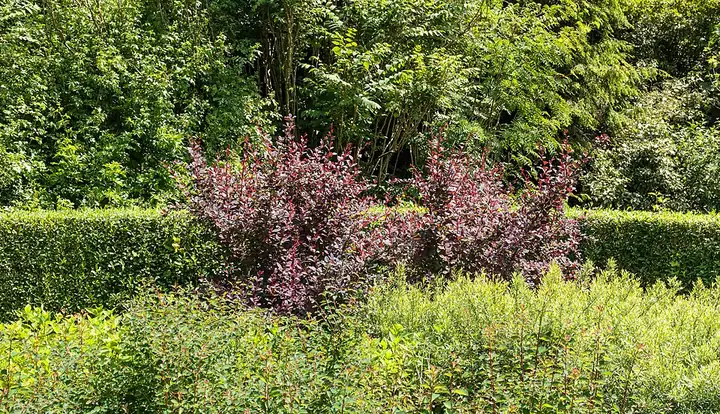
Japanese barberry
Berberis thunbergii · Barberry family (Berberidaceae)
| Hardiness zones | 4 to 8 |
|---|---|
| Sun | full sun to part shade |
| Water | low |
| Life cycle | perennial |
| Frost | Hardy: takes frost |
About Japanese barberry
Japanese barberry is a thorny Asian shrub sold for its red, purple or gold leaves. It is invasive: birds spread its berries into forests, where it forms dense thickets, and Pennsylvania added it to its noxious weed list in 2021 and stopped sales by fall 2023, except for four sterile WorryFree cultivars (NC State, Pennsylvania Department of Agriculture). In Connecticut woods, dense barberry held more than twice as many Lyme-infected blacklegged ticks as areas where it was controlled (Williams and Ward, 2010). Native alternatives include American beautyberry, New Jersey tea, winterberry, spicebush, bayberry, shrubby St. John's wort and mapleleaf viburnum (NC State).
Hardy in zones 4-8 (NC State). Invasive across much of the East and listed by the NC Invasive Plant Council; Pennsylvania lists it as a Class B noxious weed. Check your state's rules before planting.
When to plant
Timing is counted from your average last spring frost (and first fall frost). Sow & Tell works out the actual dates for your ZIP code.
Not recommended for planting. If you want the look, NC State suggests sterile cultivars (Sunjoy and WorryFree groups) or natives instead.
Soil
Grows in almost any well-drained soil and tolerates drought, heat, city conditions and some salt (NC State).
Test the soil before planting; mature shrubs in decent soil need little or no fertilizer (Clemson).
Feeding
Invasive: don't plant or feed it; see the plant page for native alternatives (NC State).
Harvest
Small pale yellow flowers hang under the leaves in April-May; glossy red berries ripen in fall and last into winter, and birds spread them (NC State).
Varieties (8)
Invasive. Only the sterile cultivars are reasonable choices; Pennsylvania allows only the four WorryFree cultivars named here.
| Variety | Type | Days | Notes |
|---|---|---|---|
| Atropurpurea | Fertile, not recommended | Purple-leaved red barberry form. | |
| Crimson Pygmy | Fertile, not recommended | Dwarf with reddish-purple leaves. | |
| Rose Glow | Fertile, not recommended | Pinkish mottled new growth maturing deep red-purple. | |
| Sunjoy series | Sterile (developed at NC State) | Sterile cultivars that don't spread by seed. | |
| WorryFree Crimson Cutie | Sterile (WorryFree series) | Seedless; one of four cultivars Pennsylvania still allows. | |
| WorryFree Lemon Cutie | Sterile (WorryFree series) | Seedless; allowed in Pennsylvania. | |
| WorryFree Lemon Glow | Sterile (WorryFree series) | Seedless; allowed in Pennsylvania. | |
| WorryFree Mr. Green Genes | Sterile (WorryFree series) | Seedless; allowed in Pennsylvania. |
Pests to watch for
Aphids, Scale insects
Diseases and problems
Anthracnose, Root rot, Bacterial leaf spot, Wilt
In the kitchen
Safety: Sharp spines at every node make it a poor choice near play areas (NC State). Dense thickets also shelter blacklegged ticks that carry Lyme disease (Williams and Ward, 2010).
Pets: Not on the ASPCA toxic plant lists.
Sources
- plants.ces.ncsu.edu
- pa.gov
- academic.oup.com
- aspca.org
- aspca.org
- extension.rutgers.edu
- hgic.clemson.edu
- extension.umn.edu
Photo: Photo: Dominicus Johannes Bergsma / Wikimedia Commons, CC BY-SA 4.0 (CC BY-SA 4.0). Photo resized for the web.

Planting dates and advice are general guidance; check with your local Cooperative Extension office for your area.