
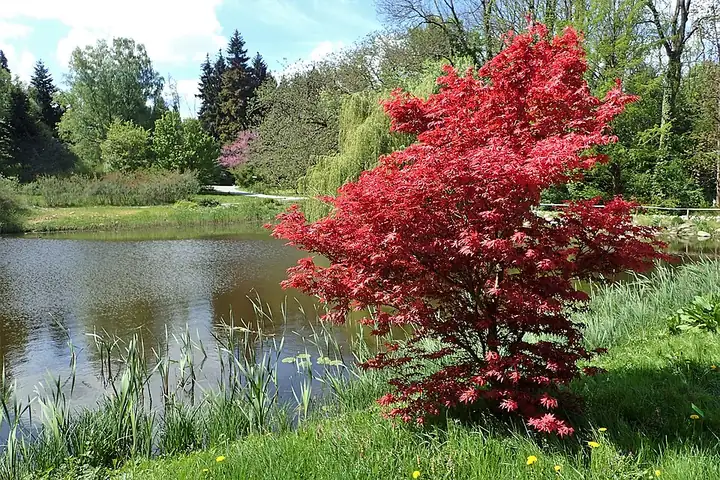
Japanese maple
Acer palmatum (and its many cultivars, including the cutleaf var. dissectum types) · Soapberry family (Sapindaceae; maples were formerly Aceraceae)
| Hardiness zones | 5 to 8 |
|---|---|
| Sun | part shade |
| Water | moderate |
| Life cycle | perennial |
| Frost | Hardy: takes frost |
About Japanese maple
Japanese maple is a small, slow-growing tree from Japan and Korea, loved for its finely lobed or lacy leaves in green, red, purple or gold and its bright fall color. Cultivars run from knee-high weeping mounds to 25-foot trees, and many have colorful twigs for winter. It self-sows easily and is listed as invasive in Virginia and Washington, DC.
Zones 5-8 (Morton Arboretum); not every cultivar is fully hardy in zone 5, and late spring frosts can burn new leaves. Invasive: it self-seeds and the Mid-Atlantic Pest Council lists it as invasive in Virginia and DC (NC State).
When to plant
Timing is counted from your average last spring frost (and first fall frost). Sow & Tell works out the actual dates for your ZIP code.
Plant container or balled-and-burlapped trees. Container trees can go in any time the ground can be worked, but fall is the best season in the South because roots keep growing through mild weather (Clemson). Dig the hole no deeper than the root ball and at least twice as wide, keep the top roots level with the soil, and mulch 2-4 inches without touching the trunk. Pick a spot with morning sun and afternoon shade, sheltered from drying wind. Most cultivars are grafted (NC State). Don't prune in spring, when maples bleed sap heavily (Morton Arboretum).
Soil
Evenly moist, well-drained, acidic soil rich in organic matter; it tolerates alkaline soil but not drought, and dry, sunny or windy spots scorch the leaves (NC State, Morton Arboretum).
Test the soil first. Loosen a wide planting area and mix 10-20 percent compost into the native soil you dig out; don't use uncomposted bark, and don't dig deeper than the root ball (Clemson). Aim for acidic, evenly moist soil rich in organic matter.
Feeding
- Spring to early summer, after the tree is established, and only if a soil test or pale leaves and weak twig growth show a need: slow-release nitrogen fertilizer with a ratio near 3-1-1 or 3-1-2 (3-0-1 or 3-0-2 if the soil test shows enough phosphorus). Spread it evenly from just outside the trunk flare to the dripline and water it in. Clemson cites 2-4 lb of slow-release nitrogen per 1,000 sq ft per year, split into a spring and a late-summer feeding; follow your soil test.
- Late summer to early fall, the second half of the year's split feeding (only if a soil test calls for it): slow-release nitrogen fertilizer, same as spring. Apply the rest of the year's amount over the root zone and water in. Don't feed a drought-stressed tree in summer (Clemson).
First-year watering matters far more than fertilizer: water daily for the first 1-2 weeks, every 2-3 days until week 12, then weekly, using about 1-1.5 gallons per inch of trunk diameter, until the tree is established, roughly 1.5 years per inch of trunk (UMN). Don't count on rain unless it was over an inch. Don't prune in spring, when maples bleed sap (Morton Arboretum), and don't let the soil dry out: drought and hot sun scorch the leaves. Too much fertilizer can burn roots and push soft growth that pests and cold injure (Clemson).
Varieties (16)
| Variety | Type | Days | Notes |
|---|---|---|---|
| Sharp's Pygmy | Dwarf | Truly dwarf, slow and dense, with tiny leaves. | |
| Seiryu | Upright cutleaf | Lacy green leaves with red-tipped new growth; multi-trunked and spreading. | |
| Sango-kaku (coral bark maple) | Upright, colorful bark | Coral-red twigs for winter color; multi-trunked, rounded habit. | |
| Osakazuki | Upright, green | Noted for excellent fall color. | |
| Shishigashira (Lion's Head) | Upright, green | Vase-shaped, about 15 ft tall and 10 ft wide; crinkled deep green leaves, golden to orange-red in fall. | |
| Atropurpureum | Upright, red-leaf | Dark purple leaves turning bright crimson in fall. | |
| Bloodgood | Upright, red-leaf | Rounded tree about 18 ft tall and wide; deep burgundy leaves spring and summer, crimson in fall. | |
| Emperor I | Upright, red-leaf | About 18 ft tall, 16 ft wide; purple-red leaves, scarlet fall color. Leafs out late, so late frosts hurt it less. | |
| Trompenburg | Upright, red-leaf | Glossy burgundy-red leaves whose lobes curl down at the edges. | |
| Twombly Red Sentinel | Upright, red-leaf | Bright red spring leaves, maroon in summer, red in fall. | |
| Koto no ito | Upright, threadleaf | Very fine, thread-like leaves. | |
| Orangeola | Weeping cutleaf (dissectum) | About 8 ft tall and wide; finely cut leaves orange-red in spring, green in summer, bright orange in fall. | |
| Viridis | Weeping cutleaf (dissectum), green | About 8-10 ft tall and 8 ft wide; green lacy leaves turn gold to orange-red in fall. | |
| Waterfall | Weeping cutleaf (dissectum), green | Cascading branches with feathery green leaves. | |
| Crimson Queen | Weeping cutleaf (dissectum), red | Mounded weeping dwarf about 6 ft tall and 8 ft wide; lacy purple-red leaves, scarlet in fall. | |
| Tamukeyama | Weeping cutleaf (dissectum), red | Mounded, about 10 ft tall and 12 ft wide; crimson new growth deepening to purple-red. |
Pests to watch for
Aphids, Scale insects, Leafhoppers, Asian longhorned beetle
Diseases and problems
Anthracnose, Verticillium wilt, Leaf scorch, Frost injury, Drought stress, Mechanical damage (mower, trimmer and tie wounds)
In the kitchen
Pets: Not on the ASPCA's toxic plant list for dogs. The ASPCA's maple warning is for red maple, whose wilted leaves poison horses.
Sources
- plants.ces.ncsu.edu
- mortonarb.org
- extension.rutgers.edu
- aspca.org
- aspca.org
- hgic.clemson.edu
- hgic.clemson.edu
- extension.umn.edu
Photo: Photo: Krzysztof Ziarnek (Kenraiz) / Wikimedia Commons, CC BY-SA 4.0 (CC BY-SA 4.0). Photo resized for the web.

Planting dates and advice are general guidance; check with your local Cooperative Extension office for your area.