
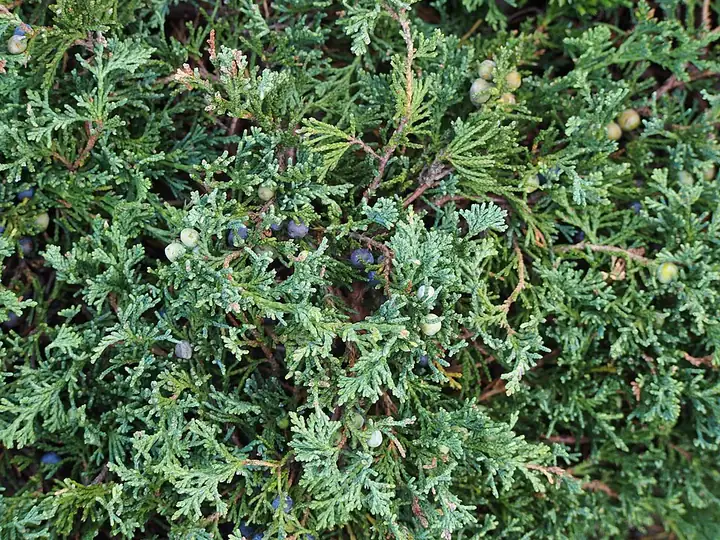
Juniper
Juniperus chinensis (Chinese juniper), J. horizontalis (creeping juniper), J. virginiana (eastern red-cedar), J. x pfitzeriana and other garden junipers · Cypress family (Cupressaceae)
| Hardiness zones | 3 to 9 |
|---|---|
| Sun | full sun |
| Water | low |
| Life cycle | perennial |
| Frost | Hardy: takes frost |
| Soil pH | 5.0–8.0 |
About Juniper
Junipers are tough evergreen conifers, from low groundcovers that spill over walls to upright shrubs and tall trees. They handle heat, drought, poor soil and salt better than most evergreens. Thirteen species are native to North America, including creeping juniper and eastern red-cedar, while Chinese juniper comes from East Asia (Clemson, NC State). Junipers are the alternate host of cedar-apple rust, so they matter to nearby apple trees.
Creeping juniper is hardy in zones 3-9 and Chinese juniper in zones 4-9 (NC State).
When to plant
Timing is counted from your average last spring frost (and first fall frost). Sow & Tell works out the actual dates for your ZIP code.
Water regularly until established; after that they need little extra water (Clemson). NC State suggests 6-12 ft between creeping junipers used as groundcover.
Soil
Any well-drained soil, including sandy, rocky or poor soil; avoid wet spots. Space plants for their mature size so air moves through and the foliage dries quickly, which cuts fungal blights (Clemson, NC State).
Junipers need well-drained soil but little feeding; test the soil first (Clemson).
Feeding
Water is what new shrubs need most: daily for the first 2 weeks, every 2-3 days through week 12, then weekly until the roots spread (at least two growing seasons), using about a quarter to a third of the nursery pot's volume each time (UMN). Once established, junipers need minimal extra fertilizer or water, and they need well-drained soil (Clemson).
Varieties (17)
| Variety | Type | Days | Notes |
|---|---|---|---|
| Blue Point | Chinese juniper | Blue-green teardrop pyramid about 12 ft tall. | |
| Gold Coast | Chinese juniper | Compact, yellow-gold, drought tolerant. | |
| Kaizuka | Chinese juniper | Twisted, sculptural branches; 20 ft or more. | |
| Sea Green | Chinese juniper | Upright with arching branches. | |
| Spartan | Chinese juniper | Dense column 15-20 ft tall and about 5 ft wide. | |
| Sargent's juniper (var. sargentii) | Chinese juniper (J. chinensis) | Groundcover 1-2 ft tall and 8-10 ft wide. | |
| Andorra | Creeping juniper | Light green foliage tinged purple in winter. | |
| Bar Harbor | Creeping juniper | Low groundcover with tiny scale-like leaves. | |
| Blue Chip | Creeping juniper | Silver-blue-green all year with purplish winter tips. | |
| Mother Lode | Creeping juniper | Flat, pancake-like gold groundcover. | |
| Wiltonii | Creeping juniper | Long, floppy branches forming dense mats. | |
| Blue Rug | Creeping juniper (J. horizontalis) | Dense, trailing, creeping groundcover. | |
| Taylor | Eastern red-cedar (J. virginiana) | Very narrow, 20-25 ft tall and 4 ft wide; thought to be male, no cones. | |
| Blue Pacific | Groundcover juniper (listed by NC State with creeping juniper) | Low, 0.5-1 ft tall and 6-8 ft wide; blue-green; full sun. | |
| Wilhelm Pfitzer | Pfitzer juniper | Male, gray-green, 6-10 ft tall and 15-20 ft wide; NC State rates Pfitzer highly flammable. | |
| Hetzii (Hetz) | Pfitzer juniper (J. x pfitzeriana) | Blue-green, 8-12 ft tall and wide. | |
| Brodie | Upright juniper | Female; bright green foliage that doesn't bronze in winter; 20-30 ft tall. |
Pests to watch for
Bagworm, Scale insects, Spruce spider mite, Aphids
Diseases and problems
Phomopsis blight, Kabatina tip blight, Cercospora needle blight, Cedar apple rust, Winter injury, Dog urine damage, Girdling roots, Diplodia tip blight
In the kitchen
Safety: NC State tags garden junipers for contact dermatitis, so wear gloves and long sleeves when pruning if your skin is sensitive. NC State rates Pfitzer juniper as highly flammable.
Pets: Not on the ASPCA toxic plant lists.
Sources
- hgic.clemson.edu
- plants.ces.ncsu.edu
- plants.ces.ncsu.edu
- aspca.org
- aspca.org
- extension.rutgers.edu
- extension.rutgers.edu
- extension.rutgers.edu
- extension.rutgers.edu
- hgic.clemson.edu
- extension.umn.edu
Photo: Photo: Agnieszka Kwiecień (Nova) / Wikimedia Commons, CC BY-SA 4.0 (CC BY-SA 4.0). Photo resized for the web.

Planting dates and advice are general guidance; check with your local Cooperative Extension office for your area.