
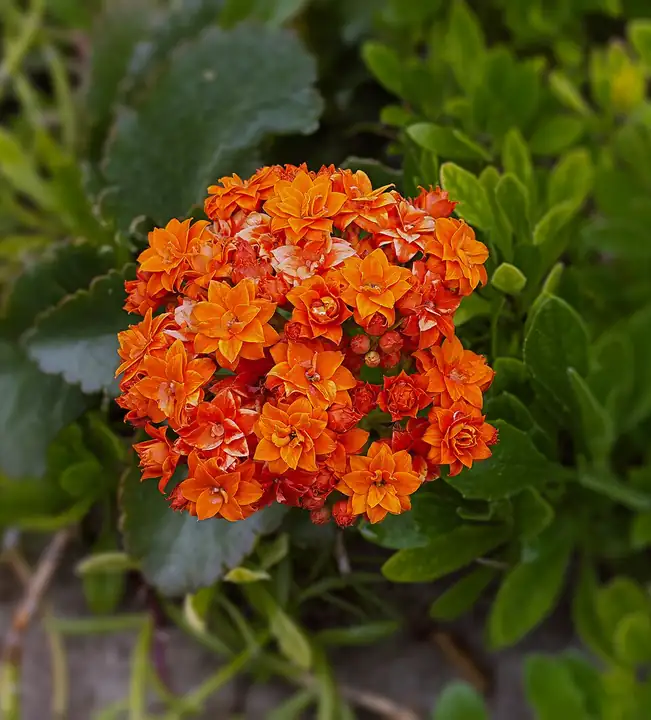
Kalanchoe
Kalanchoe blossfeldiana · Stonecrop family (Crassulaceae)
| Hardiness zones | 10 to 12 |
|---|---|
| Sun | full sun to part shade |
| Water | low |
| Life cycle | perennial |
| Frost | Tender: killed by frost |
About Kalanchoe
Florist's kalanchoe is a compact succulent from Madagascar, introduced in 1932 by the German nurseryman Robert Blossfeld, with glossy scalloped leaves and dense clusters of small red, orange, yellow, pink or white flowers that last for weeks (NC State, Clemson). Growers force it into bloom year-round, which is why it fills grocery stores every winter; at home it reblooms each late winter if it gets six weeks of long, dark nights in fall. It is a succulent at heart, so it wants sun and a dry pot, and it is toxic to pets.
Hardy outdoors only in zones 10-12 (NC State); it is grown indoors everywhere and can summer outdoors in bright, lightly shaded light after frost danger passes, coming in before the first frost and before temperatures fall to 45 F (Clemson, NC State).
When to plant
Timing is counted from your average last spring frost (and first fall frost). Sow & Tell works out the actual dates for your ZIP code.
Usually bought in bloom as a nursery plant and often discarded afterward; it is easy to keep going from 2-3 in tip cuttings taken in spring (Clemson, Iowa State).
Growing it indoors
- Light: Needs 6-8 hours of bright light to bloom and gets leggy in a dim room (NC State, Clemson); a south or west window in winter, with some afternoon shade in summer since prolonged hot sun scorches the leaves.
- Water: Let the mix dry between waterings, then water deeply and let it drain; never leave it standing in water, and go lighter in winter (NC State, Iowa State). Overwatering rots the roots and stems, which is how most florist kalanchoes die.
- Humidity: Ordinary dry room air is fine; crowded, damp conditions invite powdery mildew (NC State, Clemson).
- Temperature: Clemson gives 45-65 F nights and 50-70 F days, with cooler nights making the flowers last longer; it prefers about 60 F nights and 70 F days, and nights above 80 F delay bloom (NC State, Clemson).
- Feeding: Clemson feeds any houseplant fertilizer monthly while the plant is actively growing in spring and summer; none in fall and winter while it sets buds and blooms.
- Repotting: Move it to a slightly larger pot after flowering, when you cut it back (Clemson).
Soil
A well-drained cactus-and-succulent mix, or 60 percent peat and 40 percent perlite, in a pot with a drainage hole (NC State, Clemson).
Pot in a well-drained cactus-and-succulent mix, or 60 percent peat and 40 percent perlite (NC State, Clemson).
Feeding
- Spring and summer, while it is actively growing after bloom: balanced houseplant fertilizer. Once a month on moist mix (Clemson); MU Extension says monthly for any growing houseplant.
- Fall and winter, during bud set and bloom: none. Stop feeding while it sets buds under short days and blooms (Clemson, MU Extension).
Overwatering kills more kalanchoes than any pest; feed only a plant that is growing in good light (Clemson, Iowa State).
Harvest
Blooms in late winter and spring for about 4 weeks per flush once it has had about 6 weeks of 14-hour nights starting in October (NC State, Clemson, Iowa State); deadhead, then cut the spent flower stems and leggy growth back.
Varieties (7)
NC State names 7 cultivars; most florist plants are sold unnamed by color.
| Variety | Type | Days | Notes |
|---|---|---|---|
| Queen Jodie | Double-flowered | Up to 12 in tall with double salmon-pink flowers. | |
| Queen Lindsay | Double-flowered | Up to 12 in tall with double golden-yellow flowers. | |
| Flaming Katy | Single-flowered | The classic bright red single-flowered kalanchoe; 'flaming Katy' is also used as a common name for the species. | |
| Kerinci | Single-flowered | Pink flower clusters. | |
| Lanin | Single-flowered | Up to 12 in tall with bright orange clusters. | |
| Simone | Single-flowered | Up to 12 in tall with pure white clusters. | |
| f. variegata | Variegated leaf | Dark green leaves edged in pink and cream, with red or orange flowers. |
Pests to watch for
Aphids, Mealybugs, Twospotted spider mite, Scale insects
Diseases and problems
Root and crown rot, Powdery mildew, Stem rot
In the kitchen
Safety: NC State rates it medium severity: the flowers, leaves and stems contain bufadienolides, heart-active compounds, and eating them causes nausea, vomiting, diarrhea, lethargy and abnormal heart rhythms. It does not irritate skin, but keep it away from children, dogs and cats.
Pets: Toxic to dogs and cats (ASPCA): bufadienolides cause vomiting and diarrhea and, rarely, an abnormal heart rhythm; NC State adds that seizures and death are possible in pets.
Sources
- plants.ces.ncsu.edu
- hgic.clemson.edu
- yardandgarden.extension.iastate.edu
- extension.missouri.edu
- aspca.org
- assessment.ifas.ufl.edu
Photo: Photo: Sabalo22, CC0, via Wikimedia Commons (CC0). Photo resized for the web.

Planting dates and advice are general guidance; check with your local Cooperative Extension office for your area.