
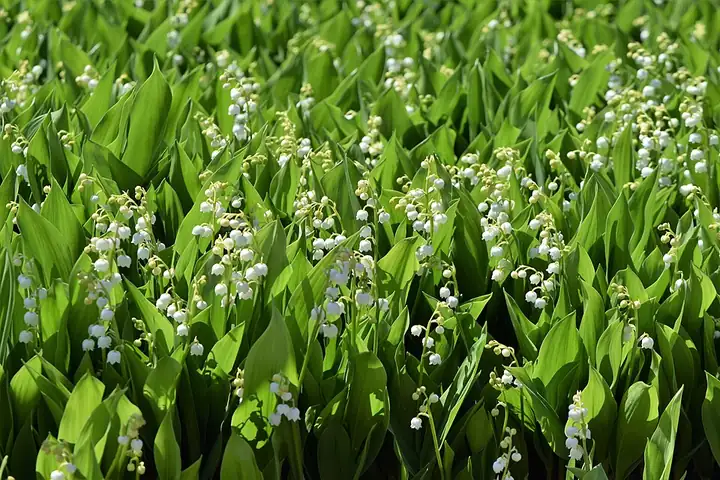
Lily of the valley
Convallaria majalis · Asparagus family (Asparagaceae)
| Hardiness zones | 3 to 7 |
|---|---|
| Sun | part shade |
| Water | moderate |
| Life cycle | perennial |
| Frost | Hardy: takes frost |
About Lily of the valley
Lily of the valley is a low Eurasian groundcover with very fragrant, nodding white bells in late spring. Every part is poisonous to people and pets because it contains heart-affecting glycosides (NC State, ASPCA). Its dense rhizomes spread hard and crowd out other plants, and it is reported as invasive in Wisconsin and Arkansas; NC State suggests native alternatives.
Hardy in zones 3-7 (NC State). It spreads aggressively in cool, moist climates and is reported as invasive in Wisconsin and Arkansas.
When to plant
Timing is counted from your average last spring frost (and first fall frost). Sow & Tell works out the actual dates for your ZIP code.
Plant rhizomes (pips) about 3 inches deep; NC State gives a planting density of 15-25 per square foot. Divide in fall. Plant only where you want a permanent, spreading patch, away from children's play areas.
Soil
Moist, rich soil, but it tolerates clay, dry soil and summer drought (NC State).
Moist, rich soil, though it tolerates clay and dry soil (NC State).
Feeding
- Every fall: mulch (shredded leaves or compost). Top the bed with mulch each fall (NC State).
Plant it only where its spread is welcome; it crowds out other plants (NC State).
Harvest
Blooms late spring to early summer for about 3 weeks (NC State). The fragrant stems can be cut for small vases (NC State); wash your hands after handling the plant.
Diseases and problems
Leaf spot
In the kitchen
Safety: All parts are poisonous: it contains cardiac glycosides and saponins that can cause stomach pain, diarrhea, a slow or irregular pulse, low blood pressure and confusion (NC State).
Pets: Toxic to dogs, cats and horses (ASPCA): cardenolides (heart toxins) can cause vomiting, irregular heartbeat, low blood pressure, disorientation, collapse and seizures. Call a vet right away if a pet chews it.
Sources
Photo: Photo: Krzysztof Ziarnek (Kenraiz) / Wikimedia Commons, CC BY-SA 4.0 (CC BY-SA 4.0). Photo resized for the web.

Planting dates and advice are general guidance; check with your local Cooperative Extension office for your area.