
Linden
American linden or basswood (Tilia americana) and littleleaf linden (Tilia cordata) · Mallow family (Malvaceae; formerly the linden family, Tiliaceae)
| Hardiness zones | 3 to 8 |
|---|---|
| Sun | full sun to part shade |
| Water | moderate |
| Life cycle | perennial |
| Frost | Hardy: takes frost |
About Linden
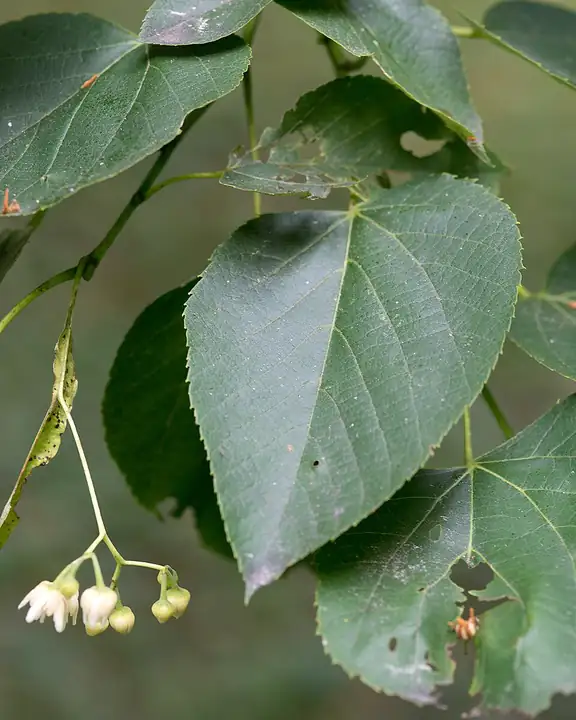
Lindens are big, dense shade trees with heart-shaped leaves and dangling clusters of very fragrant, creamy flowers in early summer that bees love, which is why basswood is also called bee tree. American basswood is native from southern Quebec to Manitoba and eastern North Dakota, south to western North Carolina, Tennessee, Louisiana and eastern Texas (wildflower.org); littleleaf linden comes from Europe and is a common, tidy street tree (Morton Arboretum). Japanese beetles love linden leaves, and NC State warns heavy attacks have destroyed mature littleleaf lindens.
American linden is hardy in zones 3-8 and littleleaf linden in zones 3-7 (NC State).
When to plant
Timing is counted from your average last spring frost (and first fall frost). Sow & Tell works out the actual dates for your ZIP code.
Plant container or balled-and-burlapped trees; container trees can go in any time the ground can be worked, but fall is best in the South because roots keep growing through mild winters (Clemson). Dig no deeper than the root ball and at least twice as wide, set the top roots level with the soil, and mulch 2-4 inches deep without touching the trunk (Clemson). Lindens transplant easily (NC State, Morton Arboretum). Water young littleleaf lindens in dry spells, and a mulch layer keeps the roots cool (NC State, Morton Arboretum). American linden is easily damaged by ice storms (Morton Arboretum).
Soil
Fertile, moist, well-drained loam; American linden takes clay and dry, rocky soil, and littleleaf linden tolerates alkaline soil but not wet ground, severe drought or salt (NC State, Morton Arboretum).
Test the soil first. Loosen a wide planting area and mix 10-20 percent compost into the native soil you dig out; use only composted material, and don't dig deeper than the root ball (Clemson).
Feeding
- Spring to early summer, after the tree is established, and only if a soil test or weak growth shows a need: slow-release nitrogen fertilizer with a ratio near 3-1-1 or 3-1-2 (3-0-1 or 3-0-2 if the soil test shows enough phosphorus). Spread it evenly from just outside the trunk flare to the drip line and water it in. Clemson cites 2-4 lb of slow-release nitrogen per 1,000 sq ft per year, split between spring and late summer; follow your soil test.
- Late summer to early fall, the second half of the split feeding (only if a soil test calls for it): slow-release nitrogen fertilizer, same as spring. Water it in, and skip it if the tree is drought-stressed, since roots can't take up fertilizer from dry soil (Clemson).
First-year watering matters far more than fertilizer: water daily for the first 2 weeks, every 2-3 days through week 12, then weekly, using 1-1.5 gallons per inch of trunk diameter, until the tree is established (about 1.5 years for a 1-inch trunk). Skip a watering only after more than an inch of rain (UMN). Lindens are sensitive to heat and soil compaction; water young trees in dry spells and keep a mulch layer over the roots (NC State, Morton Arboretum). Too much fertilizer can burn roots and push soft growth (Clemson).
Harvest
Blooms in early summer, June to early July, in hanging clusters on a long, strap-like bract; the pea-sized nutlets follow in late summer (NC State, Morton Arboretum). Littleleaf linden takes heavy pruning and can even be clipped into a hedge (NC State).
Varieties (13)
NC State and the Morton Arboretum document these 13 cultivars, chosen mainly for shape and size.
| Variety | Type | Days | Notes |
|---|---|---|---|
| Redmond | American linden (formerly listed under Tilia x euchlora) | Dense pyramid, 40-60 ft tall. | |
| American Sentry ('McKSentry') | American linden (native) | Very even pyramid about 45 ft tall and 30 ft wide; reported to have some resistance to Japanese beetles. | |
| Bailyard | American linden (native) | Symmetrical, about 70 ft tall and 40 ft wide. | |
| Boulevard | American linden (native) | Narrow pyramid about 50-60 ft tall and 25 ft wide; yellow fall color. | |
| Legend ('DTR 123') | American linden (native) | Pyramidal with good branching; thick leaves that stay good-looking in late summer; bright red winter twigs and buds. | |
| Continental Appeal | American linden (native, white basswood form) | Narrow oval, about 50 ft tall and 30 ft wide, with ascending branches; dark green leaves with white undersides. | |
| Glenleven | Linden hybrid (now Tilia x flavescens) | Fast-growing with a straight trunk and a more open habit. | |
| Chancellor | Littleleaf linden (non-native) | More compact, about 50 ft tall; upright when young, more pyramidal with age. | |
| Corzam (Cornithian) | Littleleaf linden (non-native) | Narrow pyramid with a straight trunk, about 45 ft tall and 15 ft wide. | |
| Fairview | Littleleaf linden (non-native) | Fast-growing with thicker foliage, about 60 ft tall. | |
| Greenspire | Littleleaf linden (non-native) | The most common one: neat pyramid with a central trunk, about 40-50 ft tall; the most city-tolerant littleleaf linden. | |
| Shamrock ('Baileyi') | Littleleaf linden (non-native) | Like Greenspire but with a more open crown, about 50 ft tall and 30 ft wide. | |
| Summer Sprite ('Halka') | Littleleaf linden (non-native) | Compact and rounded, only about 20 ft tall and 15 ft wide. |
Pests to watch for
Japanese beetle, Aphids, Lace bugs (azalea and chrysanthemum lace bugs), Scale insects, Twospotted spider mite
Diseases and problems
Verticillium wilt, Anthracnose, Powdery mildew, Leaf spots, Canker
In the kitchen
NC State lists the dried flowers for tea, young leaves for salads and the sap for syrup, but warns that overusing the dried-flower tea can damage the heart.
Safety: NC State gives no poison rating, but warns that overusing linden-flower tea can cause heart damage.
Pets: Non-toxic to dogs, cats and horses (ASPCA, Linden, Tilia americana).
Sources
- plants.ces.ncsu.edu
- plants.ces.ncsu.edu
- wildflower.org
- mortonarb.org
- mortonarb.org
- aspca.org
- extension.rutgers.edu
- extension.rutgers.edu
- hgic.clemson.edu
- hgic.clemson.edu
- extension.umn.edu
Photo: Photo: Plant Image Library / Wikimedia Commons, CC BY-SA 2.0 (CC BY-SA 2.0). Photo resized for the web.

Planting dates and advice are general guidance; check with your local Cooperative Extension office for your area.