
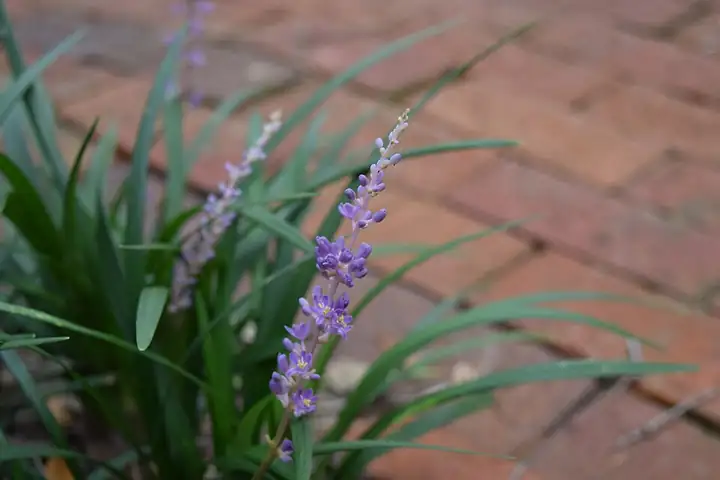
Liriope (lilyturf, monkey grass)
Liriope muscari (big blue lilyturf) and L. spicata (creeping lilyturf) · Asparagus family (Asparagaceae)
| Hardiness zones | 5 to 10 |
|---|---|
| Sun | full sun to part shade |
| Water | low |
| Life cycle | perennial |
| Frost | Hardy: takes frost |
| Spacing | 12 inches |
About Liriope (lilyturf, monkey grass)
Liriope is a tough evergreen edging plant with grassy leaves and spikes of purple or white flowers in late summer, followed by black berries. Big blue lilyturf stays in clumps; creeping lilyturf (L. spicata) spreads by underground runners, invades nearby beds and lawn, and is listed as invasive in Tennessee and Georgia (NC State, Clemson). Choose L. muscari for edging.
L. muscari zones 5-10, L. spicata 4-10 (NC State). Creeping lilyturf (L. spicata) is invasive in Tennessee and Georgia (NC State).
When to plant
Timing is counted from your average last spring frost (and first fall frost). Sow & Tell works out the actual dates for your ZIP code.
Space plants about 1 foot apart with the crown at soil level, not buried (Clemson). Water regularly the first year; after that it needs little extra water (NC State). Divide every 3-4 years if you want more plants.
Soil
Almost any well-drained soil, sand to clay; it takes heat, drought and salt spray but not wet feet (Clemson).
Any well-drained soil; don't bury the crown or pile mulch against it (Clemson).
Feeding
- Early spring: slow-release or organic fertilizer. Feed lightly (NC State); scatter it around plants and keep granules out of the leaves (Clemson).
Water regularly the first year (NC State); after that, water weekly only in summer droughts and never late in the day. Don't overfertilize (Clemson).
Harvest
Flower spikes in late summer to fall (August-September), then black berries into winter (NC State). Mow or cut old leaves to about 3 inches in late winter before new growth starts: late January on the SC coast, mid-February upstate (Clemson).
Varieties (15)
| Variety | Type | Days | Notes |
|---|---|---|---|
| Big Blue | L. muscari | Lavender spikes; 12-15 in; spreads less than most. | |
| Christmas Tree | L. muscari | Light lavender spikes; prefers shade. | |
| Evergreen Giant | L. muscari | 18-24 in; stiff leaves, white flowers; prone to crown rot. | |
| Gold Band | L. muscari | Gold leaf edges; lavender flowers. | |
| Ingwersen | L. muscari | Blooms best in part to full shade. | |
| John Burch | L. muscari | Cream-yellow leaf edges; lavender flowers. | |
| Majestic | L. muscari | Deep lilac flowers; dark leaves; 12-15 in. | |
| Monroe's White | L. muscari | White flowers; slower growing; best in shade. | |
| Pee Dee Ingot | L. muscari | Yellow leaves. | |
| Royal Purple | L. muscari | Deep purple spikes. | |
| Silvery Sunproof | L. muscari | White and yellow striped leaves; takes sun better than most variegated kinds. | |
| Variegata | L. muscari | White-striped leaves. | |
| Webster Wideleaf | L. muscari | The widest leaves; lavender flowers. | |
| Franklin Mint | L. spicata | Pale lavender flowers; 12-15 in. | |
| Silver Dragon | L. spicata | Silver and white striped leaves; spreads by runners. |
Pests to watch for
Scale insects, Slugs, Brown garden snail
Diseases and problems
Anthracnose, Crown rot, Root rot
In the kitchen
Safety: NC State lists the berries as possibly mildly poisonous to people (no cases known), so don't eat them.
Pets: Non-toxic to dogs, cats and horses (ASPCA, listed as turf lily).
Sources
Photo: Photo: P,TO 19104 / Wikimedia Commons, CC BY-SA 4.0 (CC BY-SA 4.0). Photo resized for the web.

Planting dates and advice are general guidance; check with your local Cooperative Extension office for your area.