
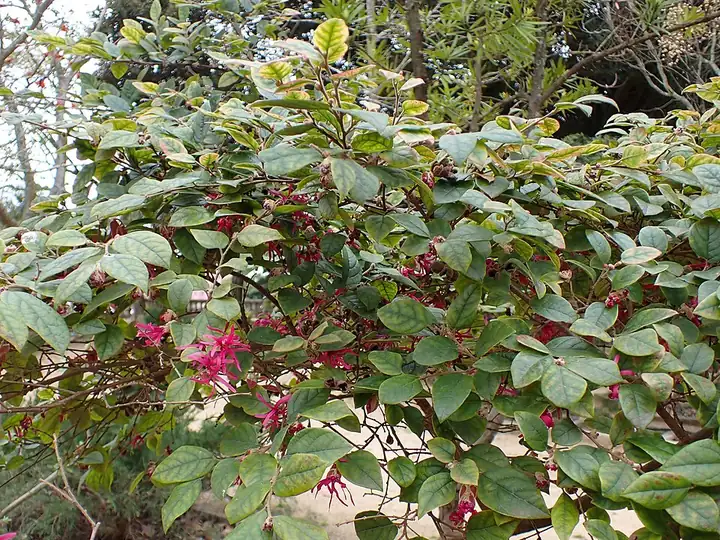
Loropetalum
Loropetalum chinense (white-flowered) and L. chinense var. rubrum (purple-leaved, pink-flowered) · Witch-hazel family (Hamamelidaceae)
| Hardiness zones | 7 to 9 |
|---|---|
| Sun | full sun to part shade |
| Water | moderate |
| Life cycle | perennial |
| Frost | Hardy: takes frost |
About Loropetalum
Loropetalum, or Chinese fringe flower, is an evergreen shrub from China and Japan covered in spidery, lightly fragrant flowers in late winter and early spring. The purple-leaved, pink-flowered kinds are a Southern landscape staple, and many grow much bigger than their tags suggest: 10-20 ft if never pruned (NC State, Clemson). It is a Southern shrub, hardy only to about zone 7b.
Hardy in zones 7b-9b (NC State, Clemson); in zones 6b-7a plant it in a sheltered spot out of winter wind and mulch the roots.
When to plant
Timing is counted from your average last spring frost (and first fall frost). Sow & Tell works out the actual dates for your ZIP code.
In colder areas, plant in spring so roots establish before winter (NC State). Drought tolerant once established; water deeply in long dry spells (Clemson).
Soil
Rich, moist, well-drained acid soil; alkaline soil yellows the leaves, and poorly drained soil leads to root rot (NC State, Clemson).
Test the soil before planting; mature shrubs in decent soil need little or no fertilizer (Clemson).
Feeding
- Spring to early summer after new growth starts, only if a soil test shows a need: slow-release complete fertilizer in a 3:1:2 ratio, or what the soil test calls for. Spread evenly from the trunk out to the drip line and water it in; a typical soil-test rate for shrubs is about 2 lb of 12-6-6 per 100 sq ft (Clemson). Follow a soil test.
Water is what new shrubs need most: daily for the first 2 weeks, every 2-3 days through week 12, then weekly until the roots spread (at least two growing seasons), using about a quarter to a third of the nursery pot's volume each time (UMN). Drought tolerant once established; water deeply in long dry spells (Clemson). Alkaline soil causes yellowing (NC State).
Harvest
Blooms late winter to early spring (late March-April for two to three weeks), and some cultivars rebloom in fall. Prune after the spring bloom; overgrown plants can be cut back to 6-12 inches above the crown (Clemson, NC State).
Varieties (15)
| Variety | Type | Days | Notes |
|---|---|---|---|
| Burgundy | Pink-flowered | Hot pink; reddish-purple leaves; about 14 ft. | |
| Cerise Charm ('Kurobijin') | Pink-flowered | Pink; deep reddish-purple; 3-4 ft at 10 years. | |
| Crimson Fire ('PIILC-I') | Pink-flowered | Bright pink; reddish-purple; about 10 ft at 6 years. | |
| Darkfire | Pink-flowered | Pink; very dark leaves that stay purple; 5-6 ft. | |
| Purple Daydream ('PIILC-III') | Pink-flowered | Dark pink; dark purple; 3.5 ft tall and 7 ft wide at 5 years. | |
| Purple Diamond ('Shang-hi') | Pink-flowered | Pink flowers; deep purple leaves through summer; reached 15 ft at 14 years. | |
| Ruby | Pink-flowered | Bright pink; reddish-burgundy leaves; about 12 ft tall. | |
| Zhuzhou Fuchsia | Pink-flowered | Deep pink; dark maroon leaves; 30 ft tall at 25 years. | |
| Ever Red ('Chang Nian Hong') | Pink-flowered (var. rubrum) | Red flowers; dark burgundy leaves into summer; about 6 ft. | |
| Jazz Hands Mini ('Beni Hime') | Pink-flowered dwarf | Pink; dark purple; about 1 ft tall, 3 ft wide. | |
| Purple Pixie ('Peack') | Pink-flowered dwarf | Bright pink; dark purple; 1.5-3 ft at 3 years. | |
| Carolina Moonlight ('NC1002') | White-flowered | Creamy white flowers; olive-green; about 6 ft. | |
| Emerald Snow ('Shang-White') | White-flowered | White spring and fall flowers; lime-green new leaves. | |
| Snow Muffin | White-flowered | Dense mound; 18-24 in at 5-7 years, 4-5 ft at 25 years. | |
| Jazz Hands Dwarf White ('Hakuou') | White-flowered dwarf | About 3 ft tall and wide. |
Pests to watch for
Twospotted spider mite, Aphids
Diseases and problems
Root rot, Powdery mildew, Anthracnose, Olive gall
In the kitchen
Safety: No toxicity is listed in the extension sources we used.
Pets: Not on the ASPCA toxic plant lists.
Sources
Photo: Photo: Krzysztof Ziarnek (Kenraiz) / Wikimedia Commons, CC BY-SA 4.0 (CC BY-SA 4.0). Photo resized for the web.

Planting dates and advice are general guidance; check with your local Cooperative Extension office for your area.