
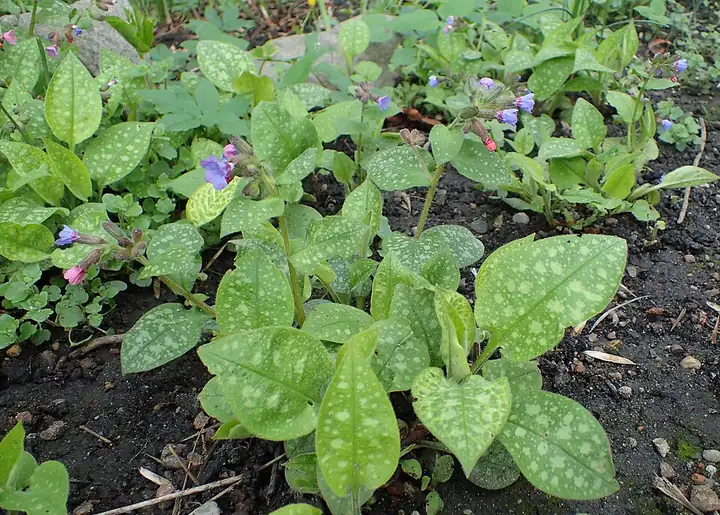
Lungwort (Pulmonaria)
Pulmonaria saccharata, P. officinalis, P. longifolia and hybrids · Borage family (Boraginaceae)
| Hardiness zones | 3 to 8 |
|---|---|
| Sun | part shade |
| Water | moderate |
| Life cycle | perennial |
| Frost | Hardy: takes frost |
About Lungwort (Pulmonaria)
Lungwort is one of the first shade perennials to bloom in spring. Its flowers often open pink and turn blue as they age, so one plant shows several colors at once, and its fuzzy leaves are spotted or splashed with silver (NC State). The name comes from the spotted leaves, which old herbalists thought looked like lungs.
Hardy in zones 3-8 (NC State). It spreads slowly by rhizomes and is not invasive.
When to plant
Timing is counted from your average last spring frost (and first fall frost). Sow & Tell works out the actual dates for your ZIP code.
Plant nursery plants in spring or fall in part to full shade. Divide in fall; seed can be sown in early spring (NC State). Leaves scorch or wilt in full sun or dry soil.
Soil
Cool, moist, well-drained soil high in organic matter; it takes clay but not soggy or dry soil (NC State).
Work in organic matter for cool, moist soil (NC State).
Feeding
Keep the soil moist the first summer; dry soil or full sun scorches the leaves, and soggy soil causes root rot (NC State). No feeding schedule in our sources.
Harvest
Blooms in early to mid spring, around April-May (NC State). Trim off the old flower stems after bloom so the fresh leaves take over.
Varieties (10)
NC State documents these 10 cultivars.
| Variety | Type | Days | Notes |
|---|---|---|---|
| Ankum | Hybrid | Blue to mauve flowers; silver-spotted green leaves. | |
| Diana Clare | Hybrid | Blue flowers aging pink; silver-speckled leaves. | |
| Magic Flower | Hybrid | Named by NC State without a description. | |
| Raspberry Splash | Hybrid | Pink flowers; silver-mottled leaves. | |
| Roy Davidson | Hybrid | Light blue flowers fading to pink. | |
| Trevi Fountain | Hybrid | Cobalt-blue flowers; green leaves spotted silvery white. | |
| Bertram Anderson | P. longifolia | Bright blue flowers; deep green leaves spotted silver. | |
| Dordogne | P. longifolia | Violet flowers; dark green leaves with white spots. | |
| Mrs. Moon | P. saccharata | Pink flowers turning blue; silver-spotted leaves. | |
| Sissinghurst White | P. saccharata | White flowers. |
Pests to watch for
Slugs
Diseases and problems
Powdery mildew, Root rot
In the kitchen
Safety: NC State lists narrow-leaf lungwort leaves as mildly poisonous (pyrrolizidine alkaloids); a large amount can upset the stomach. Don't eat it.
Pets: Not listed as toxic by the ASPCA. NC State's narrow-leaf lungwort page says the leaves contain pyrrolizidine alkaloids and can cause vomiting, diarrhea and lethargy in cats and dogs.
Sources
Photo: Photo: Krzysztof Ziarnek (Kenraiz) / Wikimedia Commons, CC BY-SA 4.0 (CC BY-SA 4.0). Photo resized for the web.

Planting dates and advice are general guidance; check with your local Cooperative Extension office for your area.