
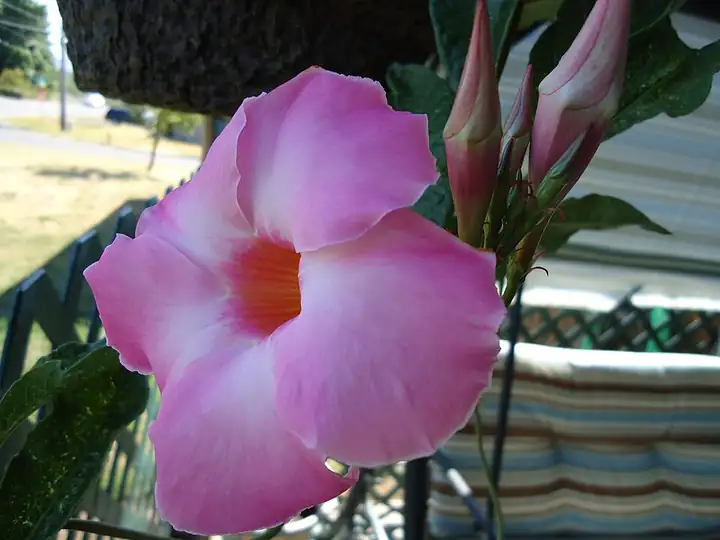
Mandevilla
Mandevilla spp. and hybrids (incl. M. x amabilis, M. sanderi, M. boliviensis; the former Dipladenia) · Dogbane family (Apocynaceae)
| Hardiness zones | 10 to 11 |
|---|---|
| Sun | full sun |
| Water | moderate |
| Life cycle | tender perennial (grown as an annual) |
| Frost | Tender: killed by frost |
| Soil pH | 6.0–8.0 |
| Spacing | 36 to 60 inches |
About Mandevilla
Mandevilla is a tropical twining vine with glossy evergreen leaves and big trumpet-shaped flowers in pink, red, white and yellow. It's a summer favorite for mailboxes, trellises, patio pots and hanging baskets, and hummingbirds and butterflies visit the flowers (NC State; UF/IFAS). Plants once sold as Dipladenia now belong to Mandevilla; newer kinds are bushier and need little support. Outside frost-free areas it's grown as a summer annual or brought indoors for winter.
Survives winter outdoors only in zones 10-11, where it can bloom all year (UF/IFAS); everywhere else grow it as a summer annual or overwinter it indoors.
When to plant
Timing is counted from your average last spring frost (and first fall frost). Sow & Tell works out the actual dates for your ZIP code.
Set out nursery plants after frost danger has passed and nights stay warm; it grows best around 65-70 F (NC State). Give vining kinds a pole, wire or trellis to twine on, and in very hot, humid areas some afternoon shade (NC State, UF/IFAS). To keep it, bring it in before nights regularly fall to the low 50s F (UMD): grow it on in a bright, cool room around 55 F with extra humidity, or cut it back to about 12 inches and let it rest near 50 F in a frost-free garage or basement, watering only now and then (NYBG, MU Extension). Days to first bloom aren't documented; nursery plants are usually sold in bloom.
Soil
Moist, well-drained soil or potting mix; it handles sand, loam or clay as long as water drains away (UF/IFAS, NC State).
Use a well-drained potting mix or loose garden soil; it tolerates sand, loam or clay if water drains away (UF/IFAS).
Feeding
- Spring through summer, while it's growing and blooming: balanced or water-soluble fertilizer. UF/IFAS advises regular watering and regular feeding through the growing season; follow the label rate, especially in pots.
- Late winter or spring, when an overwintered plant puts out new growth: water-soluble houseplant fertilizer. Hold off feeding through winter, then start again once new growth appears and move it to a sunny spot (UMD).
Don't keep it soggy indoors; let the soil dry out somewhat in winter (NC State), and don't feed while it rests (UMD).
Harvest
Blooms most heavily in summer, and all year in zones 10-11 (UF/IFAS). Pinch the shoot tips of young plants for a bushier, fuller vine, and wear gloves when you prune because the milky sap can irritate skin (UF/IFAS, NC State).
Varieties (11)
Extension sources document these 11; breeders now favor shrubbier kinds. Yellow-flowered vines sold as 'yellow mandevilla' are a different plant (Pentalinon luteum) per UF/IFAS.
| Variety | Type | Days | Notes |
|---|---|---|---|
| Rio Pink | Bush type (M. sanderi, Dipladenia type) | Compact, bushy plant with large pink trumpet flowers and little twining; good for baskets, pots and mailboxes. | |
| Alice du Pont | Climbing mandevilla | Vigorous twining vine with deep pink, funnel-shaped flowers up to about 4 inches wide, lightly fragrant (UF/IFAS); NC State describes pale pink flowers with darker throats. | |
| Leah | Climbing mandevilla | Pale pink flowers with a dark pink throat. | |
| Red Velvet | Climbing mandevilla | A big climber that can grow up to 20 ft in one season. | |
| Sun Parasol Burgundy | Compact Sun Parasol type | Compact, bushier plant suited to hanging baskets and containers. | |
| Rita Mae Green | Mandevilla hybrid | Vivid hot pink flowers. | |
| White mandevilla (M. boliviensis) | Species | White, pinwheel-shaped flowers with a yellow throat; a popular climber. | |
| Sun Parasol Original XP Sunbeam | Sun Parasol series | Yellow flowers with a darker throat. | |
| Sun Parasol Original Crimson | Sun Parasol series (vining) | Dark red flowers on a vining plant. | |
| Sun Parasol Original Pink | Sun Parasol series (vining) | Medium pink flowers on a vining plant. | |
| Sun Parasol Original White | Sun Parasol series (vining) | White flowers with a yellow throat. |
Pests to watch for
Aphids, Twospotted spider mite, Thrips, Whiteflies, Mealybugs, Scale insects
In the kitchen
Safety: The milky sap can irritate skin and may be toxic if swallowed (UF/IFAS). Wear gloves when pruning, and don't eat any part.
Pets: Not listed by the ASPCA (no mandevilla entry). UF/IFAS warns the milky sap may be toxic if swallowed, so keep pets from chewing it.
Sources
- plants.ces.ncsu.edu
- gardeningsolutions.ifas.ufl.edu
- ask.ifas.ufl.edu
- extension.umd.edu
- extension.missouri.edu
- libanswers.nybg.org
- aspca.org
Photo: Photo: Symphony999 / Wikimedia Commons, CC BY-SA 3.0 (CC BY-SA 3.0). Photo resized for the web.

Planting dates and advice are general guidance; check with your local Cooperative Extension office for your area.