
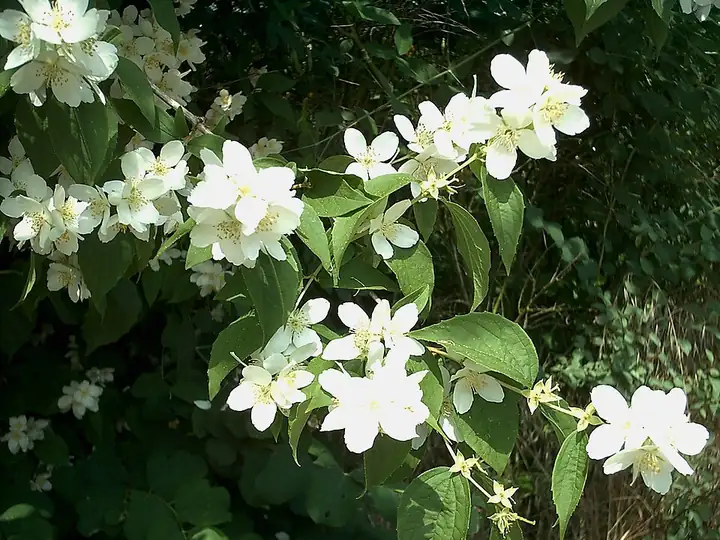
Mock orange
Philadelphus coronarius (sweet mock orange), P. lewisii (Lewis' mock orange) and hybrids such as P. x virginalis · Hydrangea family (Hydrangeaceae)
| Hardiness zones | 3 to 8 |
|---|---|
| Sun | full sun to part shade |
| Water | moderate |
| Life cycle | perennial |
| Frost | Hardy: takes frost |
About Mock orange
Mock orange is an old-fashioned, easy shrub grown for its white late-spring flowers with a sweet scent like orange blossoms; plant it near a patio or path to enjoy the fragrance, especially in the evening (NC State, UMN). Sweet mock orange comes from Turkey and the Caucasus and the popular double kinds are hybrids (P. x virginalis), but Lewis' mock orange is native to the Northwest, from British Columbia and Montana to northern California, and is Idaho's state flower (NC State, wildflower.org, NRCS). Its fall color and seed capsules are plain (NC State, UMN), so compact 2-4 ft cultivars are a good fit for small yards.
Zones 3-8 depending on cultivar (UMN); sweet mock orange is hardy in zones 4-8 (NC State).
When to plant
Timing is counted from your average last spring frost (and first fall frost). Sow & Tell works out the actual dates for your ZIP code.
Plant container shrubs in spring or fall and water deeply until established, at least two growing seasons (UMN).
Soil
Moist, well-drained soil with organic matter; it tolerates clay, sand and alkaline soil and some drought once established, but not soggy sites (UMN, NC State, Morton Arboretum).
Work in compost for a moist, well-drained, organic soil and test the soil first (UMN, Morton Arboretum).
Feeding
- Spring to early summer after new growth starts, only if a soil test or poor growth shows a need: slow-release complete fertilizer in a 3:1:2 or 3:1:1 ratio, or what the soil test calls for. Spread it evenly from the stems out to the drip line and water it in; a typical rate for shrubs is about 2 lb of 12-6-6 per 100 sq ft (Clemson). Follow a soil test.
Water is what new shrubs need most: daily for the first 2 weeks, every 2-3 days through week 12, then weekly until the roots spread, at least two growing seasons, using about a quarter to a third of the nursery pot's volume each time (UMN). Don't prune in fall, winter or early spring, or you'll cut off the flower buds; prune right after bloom (NC State, UMN).
Harvest
Blooms in late spring to early summer (May-June) on last year's wood, so prune right after flowering; take out a few leggy older stems each year, and it tolerates hard cutting to renew an overgrown shrub (NC State, UMN, Morton Arboretum).
Varieties (8)
UMN, NC State, Morton Arboretum and NRCS document these. Sources disagree on 'Minnesota Snowflake''s size.
| Variety | Type | Days | Notes |
|---|---|---|---|
| Buckley's Quill | Hybrid | About 6 ft by 4 ft; fragrant double flowers. | |
| Miniature Snowflake | Hybrid (P. x virginalis) | Dwarf, 2-3 ft; very fragrant double flowers. | |
| Minnesota Snowflake | Hybrid (P. x virginalis) | Fragrant double white flowers up to 2 in. across. | |
| Snow White Sensation | Hybrid (P. x virginalis) | Vase-shaped, 5-6 ft; clusters of fragrant double flowers about 2 in. wide. | |
| Snowbelle | Hybrid (P. x virginalis) | Mounded, 3-4 ft; very fragrant double white flowers. | |
| Blizzard | Lewis' mock orange (P. lewisii) | Compact, about 5 ft by 3 ft; single fragrant flowers in clusters; very winter hardy. From the Morden Research Station in Manitoba. | |
| Waterton | Lewis' mock orange (P. lewisii) | Selection from Waterton Lakes, Alberta, for landscape use. | |
| Aureus | Sweet mock orange (P. coronarius) | Golden spring leaves; compact, about 6 ft by 5 ft; single fragrant flowers. |
Pests to watch for
Aphids, Scale insects, Leafminers
Diseases and problems
Leaf spot, Canker, Powdery mildew, Rust
In the kitchen
Safety: No toxicity is listed in the extension sources we used.
Pets: Not listed by the ASPCA.
Sources
- plants.ces.ncsu.edu
- plants.ces.ncsu.edu
- extension.umn.edu
- mortonarb.org
- wildflower.org
- plants.sc.egov.usda.gov
- extension.umn.edu
- extension.rutgers.edu
- aspca.org
- hgic.clemson.edu
Photo: Photo: Rainer Bielefeld, Public domain, via Wikimedia Commons. Photo resized for the web.

Planting dates and advice are general guidance; check with your local Cooperative Extension office for your area.