
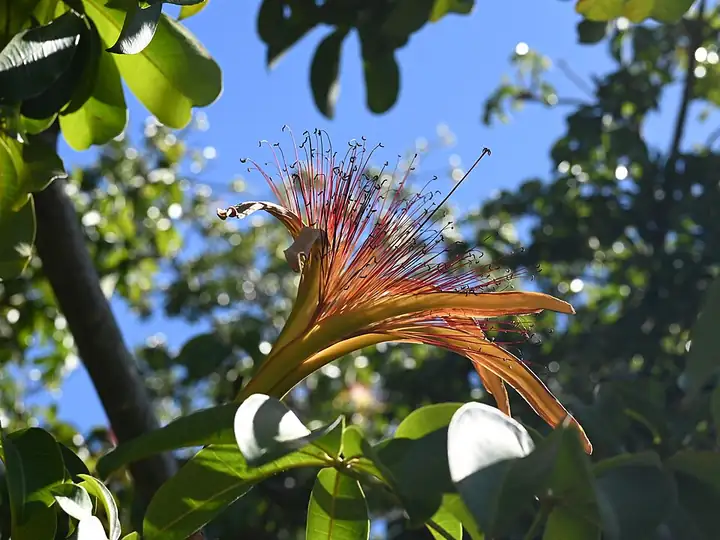
Money tree
Pachira aquatica · Mallow family (Malvaceae)
| Hardiness zones | 10 to 12 |
|---|---|
| Sun | part shade |
| Water | moderate |
| Life cycle | perennial |
| Frost | Tender: killed by frost |
About Money tree
The money tree is a swamp and riverbank tree from southern Mexico to Brazil that reaches 60 ft in the wild, sold as a 6-8 ft houseplant with glossy hand-shaped leaves on a swollen water-storing trunk, usually several seedlings braided together, a fashion that began in Taiwan in the 1980s (NC State, Missouri Botanical Garden). It is popular in feng shui as a bringer of luck, is easy in bright indirect light with even moisture, and is one of the houseplants the ASPCA lists as non-toxic to cats, dogs and horses. Its edible 'Malabar chestnuts' never form indoors.
Hardy outdoors only in zones 10-12 (NC State, Missouri Botanical Garden); it is grown indoors everywhere and can summer outdoors in part shade, sheltered from wind, once nights stay well above 45 F, which NC State gives as the point to bring it in.
When to plant
Timing is counted from your average last spring frost (and first fall frost). Sow & Tell works out the actual dates for your ZIP code.
Bought as a nursery plant, usually with a braided trunk, or started from a softwood cutting, by layering, or from seed (NC State).
Growing it indoors
- Light: It wants bright light without direct sun, or a mix of sun and shade, and direct sun scorches the leaves; it tolerates fairly deep shade but grows slowly there (NC State, Missouri Botanical Garden).
- Water: Give it moderate but even moisture, watering thoroughly when the top of the mix has dried and letting the pot drain; standing water rots the roots, while a pot left dry makes it drop leaves (NC State, Missouri Botanical Garden). Water less in winter when growth slows.
- Humidity: It thrives in humid air at 65-75 F, and NC State lists low humidity as a cause of yellow leaves, so set it on a pebble tray or near other plants in winter.
- Temperature: Happiest at 65-75 F; bring it indoors before temperatures drop to 45 F and keep it out of drafts and strong wind (NC State).
- Feeding: Neither NC State nor the Missouri Botanical Garden gives a schedule; follow MU Extension's general rule and feed a water-soluble houseplant fertilizer monthly while it is putting out new leaves in spring and summer, and not in winter, since NC State does tie yellow leaves to poor nutrition.
- Repotting: Repot in spring when the roots fill the pot or grow out the drainage hole, moving up about 1 in in pot size; a small pot keeps a big plant manageable (UGA, MU Extension).
Soil
A moist but well-drained potting mix of peat, perlite and loam or sand in a pot with a drainage hole; it will not stand in water in a pot even though it grows in swamps outdoors (NC State).
Pot in a moist but well-drained mix of peat, perlite and loam or sand in a container with a drainage hole (NC State).
Feeding
- Spring and summer, while new leaves are coming: water-soluble houseplant fertilizer. Feed monthly at about a quarter of the label rate (UGA, MU Extension); NC State gives no schedule but ties yellow leaves to poor nutrition.
- Fall and winter: none. Don't feed while no new growth is showing (MU Extension).
Don't feed a plant that is dropping leaves from dry mix or a draft; fix the water and the spot first (NC State, MU Extension).
Pests to watch for
Aphids, Mealybugs, Scale insects, Fungus gnats
Diseases and problems
Root and crown rot, Anthracnose, Powdery mildew
In the kitchen
In its native range the seeds are eaten raw, roasted or ground into flour and the young leaves and flowers are cooked (NC State, Missouri Botanical Garden), but NC State warns the seeds contain cyclopropenoid fatty acids that may be toxic or carcinogenic, and a houseplant never sets fruit anyway, so don't count it as a food plant.
Safety: Low severity (NC State): the leaves and stems carry no listed poison, and the only concern is the seeds, which a houseplant never produces. The leaves are not a hazard to handle.
Pets: Non-toxic to dogs, cats and horses (ASPCA, money tree, Pachira aquatica); like any plant it may cause nausea, vomiting or loose stool if a pet eats a lot of it, and NC State notes mild stomach upset in cats.
Sources
- plants.ces.ncsu.edu
- missouribotanicalgarden.org
- extension.missouri.edu
- fieldreport.caes.uga.edu
- aspca.org
Photo: Photo: Krzysztof Ziarnek, Kenraiz, CC BY-SA 4.0, via Wikimedia Commons (CC BY-SA 4.0). Photo resized for the web.

Planting dates and advice are general guidance; check with your local Cooperative Extension office for your area.