
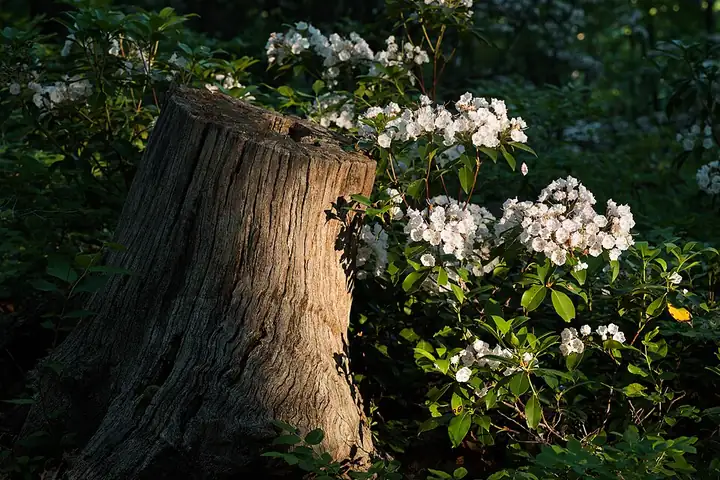
Mountain laurel
Kalmia latifolia · Heath family (Ericaceae)
| Hardiness zones | 4 to 9 |
|---|---|
| Sun | part shade |
| Water | moderate |
| Life cycle | perennial |
| Frost | Hardy: takes frost |
About Mountain laurel
Mountain laurel is a native broadleaf evergreen of the eastern US with clusters of cup-shaped pink, white or red-marked flowers in late spring. Each flower has spring-loaded stamens that dust visiting bees with pollen. It grows slowly into a dense shrub 6-10 ft tall, likes cool, moist, acid soil and part shade, and every part of the plant is highly poisonous (NC State).
Native from New England to the Florida panhandle and Louisiana; hardy in zones 4-9 (NC State).
When to plant
Timing is counted from your average last spring frost (and first fall frost). Sow & Tell works out the actual dates for your ZIP code.
Plant container shrubs in spring or fall and water deeply until established (UMN). Morning sun with shade from early afternoon on suits it best (NC State).
Soil
Cool, moist, acid, well-drained soil high in organic matter; it fails in heavy clay or wet soil, so use raised beds there, and mulch to keep the roots cool (NC State).
Mountain laurel needs cool, moist, acid, well-drained soil high in organic matter; use raised beds in heavy clay (NC State). Test the soil first.
Feeding
- Spring to early summer after new growth starts, only if a soil test shows a need: slow-release complete fertilizer in a 3:1:2 ratio, or what the soil test calls for. Spread evenly from the trunk out to the drip line and water it in; a typical soil-test rate for shrubs is about 2 lb of 12-6-6 per 100 sq ft (Clemson). Follow a soil test.
Water is what new shrubs need most: daily for the first 2 weeks, every 2-3 days through week 12, then weekly until the roots spread (at least two growing seasons), using about a quarter to a third of the nursery pot's volume each time (UMN). Mulch to keep roots cool and moist (NC State).
Harvest
Blooms late April to July for several weeks. Snap off spent flower clusters after bloom and prune lightly then; next year's buds form on old growth (NC State).
Varieties (12)
NC State documents these.
| Variety | Type | Days | Notes |
|---|---|---|---|
| Bullseye | Banded | Two-tone flowers. | |
| Carol | Cultivar | Raspberry-pink blooms. | |
| Carousel | Cultivar | Fast, dense, upright; pink flowers. | |
| Keepsake | Cultivar | Compact; does well in part shade. | |
| Olympic Fire | Cultivar | NC State notes it is highly flammable; no other traits given. | |
| Pink Charm | Cultivar | 8-10 ft tall and wide. | |
| Richard Jaynes | Cultivar | Shade tolerant, heavy bloomer. | |
| Sarah | Cultivar | Red buds open rich pink to coral. | |
| Elf | Dwarf | Compact, 2-4 ft. | |
| Minuet | Dwarf | Grows to about 3 ft. | |
| Pristine | White | Large white flower clusters. | |
| Snowdrift | White | Compact, 5-6 ft; heavy bloom; white. |
Pests to watch for
Lace bugs (azalea and chrysanthemum lace bugs), Scale insects, Whiteflies, Deer
Diseases and problems
Leaf spots, Blight, Leaf scorch
In the kitchen
Safety: NC State rates poisoning as high severity: grayanotoxins in all parts can cause drooling, vomiting, weakness, a weak heartbeat and, in severe cases, death. Honey made mostly from its nectar can be toxic to people.
Pets: Toxic to dogs, cats and horses (ASPCA): grayanotoxins cause vomiting (not in horses), diarrhea, weakness and heart failure.
Sources
Photo: Photo: Juliancolton / Wikimedia Commons, CC BY-SA 4.0 (CC BY-SA 4.0). Photo resized for the web.

Planting dates and advice are general guidance; check with your local Cooperative Extension office for your area.