
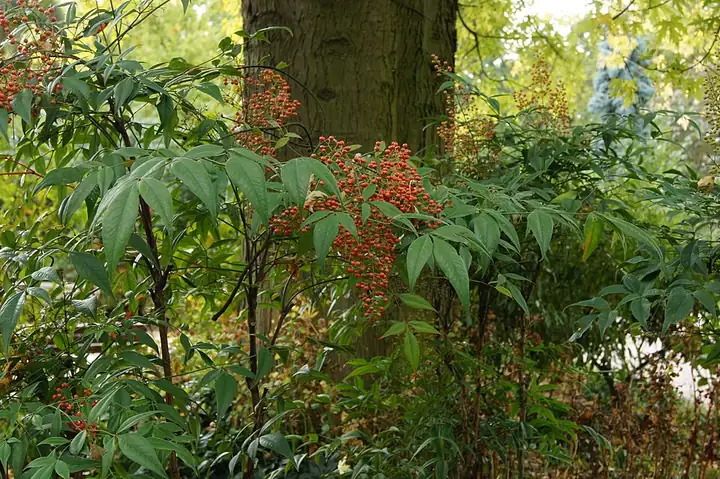
Nandina (heavenly bamboo)
Nandina domestica · Barberry family (Berberidaceae)
| Hardiness zones | 6 to 9 |
|---|---|
| Sun | full sun to part shade |
| Water | moderate |
| Life cycle | perennial |
| Frost | Hardy: takes frost |
About Nandina (heavenly bamboo)
Nandina, or heavenly bamboo, is an evergreen shrub from China and Japan with lacy leaves that turn red in winter and big clusters of red berries. It is invasive in the Southeast: it is listed by the North Carolina and South Carolina invasive plant councils, and its cyanide-containing berries have killed cedar waxwings that gorge on them (NC State, Clemson). If you grow it, pick a nearly fruitless cultivar such as 'Firepower', 'Gulf Stream' or 'Harbour Dwarf' or cut off the flowers and berries; native alternatives include American beautyberry, winterberry, inkberry and arrowwood viburnum.
Hardy in zones 6-9 (NC State). Invasive in the Southeast: listed by the NC Invasive Plant Council and as a significant threat by the SC Invasive Pest Council (NC State, Clemson).
When to plant
Timing is counted from your average last spring frost (and first fall frost). Sow & Tell works out the actual dates for your ZIP code.
Plant container shrubs in spring or fall and water deeply until established (UMN). It spreads slowly by underground stems (Clemson).
Soil
Adapts to clay, loam or sand at almost any pH, and tolerates drought and salt (NC State).
Test the soil before planting; mature shrubs in decent soil need little or no fertilizer (Clemson).
Feeding
- Spring to early summer after new growth starts, only if a soil test shows a need: slow-release complete fertilizer in a 3:1:2 ratio, or what the soil test calls for. Spread evenly from the trunk out to the drip line and water it in; a typical soil-test rate for shrubs is about 2 lb of 12-6-6 per 100 sq ft (Clemson). Follow a soil test.
Water is what new shrubs need most: daily for the first 2 weeks, every 2-3 days through week 12, then weekly until the roots spread (at least two growing seasons), using about a quarter to a third of the nursery pot's volume each time (UMN). Too much fertilizer burns roots and pushes leaves at the expense of flowers; don't feed drought-stressed shrubs (Clemson).
Harvest
White flower clusters open April to June, and red berries last through winter. To keep it from spreading, cut off the flower or berry clusters. Renew leggy plants in late winter by cutting canes back at different heights, or by removing the oldest canes at the base (Clemson).
Varieties (13)
Clemson and NC State document these. Choose the fruitless or nearly fruitless ones; fruiting kinds like 'Alba', 'Compacta', 'Moyer's Red' and Plum Passion spread by seed and are not listed here.
| Variety | Type | Days | Notes |
|---|---|---|---|
| Firepower | Dwarf, little to no fruit | 2-2.5 ft; lime-green new growth; bright red in fall and winter; can carry a mild leaf-curling virus. | |
| Harbour Dwarf | Dwarf, little to no fruit | 2 ft tall, 3 ft wide; spreads by rhizomes; reddish in fall and winter; can carry the leaf-curling virus. | |
| Blush Pink ('AKA') | Little to no fruit | Compact 2 ft mound; pinkish-red new growth. | |
| Firehouse | Little to no fruit | Compact 2 ft mound; red in fall and winter. | |
| Firestorm | Little to no fruit | Dense 3 ft mound; deep red in winter. | |
| Flirt ('Murasaki') | Little to no fruit | 1-2 ft; new leaves stay red most of the year; rarely flowers. | |
| Gulf Stream | Little to no fruit | Dense, 3 ft tall and 3-5 ft wide; copper-red new growth, red in fall and winter. | |
| Harbor Belle ('Jaytee') | Little to no fruit | 2 ft tall, 3 ft wide; reddish-orange new growth. | |
| Lemon-Lime | Little to no fruit | 3-4 ft; yellow-green new leaves. | |
| Obsession ('SEIKA') | Little to no fruit | Upright, compact, 3-4 ft; red young leaves; bright red in fall and winter. | |
| Sienna Sunrise ('Monfar') | Little to no fruit | 3-4 ft; red spring leaves. | |
| Sunray ('Greray') | Little to no fruit | 3-4 ft tall, 2 ft wide; copper and red new growth. | |
| Moon Bay | Little to no fruit (mostly) | 2-3 ft; brilliant red fall color; fruitless for nearly 20 years in Florida trials but fruits in North Carolina. |
Pests to watch for
Scale insects
Diseases and problems
Virus (leaf cupping in some dwarf cultivars)
In the kitchen
Safety: NC State rates poisoning as high severity: all parts, especially the berries, contain cyanogenic glycosides that release cyanide, and large amounts can cause weakness, seizures, coma and breathing failure. Keep children away from the berries.
Pets: Toxic to dogs, cats and horses (ASPCA): cyanogenic glycosides can cause weakness, incoordination, seizures, coma, breathing failure and, rarely in pets, death. The berries also kill birds such as cedar waxwings (NC State, Clemson).
Sources
Photo: Photo: Jebulon / Wikimedia Commons, Public domain. Photo resized for the web.

Planting dates and advice are general guidance; check with your local Cooperative Extension office for your area.