
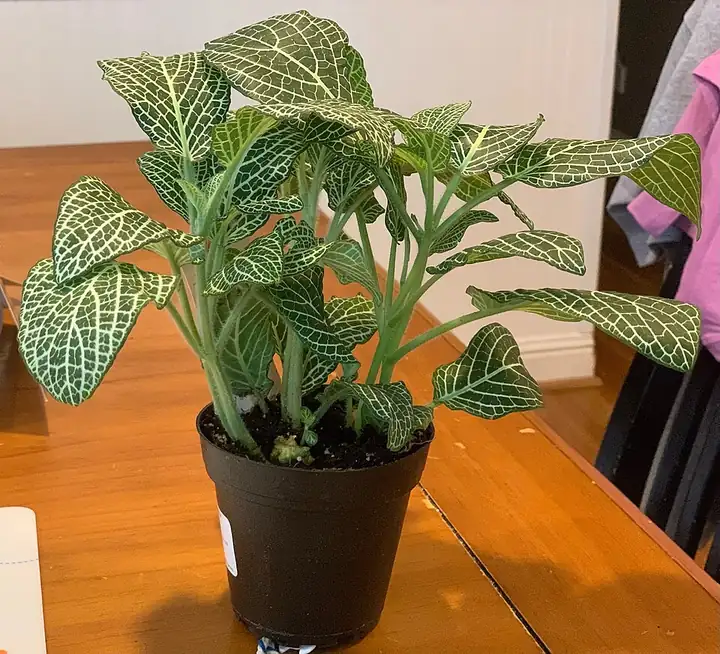
Nerve plant (fittonia)
Fittonia albivenis (formerly F. verschaffeltii and F. argyroneura) · Acanthus family (Acanthaceae)
| Hardiness zones | 11 to 12 |
|---|---|
| Sun | shade |
| Water | high |
| Life cycle | perennial |
| Frost | Tender: killed by frost |
About Nerve plant (fittonia)
The nerve plant is a low, creeping foliage plant from the rainforests of Peru, Colombia, Bolivia, Venezuela and northern Brazil, grown for its olive to deep green leaves netted with white, pink or red veins (NC State). It stays small, roots along its stems, and is a favorite for terrariums, dish gardens and desks. It is known for collapsing dramatically when it dries out and perking right back up after a drink.
Hardy outdoors only in zones 11-12 (NC State); it is grown indoors everywhere and can summer outdoors in shade while nights stay above about 50 F, coming in before fall nights dip toward 45-50 F (UMN Extension's general cutoff for tender houseplants).
When to plant
Timing is counted from your average last spring frost (and first fall frost). Sow & Tell works out the actual dates for your ZIP code.
Usually bought as a small nursery plant, often for terrariums, or started from stem cuttings; the creeping stems root where they touch the soil (NC State).
Growing it indoors
- Light: Bright to medium indirect light suits it, and it grows well under fluorescent lights; direct sun scorches the leaves and makes them shrivel and drop (NC State).
- Water: Keep the mix evenly moist; NC State waters about twice a week. It wilts flat when dry and recovers after a drink, but overwatering yellows the leaves and rots the roots, so use a pot with a drainage hole and don't leave it standing in water (NC State).
- Humidity: NC State lists medium humidity: dry air makes the leaves shrivel and fall, but air that is too humid, as in a sealed, wet terrarium, can make them wither.
- Temperature: NC State says average to cool room temperatures suit it and gives no minimum; keep it out of drafts, which make the leaves shrivel and drop.
- Feeding: NC State gives no feeding advice; follow the general Extension rule of a light monthly feeding while new growth is coming and none when it isn't growing (MU Extension).
- Repotting: Its roots are shallow, so a small pot is enough (NC State); move it up one pot size in spring only when roots fill the pot (Wisconsin's general rule).
Soil
A well-drained potting mix that holds some moisture; its roots are shallow, so a small pot is enough (NC State).
Pot in a well-drained potting mix in a small pot with a drainage hole; its roots are shallow (NC State).
Feeding
- Spring through summer, while new leaves are coming: balanced houseplant fertilizer. About once a month (MU Extension's general rule); NC State gives no rate for this plant.
- Winter, or whenever growth stops: none. Skip feeding until new growth starts (MU Extension).
Over-fertilizing can burn the leaves (Wisconsin); most nerve plant problems come from water, light and drafts, not food (NC State).
Pests to watch for
Mealybugs, Scale insects, Twospotted spider mite, Slugs
Diseases and problems
Root and crown rot, Leaf spots
In the kitchen
Safety: NC State tags it non-toxic and gives no poison warning for people.
Pets: Non-toxic to dogs, cats and horses (ASPCA, listed as nerve plant, Fittonia verschaffeltii); NC State also tags it non-toxic.
Sources
Photo: Photo: Why can't i get a cow, CC BY-SA 4.0, via Wikimedia Commons (CC BY-SA 4.0). Photo resized for the web.

Planting dates and advice are general guidance; check with your local Cooperative Extension office for your area.