
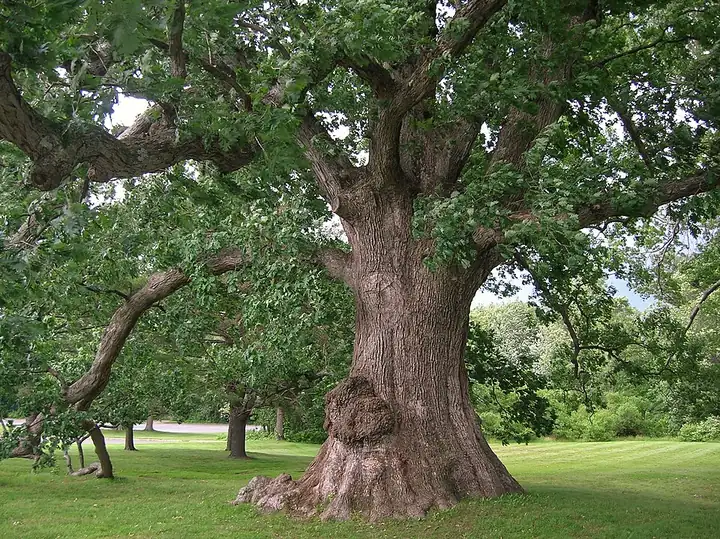
Oaks (white, red and pin oak)
Quercus alba (white oak), Q. rubra (northern red oak), Q. palustris (pin oak) · Beech family (Fagaceae)
| Hardiness zones | 3 to 9 |
|---|---|
| Sun | full sun |
| Water | moderate |
| Life cycle | perennial |
| Frost | Hardy: takes frost |
About Oaks (white, red and pin oak)
Oaks are long-lived native shade trees that feed a huge range of wildlife: jays, woodpeckers, turkeys, deer and bears eat the acorns, and the leaves feed the caterpillars of many butterflies and moths. This record covers three common yard oaks: slow, massive white oak; faster-growing northern red oak; and pin oak, a fast, pyramidal tree with drooping lower branches that needs acidic soil.
White oak zones 3-9; northern red oak and pin oak zones 4-8 (NC State). Pin oak yellows from iron chlorosis in alkaline soil and can eventually die.
When to plant
Timing is counted from your average last spring frost (and first fall frost). Sow & Tell works out the actual dates for your ZIP code.
Plant container or balled-and-burlapped trees. Container trees can go in any time the ground can be worked, but fall is the best season in the South because roots keep growing through mild weather (Clemson). Dig the hole no deeper than the root ball and at least twice as wide, keep the top roots level with the soil, and mulch 2-4 inches without touching the trunk. White oak has a deep taproot and is hard to move, so start with a young tree; pin oak is shallow-rooted and moves easily. Oaks are sensitive to soil compaction and need 60 ft or more of space (NC State).
Soil
Deep, well-drained, acidic soil; white and red oak handle dry spells once established, while pin oak likes medium to wet soil and tolerates some flooding (NC State).
Test the soil first. Loosen a wide planting area and mix 10-20 percent compost into the native soil you dig out; don't use uncomposted bark, and don't dig deeper than the root ball (Clemson).
Feeding
- Spring to early summer, after the tree is established, and only if a soil test or pale leaves and weak twig growth show a need: slow-release nitrogen fertilizer with a ratio near 3-1-1 or 3-1-2 (3-0-1 or 3-0-2 if the soil test shows enough phosphorus). Spread it evenly from just outside the trunk flare to the dripline and water it in. Clemson cites 2-4 lb of slow-release nitrogen per 1,000 sq ft per year, split into a spring and a late-summer feeding; follow your soil test.
- Late summer to early fall, the second half of the year's split feeding (only if a soil test calls for it): slow-release nitrogen fertilizer, same as spring. Apply the rest of the year's amount over the root zone and water in. Don't feed a drought-stressed tree in summer (Clemson).
First-year watering matters far more than fertilizer: water daily for the first 1-2 weeks, every 2-3 days until week 12, then weekly, using about 1-1.5 gallons per inch of trunk diameter, until the tree is established, roughly 1.5 years per inch of trunk (UMN). Don't count on rain unless it was over an inch. Don't compact, trench or pile soil over oak roots. In alkaline soil pin oak yellows from iron chlorosis; correct the pH rather than adding nitrogen (Clemson, NC State). Too much fertilizer can burn roots and push soft growth that pests and cold injure (Clemson).
Harvest
Catkins hang in spring (March-May). Acorns drop in fall; red oak acorns take two seasons to ripen, and trees may not bear until they are 15-25 years old (NC State).
Varieties (6)
Few named oak cultivars are documented; the three yard species are listed so gardeners can tell them apart.
| Variety | Type | Days | Notes |
|---|---|---|---|
| Aurea | Northern red oak cultivar | Golden-yellow young leaves; color likely fades in hot weather. | |
| Splendens | Northern red oak cultivar | Fine red fall color; not commonly sold. | |
| Green Pillar | Pin oak cultivar | Columnar pin oak. | |
| Northern red oak (Quercus rubra) | Species: red oak group | Moderate to fast; 50-75 ft tall and wide; bristle-tipped lobes, russet to scarlet fall color. | |
| Pin oak (Quercus palustris) | Species: red oak group | Fast; 50-70 ft tall, 40-60 ft wide; deeply cut leaves; drooping lower branches; needs acidic soil. | |
| White oak (Quercus alba) | Species: white oak group | Slow; 80-100 ft tall, about 80 ft wide; rounded-lobed leaves, purplish-brown fall color; hard to transplant. |
Pests to watch for
Spongy moth (formerly gypsy moth), Oak galls (gall wasps), Scale insects, Lace bugs (azalea and chrysanthemum lace bugs), Aphids, Leafminers, Sawflies (garden sawflies), Annual cicadas (dog-day cicadas), Winter moth, Cankerworms (fall and spring cankerworms), Dogwood borer
Diseases and problems
Oak wilt, Anthracnose, Oak leaf blister, Powdery mildew, Canker, Leaf spot, Iron chlorosis, Girdling roots, Armillaria root rot, Bacterial leaf scorch
In the kitchen
Acorns can be eaten once the bitter tannins are leached or boiled out (NC State).
Safety: Raw acorns and young leaves contain gallotannins; eating them can cause stomach pain, constipation and later bloody diarrhea, and acorns can block the gut (NC State, low severity).
Pets: Oak is not on the ASPCA's toxic plant list for dogs. NC State lists oaks as toxic to horses (leaves and acorns contain gallotannins).
Sources
- plants.ces.ncsu.edu
- plants.ces.ncsu.edu
- plants.ces.ncsu.edu
- extension.rutgers.edu
- extension.rutgers.edu
- aspca.org
- hgic.clemson.edu
- hgic.clemson.edu
- extension.umn.edu
Photo: Photo: Marty Aligata / Wikimedia Commons, CC BY-SA 3.0 (CC BY-SA 3.0). Photo resized for the web.

Planting dates and advice are general guidance; check with your local Cooperative Extension office for your area.