
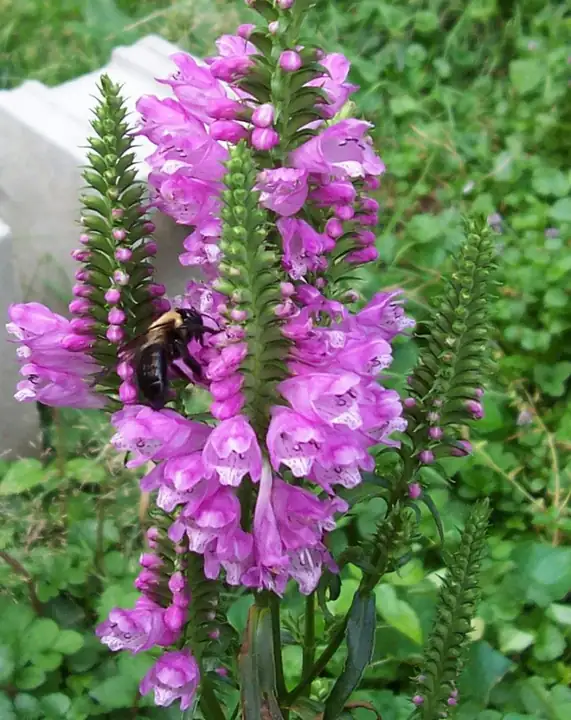
Obedient plant
Physostegia virginiana · Mint family (Lamiaceae)
| Hardiness zones | 2 to 9 |
|---|---|
| Sun | full sun to part shade |
| Water | moderate |
| Life cycle | perennial |
| Frost | Hardy: takes frost |
About Obedient plant
Obedient plant is a native wildflower with square stems and spikes of snapdragon-like pink, lavender or white flowers from midsummer to frost; push a flower sideways and it stays put, which gives it its name (NC State). It grows wild in wet meadows, prairies and riverbanks from Quebec to Minnesota and eastern South Dakota, south to Florida and Texas (Wildflower Center). Fair warning: it spreads hard by runners in rich, moist soil, so plant a less spreading kind like 'Miss Manners', divide clumps every year or two, or be ready to pull extras (NC State, Wildflower Center).
Hardy in zones 2-9 (NC State). It is native to most of the eastern and central U.S. and not listed as invasive, but it can be aggressive and weedy in damp, rich garden soil (NC State).
When to plant
Timing is counted from your average last spring frost (and first fall frost). Sow & Tell works out the actual dates for your ZIP code.
Plant or divide clumps in spring or fall (NC State). From seed, sow outdoors in fall, or chill damp seed for about 3 months at 40 F and sow in spring (Wildflower Center). Shallow roots make unwanted shoots easy to pull. We found no sourced day count to first bloom.
Soil
Moist, well-drained, moderately fertile soil; it takes clay, sand and poor drainage, and some drought (NC State, Wildflower Center). Rich soil makes it spread faster and flop.
No rich amendments needed: moderately fertile, moist, well-drained soil is best, and rich soil makes it spread faster and flop (NC State).
Feeding
- Early spring, only if a soil test shows a need: fertilizer only as a soil test recommends. Most gardens need none; extra fertilizer mainly makes this spreader more aggressive (NC State).
Rich, wet soil plus fertilizer makes it run and flop; divide clumps every year or two to keep it in bounds (NC State).
Harvest
Spikes open from the bottom up, from July into fall, often until the first frost (NC State). It makes a good cut flower, and taller stems may need staking (NC State).
Varieties (2)
NC State documents 2 cultivars; we found no other extension descriptions we could open.
| Variety | Type | Days | Notes |
|---|---|---|---|
| Miss Manners | Cultivar | Compact, 2-2.5 ft tall and wide, with white flowers; spreads much less than the species and rarely needs staking. | |
| Summer Snow | Cultivar | White flowers. |
Pests to watch for
Aphids
Diseases and problems
Black spot (fungal leaf spot)
In the kitchen
Safety: None of the sources we checked list it as poisonous, but it is not a food plant.
Pets: Not listed by the ASPCA.
Sources
Photo: Photo: LinBow / Wikimedia Commons, CC BY-SA 2.0 (CC BY-SA 2.0). Photo resized for the web.

Planting dates and advice are general guidance; check with your local Cooperative Extension office for your area.