
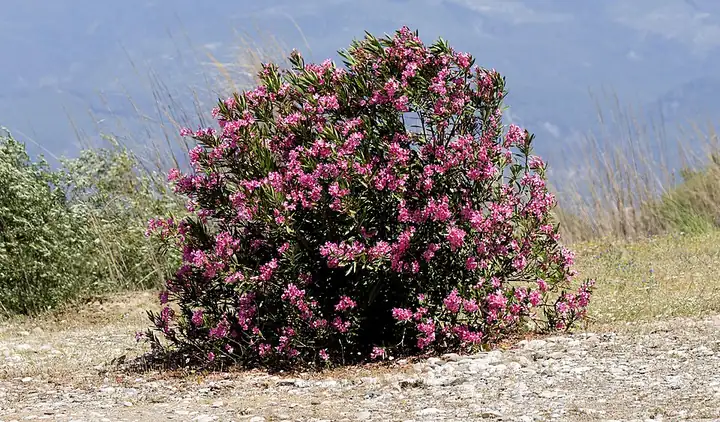
Oleander
Nerium oleander · Dogbane family (Apocynaceae)
| Hardiness zones | 8 to 11 |
|---|---|
| Sun | full sun |
| Water | low |
| Life cycle | perennial |
| Frost | Half-hardy: takes a light frost |
| Spacing | 60 to 84 inches |
About Oleander
Oleander is a fast-growing evergreen shrub or small tree from the Mediterranean and southern Asia that blooms from early summer into fall in white, yellow, salmon, pink and red (UF/IFAS, Clemson). It shrugs off heat, drought, poor soil and salt spray, so it is common in Florida, along the Gulf and Atlantic coasts and in other warm, dry places. Every part of it is deadly poisonous to people, pets and livestock, fresh or dried, and even smoke from burning the trimmings is toxic: plant it only where small children and animals won't chew it, and never burn it (NC State, Clemson, UF/IFAS).
Grows outdoors in zones 8-11; most kinds lose leaves or stems at about 15-20 F and regrow from the roots, and 'Hardy Red' and 'Hardy Pink' may survive sheltered spots in zone 7b (Clemson, UF/IFAS). Farther north, grow it in a pot and bring it indoors for winter (NC State).
When to plant
Timing is counted from your average last spring frost (and first fall frost). Sow & Tell works out the actual dates for your ZIP code.
Plant in full sun, where it blooms best; in shade it gets leggy and flowers little (UF/IFAS). For a screen, space plants 5-7 ft apart (UF/IFAS). It is hardy only in warm zones; water deeply until established, then only in long dry spells, and don't overwater. Don't plant it where small children play or where pets or livestock graze.
Soil
Almost any well-drained soil, including sand, clay, alkaline and poor soils; it does poorly in wet spots and tolerates salt spray and brackish water (Clemson, UF/IFAS, NC State).
Pick a well-drained, sunny spot; oleander grows in poor, sandy, clay or alkaline soil and needs no special prep, but test the soil before adding anything (UF/IFAS, Clemson).
Feeding
- Spring after new growth starts, only if a soil test shows a need: slow-release complete fertilizer in a 3:1:2 ratio, or what the soil test calls for. Spread it evenly over the root zone and water it in; a typical soil-test rate for shrubs is about 2 lb of 12-6-6 per 100 sq ft. Don't feed a drought-stressed plant in summer (Clemson). Follow a soil test.
Don't overwater or plant in wet spots (UF/IFAS, Clemson), and don't pinch or prune late in fall, when new growth can't harden before cold (Clemson). Watering, fertilizing or pruning that pushes lots of soft new shoots invites oleander aphids (UF/IFAS). Check new leaves for orange-and-black oleander caterpillars, which can strip a plant in a week; cut off and bag infested shoots, or use Bacillus thuringiensis (Bt) on small caterpillars, following the label (UF/IFAS).
Harvest
Blooms from early summer to mid-fall, and nearly all year in South Florida (Clemson, UF/IFAS). Flowers form on new growth, so prune in early spring, cutting out cold-damaged wood; snip off spent clusters to keep it blooming and stop seed pods (Clemson, NC State). Wear gloves when pruning, bag the trimmings for the trash, and never burn them (UF/IFAS).
Varieties (12)
Clemson, NC State and UF/IFAS document these 12 cultivars. UF/IFAS notes that nurseries often sell oleander by flower color rather than by name.
| Variety | Type | Days | Notes |
|---|---|---|---|
| Matilde Ferrier | Double-flowered | The most common yellow oleander, with double flowers on a plant over 8 ft tall. | |
| Little Red | Dwarf | Small, 3-6 ft tall and wide, with deep red flowers. | |
| Petite Pink | Dwarf | Dwarf, about 3-4 ft with light pruning, with light pink flowers. | |
| Petite Salmon | Dwarf | Dwarf, about 3-4 ft with light pruning, with salmon flowers. | |
| Algiers | Single-flowered | 5-8 ft tall with lots of single dark red flowers. | |
| Calypso | Single-flowered | Vigorous and cold hardy, 10-18 ft tall, with single cherry-red flowers. | |
| Cardinal Red | Single-flowered | About 6 ft tall and 10 ft wide with single bright red flowers. | |
| Hardy Pink | Single-flowered | Like 'Hardy Red' but with single salmon-pink flowers; hardier than the species. | |
| Hardy Red | Single-flowered | About 8 ft tall with single, very deep red flowers; the hardiest kind, surviving some sheltered Piedmont sites. | |
| Sealy Pink | Single-flowered | 8 ft or more tall and about 6 ft wide with single soft pink flowers. | |
| Sister Agnes | Single-flowered | Hardy and vigorous, 10-12 ft tall, with large single white flowers that drop cleanly. | |
| Variegated Twist of Pink | Variegated | 6-8 ft tall and wide with deep pink flowers and leaves edged in creamy white. |
Pests to watch for
Aphids, Scale insects, Mealybugs
Diseases and problems
Oleander leaf scorch (Xylella bacteria), Botryosphaeria dieback, Sphaeropsis gall (witches' broom), Leaf spot, Sooty mold, Armillaria root rot
In the kitchen
Safety: Deadly poisonous. Every part, including leaves, flowers, stems, bark, sap, seeds and roots, contains heart-affecting cardiac glycosides, fresh or dried; even small amounts can cause vomiting, stomach pain, dizziness, a slow or irregular pulse and death in people and animals (NC State, Clemson). Smoke from burning it is toxic to breathe, and the sap can irritate skin and eyes (UF/IFAS, Clemson). Never eat or chew any part; if any is swallowed, call Poison Help at 1-800-222-1222 right away.
Pets: Toxic to dogs, cats and horses (ASPCA): its cardiac glycosides can cause drooling, belly pain, diarrhea, colic, depression and death. UF/IFAS says to keep it away from pets and livestock.
Sources
- plants.ces.ncsu.edu
- hgic.clemson.edu
- gardeningsolutions.ifas.ufl.edu
- ask.ifas.ufl.edu
- ask.ifas.ufl.edu
- plantsservices.sc.egov.usda.gov
- aspca.org
- aspca.org
- aspca.org
- aspca.org
- hgic.clemson.edu
- extension.umn.edu
Photo: Photo: Zeynel Cebeci, CC BY-SA 4.0, via Wikimedia Commons (CC BY-SA 4.0). Photo resized for the web.

Planting dates and advice are general guidance; check with your local Cooperative Extension office for your area.