
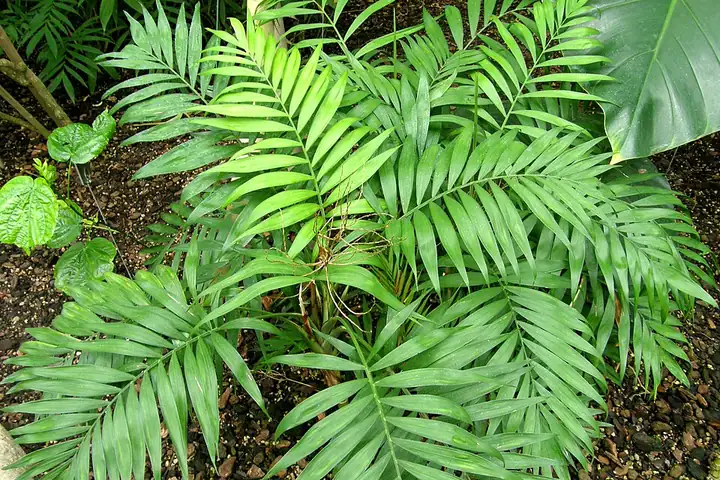
Parlor palm
Chamaedorea elegans (syn. Neanthe bella, Collinia elegans) · Palm family (Arecaceae)
| Hardiness zones | 10 to 12 |
|---|---|
| Sun | shade |
| Water | moderate |
| Life cycle | perennial |
| Frost | Tender: killed by frost |
About Parlor palm
The parlor palm is a small, slow understory palm from the rainforests of southern Mexico and northern Central America with slender bamboo-like stems and soft, feathery fronds (NC State). It has been a houseplant since Victorian parlors because it tolerates low light, cool rooms and ordinary humidity better than most palms, and it is safe around cats and dogs. Growers pot several seedlings together, so a 'plant' is usually a small grove.
Hardy outdoors only in zones 10-12 (NC State); it is grown indoors everywhere and can summer outdoors in shade once nights stay above 60 F.
When to plant
Timing is counted from your average last spring frost (and first fall frost). Sow & Tell works out the actual dates for your ZIP code.
Bought as a nursery plant; palms are grown from seed, and a pot with several stems can sometimes be divided (Clemson).
Growing it indoors
- Light: Tolerates low light and deep shade well and does fine in a north or east window; Clemson wants at least 10 hours of bright indirect light for good growth, and direct sun scorches the fronds (NC State, Clemson).
- Water: Water thoroughly when the surface dries, let it drain and dump the saucer, then let the mix dry only slightly before the next watering; overwatering is the usual killer, though it tolerates a short dry spell (NC State, Clemson). Water less in winter.
- Humidity: Likes moderate to high humidity but adapts; when the room drops below 50% set it on a tray of wet gravel or run a humidifier, since dry air invites spider mites (Clemson).
- Temperature: Clemson gives 60 F as its winter minimum, with 70-80 F days; keep it out of cold drafts near windows, doors and vents, and never below 45 F (NC State, Clemson).
- Feeding: A slow-release palm fertilizer with micronutrients, such as 12-4-12 or 8-2-12, two or three times a year in spring and summer only, none in winter; too much fertilizer browns the lower leaf tips (Clemson).
- Repotting: Only when roots fill the pot, about every 2-3 years, in spring or early summer, one size up; the roots are fragile, so handle the root ball gently (Clemson, NC State).
Soil
A well-drained, humus-rich houseplant or container mix in a pot with drainage holes (NC State, Clemson).
Pot in a porous, well-drained mix rich in organic matter, in a container with drainage holes (Clemson, NC State).
Feeding
- Spring and summer, while actively growing: slow-release palm fertilizer with micronutrients, such as 12-4-12 or 8-2-12. Two or three times a year, following the label (Clemson).
- Fall and winter: none. No feeding while growth has stopped; many palms like a cooler 55-60 F rest then (Clemson).
Excess fertilizer browns the lower leaf tips and too much iron spots the fronds; drench the pot twice a year to leach salts (Clemson).
Varieties (1)
NC State names one cultivar; the plain species is what is sold.
| Variety | Type | Days | Notes |
|---|---|---|---|
| Variegata | Variegated | Green fronds streaked with white; rarely seen for sale. |
Pests to watch for
Twospotted spider mite, Mealybugs, Scale insects, Thrips
Diseases and problems
Root and crown rot, Brown leaf tips (salts, dry air)
In the kitchen
Safety: The leaves and stems are not poisonous; NC State rates it low severity because the pulp and juice of the rare fruit contain crystals that irritate sensitive skin, so handle fruit with gloves.
Pets: Non-toxic to dogs and cats (ASPCA); Clemson HGIC and NC State list it among pet-safe houseplants.
Sources
Photo: Photo: Bachelot Pierre J-P, CC BY-SA 3.0, via Wikimedia Commons (CC BY-SA 3.0). Photo resized for the web.

Planting dates and advice are general guidance; check with your local Cooperative Extension office for your area.