
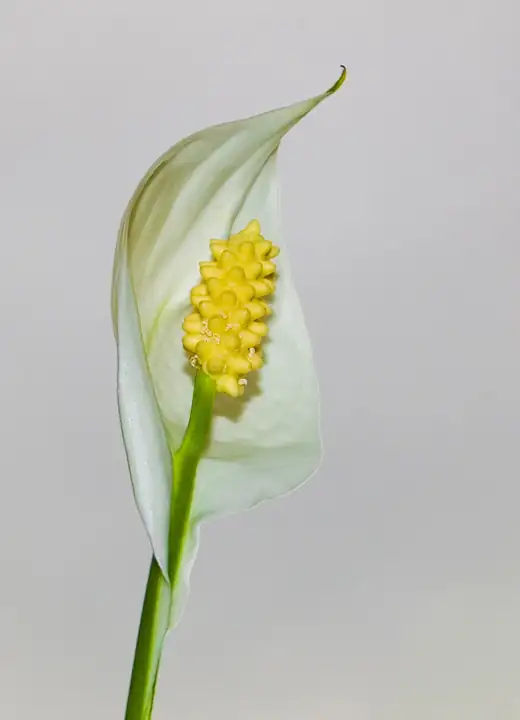
Peace lily
Spathiphyllum wallisii and hybrids · Arum family (Araceae)
| Hardiness zones | 11 to 12 |
|---|---|
| Sun | shade |
| Water | moderate |
| Life cycle | perennial |
| Frost | Tender: killed by frost |
About Peace lily
The peace lily is a glossy, dark-leaved clump from the rainforests of Mexico, tropical America and the western Pacific that sends up white sail-like flowers, really a spathe around a cream spadix, above the foliage at any season (NC State). It is not a true lily. It blooms in less light than almost any other flowering houseplant, wilts dramatically when thirsty and springs back after a drink, and is one of the easiest plants to keep for years.
Hardy outdoors only in zones 11-12 (NC State); it is grown indoors everywhere and can summer outdoors in shade once nights stay above 60 F.
When to plant
Timing is counted from your average last spring frost (and first fall frost). Sow & Tell works out the actual dates for your ZIP code.
Usually bought as a nursery plant in bloom or started from a division of an older clump (NC State).
Growing it indoors
- Light: Blooms best in bright indirect light and tolerates low light, where it may stop flowering; direct sun scorches the leaves (Clemson, NC State).
- Water: Keep the mix moist but not soggy, letting it dry only slightly between waterings, use room-temperature water and never leave the pot standing in a saucer of water, which rots the roots; bottom watering works well (Clemson, NC State). It wilts dramatically when dry and perks up after a drink, but repeated wilting yellows the leaves and browns the edges.
- Humidity: Low humidity, direct sun and dry soil all brown the leaf tips (NC State); keep it away from heat and air-conditioning vents (Clemson).
- Temperature: Likes 68-85 F days with nights about 10 F cooler; cold damage can start below 60 F, and long spells below 40 F hurt roots and stems (Clemson, NC State).
- Feeding: A balanced liquid houseplant fertilizer such as 20-20-20 at one-quarter strength every 6-8 weeks in spring and summer, flushing the mix with plain water between feedings; over-feeding browns the leaf tips and roots (Clemson, NC State).
- Repotting: Repot when roots grow out the drainage holes or circle the surface, into a pot only 1-2 inches wider, ideally in late winter or during the growing season; it flowers best a little pot-bound (Clemson, NC State).
Soil
A potting mix high in organic matter with good drainage; it prefers a slightly acidic mix (NC State).
Pot in a potting mix high in organic matter with good drainage (NC State).
Feeding
- Spring and summer: balanced liquid houseplant fertilizer such as 20-20-20 at one-quarter strength. Every 6-8 weeks, flushing the mix with plain water between feedings to wash out salts (Clemson, NC State).
- Fall and winter: none. Stop feeding while growth slows (Clemson, MU Extension).
Over-fertilizing and salt buildup burn the leaf tips and roots brown; quarter strength is enough (Clemson, NC State).
Harvest
It flowers freely at any season once it is more than a year old and gets enough light; each white spathe turns pale green after about 10 days and lasts at least another month (NC State, Clemson). Cut spent stalks off at the base.
Varieties (10)
Clemson and NC State Extension name 10 cultivars.
| Variety | Type | Days | Notes |
|---|---|---|---|
| Petite | Dwarf | A small kind bred for windowsill culture. | |
| Little Angel | Dwarf, 12-15 in | Dwarf, 12-15 in. | |
| Wallisii | Dwarf, 12-15 in | The compact species from Colombia and Venezuela, 12-15 in, with 3 in blooms. | |
| Starlight | Dwarf, 12-18 in | Dwarf, 12-18 in. | |
| Sensation | Giant, to 6 ft | The largest commercial cultivar, up to 6 ft tall and wide, with big ribbed leaves. | |
| Mauna Loa (Mauna Loa Supreme) | Standard, 2-3 ft | The classic florist's peace lily, 2-3 ft, with white spathes up to 4 in wide and leaves to nearly 3 ft (Clemson, NC State). | |
| Allison | Standard, about 2 ft | Compact, about 24 in, and flowers freely. | |
| Jetty | Standard, about 2 ft | 19-24 in tall. | |
| Gemini | Variegated dwarf | Compact, to about 12 in, with irregular white stripes. | |
| Domino | Variegated, 1-3 ft | Deep green leaves streaked white to cream; about 30 in tall and wide. |
Pests to watch for
Mealybugs, Fungus gnats, Twospotted spider mite, Scale insects
Diseases and problems
Root and crown rot, Stem rot, Magnesium deficiency
In the kitchen
Safety: The leaves contain calcium oxalate crystals; chewing them causes severe mouth pain, burning of the lips, tongue and throat, drooling, vomiting and trouble swallowing (NC State rates it medium severity). Keep it from small children. It is not a true lily, but it is still not safe to eat.
Pets: Toxic to dogs and cats (ASPCA): insoluble calcium oxalates cause oral irritation, intense burning of the mouth, tongue and lips, heavy drooling, vomiting and trouble swallowing. NC State also lists it as a problem for horses.
Sources
Photo: Photo: Peter Fiskerstrand, Public domain, via Wikimedia Commons. Photo resized for the web.

Planting dates and advice are general guidance; check with your local Cooperative Extension office for your area.