
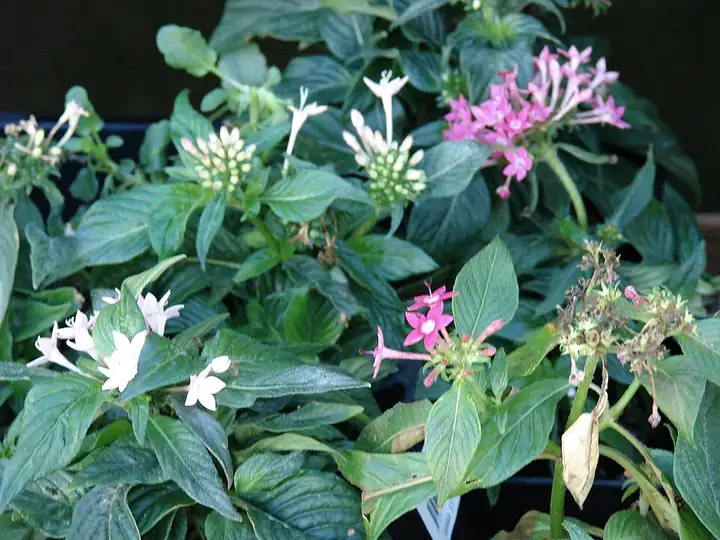
Pentas (Egyptian star flower)
Pentas lanceolata · Coffee family (Rubiaceae)
| Hardiness zones | 10 to 11 |
|---|---|
| Sun | full sun to part shade |
| Water | moderate |
| Life cycle | tender perennial (grown as an annual) |
| Frost | Tender: killed by frost |
| Spacing | 12 to 24 inches |
About Pentas (Egyptian star flower)
Pentas are bushy plants topped all summer with flat, 3-inch clusters of small star-shaped flowers in red, pink, lavender and white. They are one of the top butterfly plants in extension demonstration gardens, and the red and deep pink ones draw hummingbirds. They take heat and humidity well and keep blooming until frost.
Hardy only in frost-free zones (NC State lists 10-11; UF/IFAS lists 8b-11); everywhere else it's grown as a summer annual.
When to plant
Timing is counted from your average last spring frost (and first fall frost). Sow & Tell works out the actual dates for your ZIP code.
- Start seeds indoors: 8 to 10 weeks before the last frost
- Set out plants: up to 2 weeks after the last frost
NC State says to start seed indoors 8-10 weeks before the last frost, but Iowa State notes seedlings need 16 weeks or more to reach a good size, so most gardeners buy plants. Set them out after frost; LSU AgCenter spaces them 12-16 inches apart and UF/IFAS 18-24 inches for mass plantings.
Soil
Well-drained soil rich in organic matter; NC State lists acid soil, and plants should dry a little between waterings.
Plant in a well-prepared, raised bed of well-drained soil with organic matter; follow a soil test before adding fertilizer.
Feeding
- During summer, if plants look pale or slow: liquid fertilizer. LSU AgCenter says an occasional liquid feeding can keep plants looking their best; pentas don't need heavy feeding.
Soggy soil causes trouble; water deeply once a week without rain rather than keeping soil wet.
Harvest
Blooms from late spring or early summer until frost (year-round in frost-free areas). Pentas mostly clean themselves up, but snipping faded clusters and lightly pinching leggy stems keeps flowers coming (LSU AgCenter). Cut clusters last 3-5 days in a vase.
Varieties (18)
| Variety | Type | Days | Notes |
|---|---|---|---|
| New Look series | Compact | ||
| Lucky Star Dark Red | Compact, seed-grown | Red; 17 in tall and 26 in wide in Penn State trials. | |
| Lucky Star Lipstick | Compact, seed-grown | Red; 16 in tall and 29 in wide in Penn State container trials. | |
| Lucky Star series | Compact, seed-grown | 10-16 in tall and 12-14 in wide; colors include Lipstick, White Improved, Deep Pink, Lavender, Pink, Violet and Dark Red. | |
| Lucky Star Violet | Compact, seed-grown | Violet; 16 in tall and 27 in wide in Penn State trials. | |
| Glitterati Purple Star | Seed-grown | Purple; 16 in tall and 20 in wide in Penn State trials. | |
| Glitterati Red Star | Seed-grown | Red; 17 in tall and 27 in wide in Penn State trials. | |
| Graffiti 20/20 Flirty Pink | Seed-grown | Pink; 22 in tall and 27 in wide in Penn State trials. | |
| Graffiti 20/20 White | Seed-grown | White; 20 in tall and 29 in wide in Penn State trials. | |
| Starcluster Cascade Red | Trailing | Red; spreading, cascading habit, 28 in tall and wide in Penn State trials. | |
| Butterfly Cherry Red | Upright | Cherry-red flower clusters. | |
| Butterfly Deep Pink | Upright | Deep pink flower clusters. | |
| Butterfly series | Upright | 18-24 in tall and 12-18 in wide; colors include Deep Rose, White, Blush, Deep Pink, Light Lavender, Lavender and Red. | |
| Kaleidoscope Appleblossom | Upright | ||
| Starcluster Light Pink | Upright | Pink; 15 in tall and 22 in wide in Penn State trials. | |
| Starla Deep Rose | Upright | ||
| Sunstar Red | Upright | Red; 21 in tall and 26 in wide in Penn State trials. | |
| Stars and Stripes | Variegated foliage | Bright red flowers over cream-variegated leaves; tolerates heat and humidity. |
Pests to watch for
Twospotted spider mite, Aphids
In the kitchen
Pets: We found no ASPCA entry for pentas, so we can't say it is pet-safe; discourage pets from chewing it.
Sources
- plants.ces.ncsu.edu
- journals.flvc.org
- blogs.ifas.ufl.edu
- extension.iastate.edu
- lsuagcenter.com
- lsuagcenter.com
- aspca.org
Photo: Photo: Forest and Kim Starr, CC BY 3.0, via Wikimedia Commons (CC BY 3.0). Photo resized for the web.

Planting dates and advice are general guidance; check with your local Cooperative Extension office for your area.