
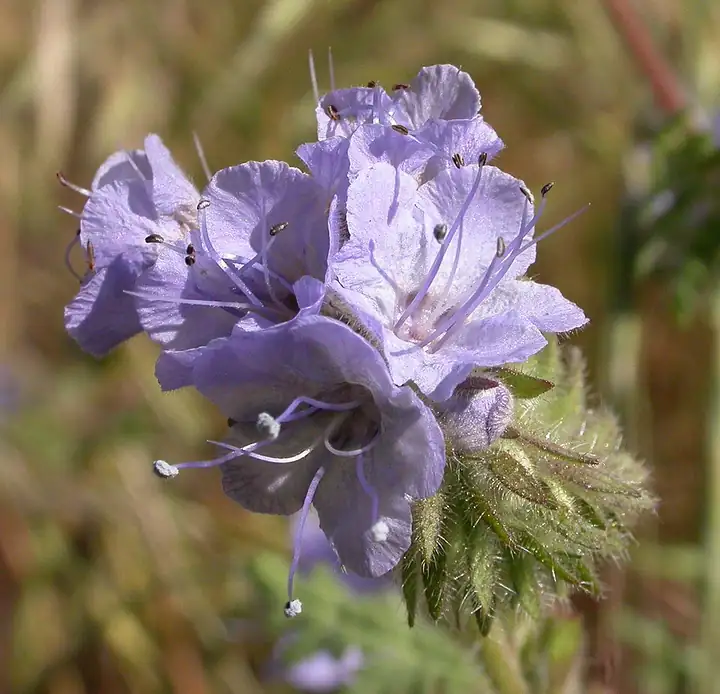
Phacelia (lacy phacelia)
Phacelia tanacetifolia · Borage family (Boraginaceae)
| Hardiness zones | 2 to 11 |
|---|---|
| Sun | full sun |
| Water | low |
| Life cycle | annual |
| Frost | Half-hardy: takes a light frost |
| Spacing | 12 to 36 inches |
About Phacelia (lacy phacelia)
Lacy phacelia is a fast annual with fern-like leaves and curled clusters of lavender-blue flowers. It ranks among the top pollen plants for honey bees and also draws bumble bees, hover flies and other beneficial insects.
Grown as an annual; it winter-kills at about 18 F, so it is not winter-hardy in many places (USDA NRCS). In its native California it sprouts with the fall rains and blooms in spring.
When to plant
Timing is counted from your average last spring frost (and first fall frost). Sow & Tell works out the actual dates for your ZIP code.
- Sow seeds outdoors: up to 2 weeks after the last frost
Sow seed about 1/4 inch deep after the last frost (NC State; USDA NRCS); untreated seed sprouts in 15-30 days, and nicking the seed coat and soaking it overnight can help. It self-seeds and can become weedy if not managed.
Soil
Well-drained sandy or gravelly soil; tolerates poor soil but not waterlogging.
Sow in open, well-drained, light-textured soil with a pH of about 6.4 to 8.5; it grows best in fertile soil and does poorly in soggy ground.
Feeding
Avoid waterlogged soil. Phacelia does poorly in very low-fertility soil.
Harvest
Grown for its flowers and the insects they feed rather than a harvest; in its native range it blooms April through June, and longer in cooler regions (USDA NRCS).
Varieties (4)
USDA NRCS says named cultivars of lacy phacelia have been bred in Europe but are not available in the US. Only one named cultivar (of Miami mist) was found; the other entries are species.
| Variety | Type | Days | Notes |
|---|---|---|---|
| Fernleaf phacelia | P. bipinnatifida | Native biennial, 1-3 ft, with blue to purple flowers for about a month in spring. Good for shady woodland gardens. | |
| Hayefield Gold | P. purshii | Miami mist selection with yellowish leaves. | |
| Miami mist | P. purshii | Native annual, 1-2 ft, with fringed blue to lavender (sometimes white) flowers in spring into summer. Likes moist, well-drained soil in sun or part shade. | |
| Lacy phacelia | P. tanacetifolia | Annual, 1-3 ft, with blue to purple bell-shaped flowers that open in sequence. Among the top pollen plants for honey bees; also used as a fast cover crop. Winter-hardy to about 18°F. |
In the kitchen
Pets: Not listed as toxic by the ASPCA
Sources
Photo: Photo: Curtis Clark, CC BY-SA 2.5, via Wikimedia Commons (CC BY-SA 2.5). Photo resized for the web.

Planting dates and advice are general guidance; check with your local Cooperative Extension office for your area.