
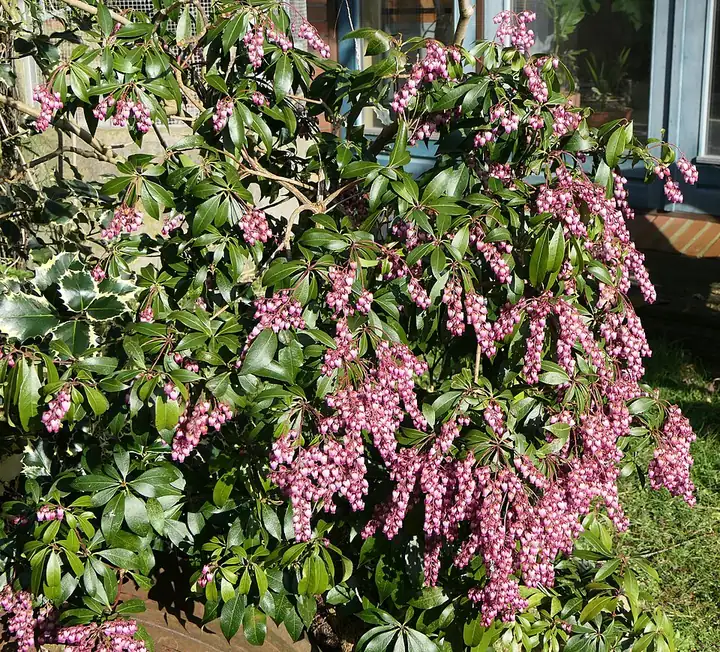
Japanese pieris
Pieris japonica (Japanese pieris, Japanese andromeda) · Heath family (Ericaceae)
| Hardiness zones | 4 to 8 |
|---|---|
| Sun | full sun to part shade |
| Water | moderate |
| Life cycle | perennial |
| Frost | Hardy: takes frost |
About Japanese pieris
Japanese pieris is an Asian broadleaf evergreen with drooping chains of small, urn-shaped flowers in spring and new leaves in bronze, red or pink. Its flower buds are showy from late summer through winter. It wants the same acid, moist, rich soil as rhododendrons, deer usually leave it alone, and it is highly poisonous if eaten (NC State).
Hardy in zones 4b-8 (NC State); shelter it from winter wind, and give it some shade in Southern gardens.
When to plant
Timing is counted from your average last spring frost (and first fall frost). Sow & Tell works out the actual dates for your ZIP code.
Plant container shrubs in spring or fall and water deeply until established (UMN).
Soil
Moist, well-drained, acid soil high in organic matter (NC State).
Pieris needs moist, well-drained, acid soil high in organic matter (NC State). Test the soil first.
Feeding
- Spring to early summer after new growth starts, only if a soil test shows a need: slow-release complete fertilizer in a 3:1:2 ratio, or what the soil test calls for. Spread evenly from the trunk out to the drip line and water it in; a typical soil-test rate for shrubs is about 2 lb of 12-6-6 per 100 sq ft (Clemson). Follow a soil test.
Water is what new shrubs need most: daily for the first 2 weeks, every 2-3 days through week 12, then weekly until the roots spread (at least two growing seasons), using about a quarter to a third of the nursery pot's volume each time (UMN). Too much fertilizer burns roots and pushes leaves at the expense of flowers; don't feed drought-stressed shrubs (Clemson).
Harvest
Blooms in spring for a long season. Prune right after flowering if needed, since next year's buds form on old growth (NC State).
Varieties (8)
NC State documents these.
| Variety | Type | Days | Notes |
|---|---|---|---|
| Cavatine | Dwarf | Low, compact mound; white flowers. | |
| Prelude | Dwarf | 2-3 ft; white flowers. | |
| Bert Chandler | Japanese pieris | Salmon-pink new leaves maturing to light green; white flowers. | |
| Dorothy Wyckoff | Japanese pieris | Red buds open pale pink to white. | |
| Flaming Silver | Japanese pieris | Red young leaves edged pink that turn silver-white; white flowers. | |
| Mountain Fire | Japanese pieris | Vivid red new growth; white flowers. | |
| Scarlet O'Hara | Japanese pieris | Narrow; bronze new growth; white flowers. | |
| Valley Rose | Japanese pieris | Pastel pink flowers; deep green leaves. |
Pests to watch for
Lace bugs (azalea and chrysanthemum lace bugs)
Diseases and problems
Phytophthora root rot, Leaf spot, Dieback, Leaf scorch
In the kitchen
Safety: NC State rates poisoning as high severity: grayanotoxins in the leaves, flowers, nectar and sap can cause salivation, vomiting, weakness, convulsions and heart failure, and can be fatal.
Pets: Toxic to dogs and cats (ASPCA): grayanotoxins cause vomiting, diarrhea, drooling, weakness, low blood pressure, collapse and even death, and a few leaves can be enough. NC State also lists it as a problem for horses.
Sources
Photo: Photo: 5snake5 / Wikimedia Commons, CC0 (CC0). Photo resized for the web.

Planting dates and advice are general guidance; check with your local Cooperative Extension office for your area.