
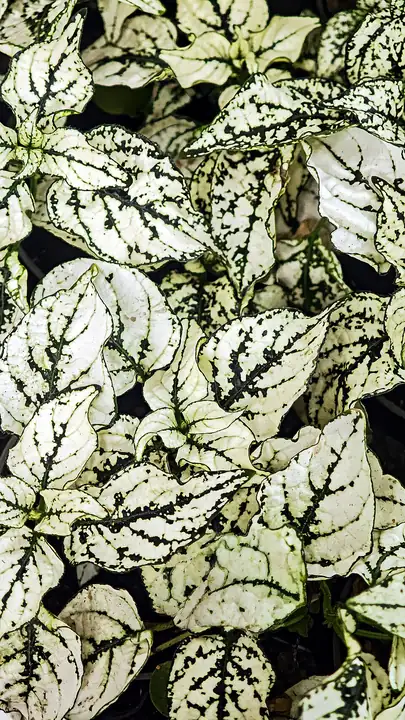
Polka dot plant
Hypoestes phyllostachya (formerly H. sanguinolenta) · Acanthus family (Acanthaceae)
| Hardiness zones | 10 to 11 |
|---|---|
| Sun | part shade |
| Water | moderate |
| Life cycle | perennial |
| Frost | Tender: killed by frost |
About Polka dot plant
The polka dot plant is a bushy little foliage plant from Madagascar whose soft green leaves are freckled or splashed with pink, red or white (NC State, Wisconsin). Once mostly a novelty houseplant, it is now also sold as a shade bedding annual. It grows fast and gets leggy with age and in low light, so it is pinched often and restarted from cuttings now and then. In Florida, UF/IFAS predicts it will be invasive and doesn't recommend planting it outdoors.
Hardy outdoors only in zones 10-11, where it can reseed freely (NC State, Wisconsin) and UF/IFAS rates it a high invasion risk in Florida; elsewhere it is grown indoors or as a summer annual and can summer outdoors in shade once nights stay above 50 F (Wisconsin).
When to plant
Timing is counted from your average last spring frost (and first fall frost). Sow & Tell works out the actual dates for your ZIP code.
Usually bought as a nursery or bedding plant, or started from 4-in stem cuttings or from seed, which can sprout in as little as 4 days at 68 F (Wisconsin).
Growing it indoors
- Light: Bright, filtered light gives the best color; it tolerates some sun, but strong direct sun can crinkle and curl the leaves, and in dim light the spots fade and the stems stretch (NC State, Wisconsin).
- Water: Water thoroughly and let the surface dry slightly between waterings while it is growing; it is somewhat drought tolerant but grows better with steady water (Wisconsin). It is prone to root rot in soggy mix, so empty the saucer and water less in winter.
- Humidity: It prefers humid air; in dry winter rooms, mist it now and then (Wisconsin).
- Temperature: Growth is poor until temperatures are above 60 F, and it should not go outdoors until temperatures stay above 50 F (Wisconsin); keep it out of cold window drafts.
- Feeding: Once established, feed periodically with a dilute liquid fertilizer while it is growing (Wisconsin); MU Extension's general rule is about monthly when new growth is showing and none in winter.
- Repotting: Wisconsin gives no repotting schedule and notes that houseplants get leggy and eventually need replacing, so restart an old, lanky plant from cuttings rather than moving it up a pot size.
Soil
A porous, well-drained potting mix high in organic matter such as peat moss (Wisconsin, NC State).
Pot in a porous mix high in organic matter, such as one with peat moss, in a container that drains well (Wisconsin).
Feeding
- Once established, spring through summer while it is growing: dilute liquid fertilizer. Feed periodically (Wisconsin); MU Extension's general rule is about once a month when new growth is showing.
- Winter, or whenever growth stops: none. Skip feeding until new growth starts (MU Extension).
Pinch it regularly instead of pushing growth with extra fertilizer; legginess comes from age and low light (Wisconsin).
Varieties (7)
NC State and Wisconsin Horticulture name the same 7 cultivars and series.
| Variety | Type | Days | Notes |
|---|---|---|---|
| Confetti | Mixed series | A compact series about 8 in tall in white, pink, red, carmine rose and burgundy, often sold as a mix; more vigorous, so it fills in fast. | |
| Splash | Mixed series | Large splashes of pink, red, rose or white against green. | |
| Pink Brocade | Pink spotted | Leaves mottled with pink spots. | |
| Pink Dot | Pink spotted | Green leaves with pink spots. | |
| Purpuriana | Purple | Purplish leaves. | |
| Carmina | Red spotted | Bright red splotches on green leaves. | |
| Wit | White marbled | Leaves marbled with white. |
Pests to watch for
Whiteflies, Aphids, Mealybugs
Diseases and problems
Powdery mildew, Root and crown rot
In the kitchen
Safety: NC State tags it non-toxic, and none of the Extension pages we opened list a hazard to people.
Pets: Non-toxic to dogs, cats and horses (ASPCA), though the ASPCA notes that eating it may cause mild vomiting and diarrhea; the cause is unknown.
Sources
Photo: Photo: Didier Descouens, CC BY-SA 4.0, via Wikimedia Commons (CC BY-SA 4.0). Photo resized for the web.

Planting dates and advice are general guidance; check with your local Cooperative Extension office for your area.