
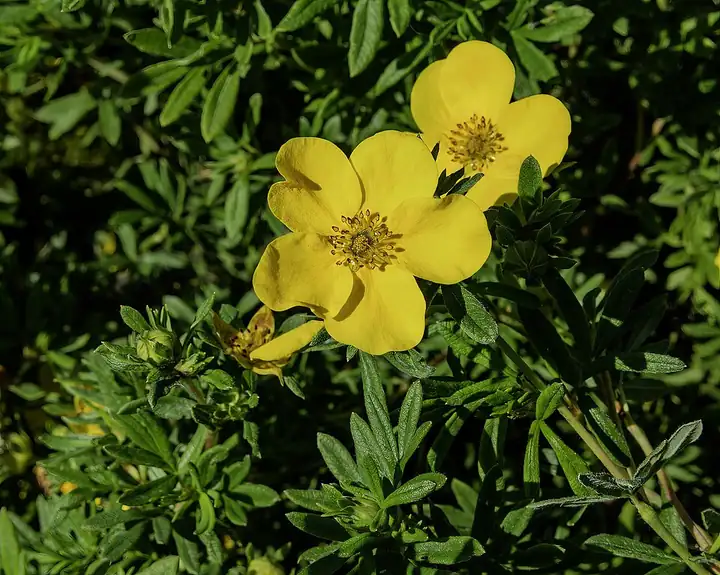
Shrubby cinquefoil (potentilla)
Dasiphora fruticosa (syn. Potentilla fruticosa, Pentaphylloides fruticosa) · Rose family (Rosaceae)
| Hardiness zones | 2 to 7 |
|---|---|
| Sun | full sun to part shade |
| Water | moderate |
| Life cycle | perennial |
| Frost | Hardy: takes frost |
About Shrubby cinquefoil (potentilla)
Shrubby cinquefoil is a small, tidy shrub that covers itself in bright yellow (or white, pink or orange) five-petaled flowers from early summer until frost. It's native across the northern U.S. and Canada, from New England and the Great Lakes west through the Rockies to Alaska and California, in fens, wet meadows, grasslands and forest edges (NC State, wildflower.org, USDA Forest Service). It's very cold hardy and shrugs off poor soil, road salt and drought, but it struggles in the hot, humid Southeast (NC State, Morton Arboretum). It isn't the weedy sulfur cinquefoil (Potentilla recta), a non-native perennial that Penn State calls invasive.
Hardy in zones 2-7 and best where summers are cool (NC State); it does poorly in humid southern heat.
When to plant
Timing is counted from your average last spring frost (and first fall frost). Sow & Tell works out the actual dates for your ZIP code.
Plant container shrubs in spring or fall and water deeply until established, at least two growing seasons (UMN). Its fibrous roots make it easy to transplant (Morton Arboretum).
Soil
Any well-drained soil, including clay, sand, poor, rocky or alkaline soil; not for permanently wet sites. Drought tolerant once established and tolerant of road salt (Morton Arboretum, NC State).
Any well-drained soil works; test the soil before adding anything (Clemson, Morton Arboretum).
Feeding
- Spring to early summer after new growth starts, only if a soil test or poor growth shows a need: slow-release complete fertilizer in a 3:1:2 or 3:1:1 ratio, or what the soil test calls for. Spread it evenly from the stems out to the drip line and water it in; a typical rate for shrubs is about 2 lb of 12-6-6 per 100 sq ft (Clemson). Follow a soil test.
Water is what new shrubs need most: daily for the first 2 weeks, every 2-3 days through week 12, then weekly until the roots spread, at least two growing seasons, using about a quarter to a third of the nursery pot's volume each time (UMN). Too much nitrogen gives leaves at the expense of flowers (Clemson); spider mites can be a problem in hot weather (Morton Arboretum).
Harvest
Blooms from June until frost, heaviest in full sun (Morton Arboretum, NC State). In late winter or early spring, remove a third of the oldest stems, or cut the whole shrub nearly to the ground every few years to renew a ragged plant (Morton Arboretum, NC State).
Varieties (15)
| Variety | Type | Days | Notes |
|---|---|---|---|
| Abbotswood | White flowers over blue-green leaves. | ||
| Coronation Triumph | Mounded, about 4 ft, with a long bloom season. | ||
| Gold Drop ('Farreri') | Yellow flowers all season. | ||
| Goldfinger | Compact and mounded, about 3 ft; large bright yellow flowers 1-2 in. across. | ||
| Hurstbourne | 2-4 ft tall and wide; yellow flowers. | ||
| Jackmannii | Larger rounded plant with deep yellow flowers all summer. | ||
| Katherine Dykes | Spreading, arching, 2-3 ft; blooms all season. | ||
| Mango Tango ('UMan') | Orange to red bicolor flowers from late spring to frost; 2-3 ft, gray-green leaves. | ||
| McKay's White | Creamy white flowers; 2-2.5 ft tall, 2-3 ft wide; handles summer heat. | ||
| Pink Beauty | Clear pink flowers; about 2-3 ft, rounded. | ||
| Primrose Beauty | Light yellow flowers from late spring to frost; silvery-gray leaves. | ||
| Snowbird | Double white flowers. | ||
| Sunset | Low and spreading, about 16 in.; yellow flowers with orange-red tones. | ||
| Tangerine | Yellow flowers flushed orange-copper; about 2 ft tall and wide. | ||
| Yellow Gem | Low, spreading groundcover with reddish young twigs and gray-green leaves. |
Pests to watch for
Twospotted spider mite
Diseases and problems
Leaf spot, Powdery mildew
In the kitchen
Safety: No toxicity is listed in the extension sources we used.
Pets: Non-toxic to dogs, cats and horses (ASPCA lists cinquefoil, Potentilla spp., including shrubby cinquefoil).
Sources
- plants.ces.ncsu.edu
- wildflower.org
- mortonarb.org
- fs.usda.gov
- extension.psu.edu
- extension.umn.edu
- extension.rutgers.edu
- aspca.org
- hgic.clemson.edu
Photo: Photo: Didier Descouens / Wikimedia Commons, CC BY-SA 4.0 (CC BY-SA 4.0). Photo resized for the web.

Planting dates and advice are general guidance; check with your local Cooperative Extension office for your area.