
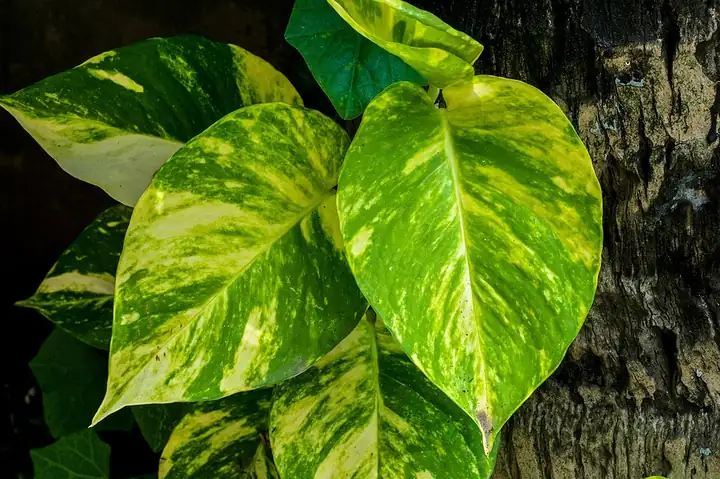
Pothos
Epipremnum aureum (formerly Scindapsus aureus) · Arum family (Araceae)
| Hardiness zones | 10 to 13 |
|---|---|
| Sun | shade |
| Water | low |
| Life cycle | perennial |
| Frost | Tender: killed by frost |
About Pothos
Pothos, also sold as golden pothos or devil's ivy, is a tropical vine from the Solomon and Society Islands with glossy heart-shaped leaves splashed in yellow, white or cream. It is one of the most forgiving houseplants: it trails from a shelf or hanging basket, climbs a pole with its aerial roots, survives long spells in dim light and roots from a cutting dropped in a glass of water (NC State, Penn State). Outdoors in Florida it escapes into hammocks and floodplain forests, so UF/IFAS says to keep it indoors there.
None of the Extension pages we opened give a hardiness range. It is a frost-tender tropical vine grown indoors everywhere, and it can summer outdoors in shade once nights stay above about 60 F; in Florida UF/IFAS rates it a high invasion risk and says not to plant it outside.
When to plant
Timing is counted from your average last spring frost (and first fall frost). Sow & Tell works out the actual dates for your ZIP code.
Usually bought as a nursery plant or started from a stem cutting rooted in water or moist mix (NC State, Penn State).
Growing it indoors
- Light: Survives long stretches in low light, but the variegation fades and growth slows, and direct sun yellows the leaves (NC State, Penn State); the all-green 'Jade' does best in dim rooms.
- Water: Water when the mix has dried, soak it until water runs out the bottom, then let it dry again; overwatering blackens leaf edges and rots the roots, so err on the dry side (NC State, Penn State). A drooping vine is usually just thirsty and perks up within hours of a drink; water less in winter.
- Humidity: Ordinary room humidity is fine; a tray of wet pebbles or a humidifier helps in dry winter air (NC State).
- Temperature: Happy at normal room temperatures of 60-80 F (Penn State); MU Extension suggests nights around 65 F, and it should never see frost.
- Feeding: Penn State feeds a balanced houseplant fertilizer every two weeks spring through fall and monthly in winter, while NC State says every other month with none during the winter rest; anything in that range keeps it growing.
- Repotting: Repot each spring into a pot one size larger with fresh soilless mix, or trim the roots and up to a third of the vines and put it back in the same pot with fresh soil; go easy on water afterward (Penn State).
Soil
A well-drained, soilless potting mix in a pot with a drainage hole; it rots in mix that stays wet (NC State, Penn State).
Pot in a well-drained soilless potting mix in a container with a drainage hole (NC State, Penn State).
Feeding
- Spring through fall, while new leaves are coming: balanced water-soluble houseplant fertilizer. Penn State feeds every two weeks at label strength; NC State feeds every other month. Water first, then feed; never feed a dry or wilted plant (MU Extension).
- Winter: balanced houseplant fertilizer, or none. Penn State drops to monthly; NC State skips feeding through the winter rest, and MU Extension says skip it whenever no new growth is showing.
Don't feed a plant that is sitting in dim light or soggy mix; poor growth there is a light or water problem, not a nutrient one (MU Extension).
Varieties (9)
NC State and Penn State Extension name 9 cultivars.
| Variety | Type | Days | Notes |
|---|---|---|---|
| Lime | Chartreuse | Bright yellow-green leaves. | |
| Neon | Chartreuse | Bright chartreuse-yellow leaves with no variegation. | |
| Jade | Solid green | Solid dark green leaves; the best choice for a dim room. | |
| Marble Queen | White variegated | Green leaves and stems heavily marbled with white; needs brighter light to hold the pattern. | |
| Njoy | White variegated | Small, thin green leaves edged and blotched in cream; compact. | |
| Pearls and Jade | White variegated | Smaller leaves with green and white variegation. | |
| Snow Queen | White variegated | Mostly white leaves with green flecks, more white than 'Marble Queen'. | |
| Tricolor | White variegated | Green and white variegated leaves on off-white stems. | |
| Golden Pothos | Yellow variegated | The classic kind: green leaves splashed with golden yellow. |
Pests to watch for
Mealybugs, Scale insects, Thrips
Diseases and problems
Root and crown rot
In the kitchen
Safety: Every part contains calcium oxalate crystals: chewing it causes burning and swelling of the mouth, lips and tongue, drooling and vomiting, and the sap can give a skin rash (NC State, medium severity). Keep it out of reach of small children and wash your hands after pruning.
Pets: Toxic to dogs and cats (ASPCA): insoluble calcium oxalates cause oral irritation, intense burning of the mouth, tongue and lips, heavy drooling, vomiting and trouble swallowing. NC State also lists it as a problem for horses.
Sources
- plants.ces.ncsu.edu
- extension.psu.edu
- extension.psu.edu
- extension.missouri.edu
- gardeningsolutions.ifas.ufl.edu
- assessment.ifas.ufl.edu
- fnai.org
- aspca.org
Photo: Photo: Joydeep, CC BY-SA 3.0, via Wikimedia Commons (CC BY-SA 3.0). Photo resized for the web.

Planting dates and advice are general guidance; check with your local Cooperative Extension office for your area.