
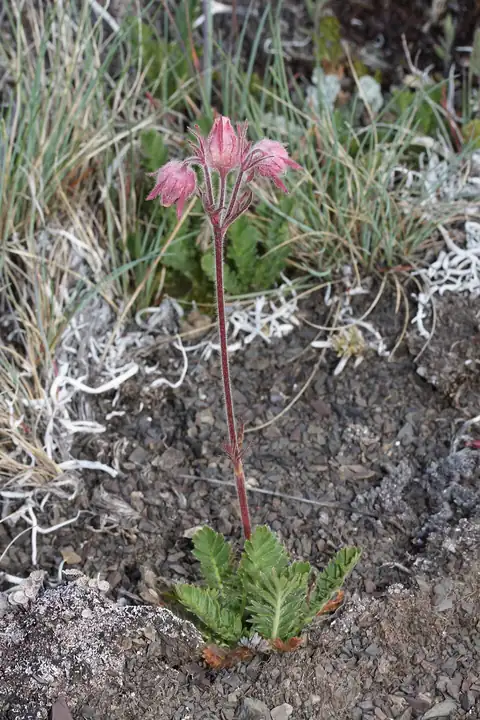
Prairie smoke
Geum triflorum (prairie smoke, old man's whiskers, purple avens) · Rose family (Rosaceae)
| Hardiness zones | 3 to 7 |
|---|---|
| Sun | full sun |
| Water | moderate |
| Life cycle | perennial |
| Frost | Hardy: takes frost |
| Soil pH | 6.8–7.2 |
About Prairie smoke
Prairie smoke is one of the first prairie wildflowers to bloom. Nodding, dusky pink-to-maroon flowers hang in threes over a low clump of ferny leaves, then turn upward and grow long, feathery pink-gray plumes that look like smoke drifting over the planting (Wisconsin Extension, Wildflower Center). It's native from New York and southern Ontario west to the Rockies, reaching British Columbia and California, but has become rare over much of its range as prairies were lost (Wildflower Center, Wisconsin Extension). It makes a good edging or rock-garden plant, and the semi-evergreen leaves turn red in fall.
Hardy in zones 3-7 (Wisconsin Extension). It dislikes hot, humid summers and wet winters.
When to plant
Timing is counted from your average last spring frost (and first fall frost). Sow & Tell works out the actual dates for your ZIP code.
Set out nursery plants or divisions in early spring, after flowering or in fall (Wisconsin Extension). From seed: chill it moist for 4-6 weeks, sow indoors in late February and plant out in late May in Wisconsin; seed sown outdoors in fall can also work (Wisconsin Extension). Keep taller plants from crowding it, since it competes poorly. We found no sourced day count to first bloom.
Soil
Any well-drained soil, from sand to clay; it grows bigger with organic matter but also takes lean, rocky soil and limestone. Moist in spring, drier in summer, and never wet in winter (Wisconsin Extension, Wildflower Center).
Any well-drained soil works; some organic matter makes bigger clumps, but it also grows in lean, rocky soil (Wisconsin Extension).
Feeding
We found no source that recommends regular feeding. Avoid wet winter soil and don't let taller plants shade or crowd it (Wisconsin Extension).
Harvest
Blooms in mid to late spring, April-May (Wildflower Center), into early summer, and the feathery seed heads last for weeks after (Wisconsin Extension). Leave them for the show, or cut whole stems with seed heads and hang them upside down somewhere warm and dry for arrangements.
In the kitchen
Safety: We found no extension source that lists prairie smoke as poisonous. It isn't a food plant, so don't eat it.
Pets: Not listed by the ASPCA (no prairie smoke, avens or Geum entry on its plant lists), so we can't call it pet-safe; discourage pets from chewing it.
Sources
- hort.extension.wisc.edu
- wildflower.org
- fs.usda.gov
- aspca.org
- aspca.org
- aspca.org
- aspca.org
- extension.rutgers.edu
Photo: Photo: Walter Siegmund, CC BY-SA 3.0, via Wikimedia Commons (CC BY-SA 3.0). Photo resized for the web.

Planting dates and advice are general guidance; check with your local Cooperative Extension office for your area.