
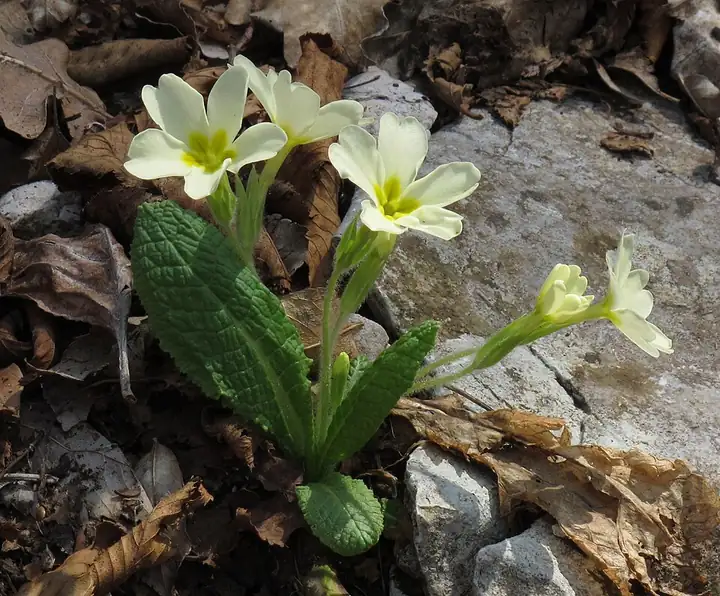
Primrose
Primula vulgaris (English primrose), P. x polyantha (polyanthus) and other garden Primula such as cowslip (P. veris) · Primrose family (Primulaceae)
| Hardiness zones | 3 to 8 |
|---|---|
| Sun | part shade |
| Water | moderate |
| Life cycle | perennial |
| Frost | Hardy: takes frost |
| Soil pH | 6.0–8.0 |
About Primrose
Primroses are low spring flowers that bloom in bright clusters over a rosette of crinkled leaves. English primrose has soft yellow, lightly fragrant flowers, while polyanthus hybrids come in many colors, often with a contrasting eye, and are popular in pots and cool-season beds (NC State). They want cool, moist, partly shaded spots and give early bees some of the year's first nectar. Evening primrose is a different plant with its own entry.
Polyanthus is hardy in zones 3-8 and English primrose in 4-8 (NC State). They need cool weather and may not return in the hot coastal South, where they're grown as cool-season annuals; cowslip handles heat and humidity better than most.
When to plant
Timing is counted from your average last spring frost (and first fall frost). Sow & Tell works out the actual dates for your ZIP code.
Set out nursery plants in spring, or in fall where they're used as cool-season bedding (NC State). Divide crowded clumps right after flowering or in spring. Cowslip seed sown in May blooms the following spring (NC State). We found no sourced day count to first bloom.
Soil
Cool, consistently moist, well-drained soil rich in organic matter; shield plants from hot afternoon sun in the Southeast (NC State).
Work in compost so the soil stays cool, moist and rich in organic matter (NC State).
Feeding
- Early spring, as new leaves start: complete slow-release fertilizer such as 12-6-6. Without a soil test, Clemson suggests 1-2 lb per 100 sq ft for perennials; water it in and keep it off the leaves.
Overfeeding gives soft growth and fewer flowers (Penn State). Don't let plants dry out or bake in afternoon sun.
Harvest
Blooms in early to mid spring, around April (NC State). Pick off faded flowers to keep plants tidy and encourage more (Clemson's general perennial advice). For small posies, cut stems when about half the flowers in a cluster are open (Oklahoma State).
Varieties (4)
Extension sources name very few primrose cultivars; we list one sourced cultivar and the main garden types NC State documents.
| Variety | Type | Days | Notes |
|---|---|---|---|
| Belarina Lively Lilac | English primrose (P. vulgaris) cultivar | ||
| Polyanthus (P. x polyantha) | Hybrid group | Early spring flowers in yellow, red, blue and purple, some with a contrasting eye; great in containers and cool-season beds. | |
| Cowslip (P. veris) | Species | Many small, nodding, deep yellow flowers over fuzzy leaves; takes heat and humidity better than other primroses. | |
| English primrose (P. vulgaris) | Species | Pale yellow to cream, lightly fragrant flowers about 1 inch across in April; zones 4-8. |
Pests to watch for
Slugs, Brown garden snail, Aphids, Twospotted spider mite
Diseases and problems
Gray mold, Root rot, Rust, Powdery mildew, Leaf spot, Viruses
In the kitchen
Safety: NC State rates English primrose low in toxicity for people (mild vomiting if eaten). Handling the leaves can irritate the skin of sensitive people; the 1918 U.S. Dispensatory blamed a secretion in the leaf hairs, so wear gloves if you react.
Pets: Toxic to dogs, cats and horses (ASPCA, Primula vulgaris): usually just mild vomiting; the toxic principle is unknown.
Sources
- plants.ces.ncsu.edu
- plants.ces.ncsu.edu
- plants.ces.ncsu.edu
- plants.ces.ncsu.edu
- henriettes-herb.com
- hgic.clemson.edu
- extension.okstate.edu
- aspca.org
- extension.rutgers.edu
- extension.psu.edu
Photo: Photo: Robert Flogaus-Faust / Wikimedia Commons, CC BY 4.0 (CC BY 4.0). Photo resized for the web.

Planting dates and advice are general guidance; check with your local Cooperative Extension office for your area.