
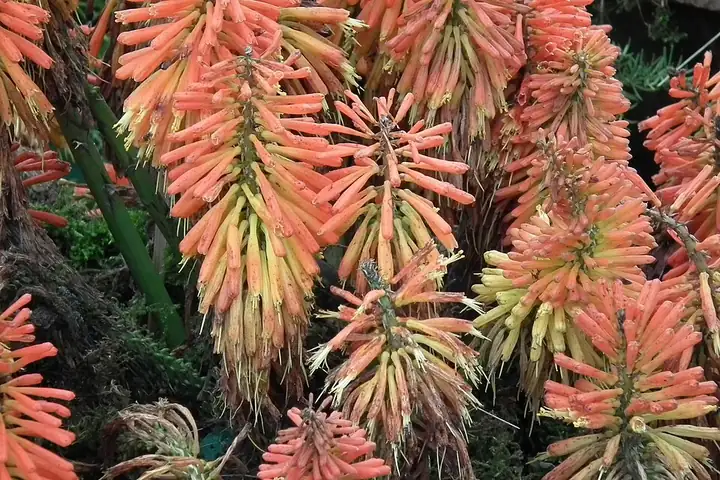
Red hot poker (torch lily)
Kniphofia uvaria and hybrids · Asphodel family (Asphodelaceae)
| Hardiness zones | 5 to 9 |
|---|---|
| Sun | full sun |
| Water | moderate |
| Life cycle | perennial |
| Frost | Hardy: takes frost |
About Red hot poker (torch lily)
Red hot poker is a South African perennial with grassy leaves and bold spikes of tubular flowers that open red and fade to yellow, so each spike looks two-toned. The flowers make lots of nectar and draw hummingbirds, bees and butterflies, while deer and rabbits leave the plants alone (NC State). Heads-up: the California Invasive Plant Council's risk screen rates Kniphofia uvaria high-risk for invasiveness, and it has already naturalized in 11 California counties, so West Coast gardeners should cut off spent spikes before seed forms or choose another plant.
Hardy in zones 5-9 (NC State). Cal-IPC's risk assessment scores K. uvaria as high risk of becoming invasive in California, where it has naturalized in 11 counties.
When to plant
Timing is counted from your average last spring frost (and first fall frost). Sow & Tell works out the actual dates for your ZIP code.
Plant the rhizomes about 4 inches deep and keep the soil evenly moist while they settle in (NC State). Named cultivars should be divided, not grown from seed, to keep their color; avoid disturbing established clumps (NC State).
Soil
Rich, well-drained soil; sandy soil is fine, but it will not stand clay or wet winter soil, which rots the roots (NC State).
Choose rich, well-drained soil (sandy is fine, clay is not) and plant the rhizomes about 4 inches deep (NC State). Follow a soil test; Clemson suggests about 1 lb of 10-10-10 per 100 sq ft worked into new perennial beds.
Feeding
- early spring, just before new shoots come up (only if growth is weak or a soil test calls for it): complete slow-release fertilizer such as 12-6-6 or 10-10-10. Clemson uses 1-2 lb of 12-6-6 per 100 sq ft of bed, scattered around the plants and watered in; Illinois Extension says most perennials need only light feeding in well-prepared soil.
Wet winter soil rots the crowns; don't plant in clay (NC State).
Harvest
Spikes bloom from the bottom up in summer. Cut spent spikes off at the base to encourage more flowers and to keep seed from spreading (NC State; Cal-IPC). In cold areas, tie the leaves together over the crown for winter and cut them back to about 3 inches in early spring (NC State).
Varieties (9)
Extension sources document 9 cultivars here.
| Variety | Type | Days | Notes |
|---|---|---|---|
| Backdraft | Hybrid red hot poker | Compact and drought-tolerant with peach-yellow flowers. | |
| Cobra | Hybrid red hot poker | Copper-orange flowers fading to yellow-white. | |
| Elvira | Hybrid red hot poker | 40-in flower stems with a long bloom period. | |
| High Roller | Hybrid red hot poker | About 2 ft tall with coral-red flowers; winter hardy. | |
| Lemon Popsicle | Hybrid red hot poker | Vigorous dwarf with yellow flowers. | |
| Papaya Popsicle | Hybrid red hot poker | Compact, about 20 in, with orange flowers. | |
| Prince Igor | Hybrid red hot poker | Tall, up to 6 ft, with large red flowers. | |
| Royal Standard | Hybrid red hot poker | Two-toned drooping spikes. | |
| Flamenco | Red hot poker (K. uvaria) | Red flowers. |
Pests to watch for
Thrips
Diseases and problems
Root rot
In the kitchen
Safety: Not an edible plant. Cal-IPC's risk assessment notes it contains compounds that can be poisonous if eaten and can irritate skin and eyes; wear gloves when dividing.
Pets: Non-toxic to dogs, cats and horses (ASPCA, listed as torch lily).
Sources
Photo: Photo: Rameshng, CC BY-SA 3.0, via Wikimedia Commons (CC BY-SA 3.0). Photo resized for the web.

Planting dates and advice are general guidance; check with your local Cooperative Extension office for your area.