
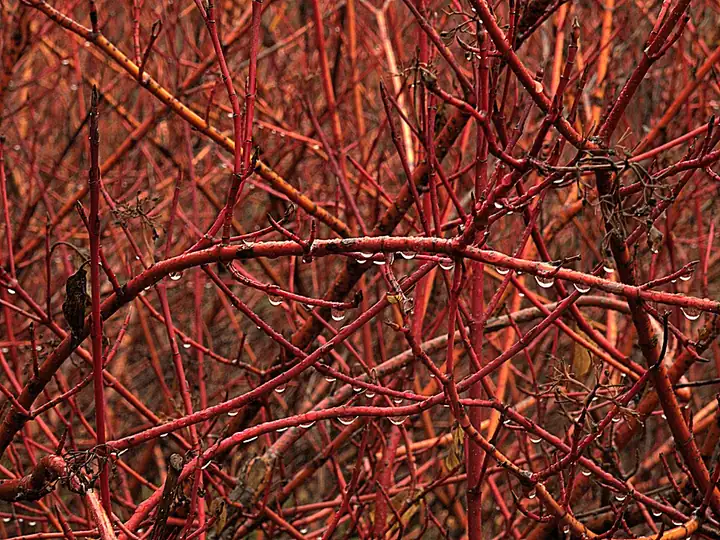
Red twig dogwood
Cornus sericea (red-osier dogwood; syn. C. stolonifera); the non-native Tatarian dogwood C. alba is grown the same way and is included as a group · Dogwood family (Cornaceae)
| Hardiness zones | 2 to 7 |
|---|---|
| Sun | full sun to part shade |
| Water | high |
| Life cycle | perennial |
| Frost | Hardy: takes frost |
About Red twig dogwood
Red twig dogwood is a fast, multi-stemmed shrub grown for its bright red (or yellow) stems that glow against snow all winter, with flat clusters of creamy flowers in late spring and white berries that birds love. Red-osier dogwood is native across most of North America, from Newfoundland to Alaska and south to Virginia, Nebraska, the New Mexico mountains and northern California, along streams, lake shores and wet ground (wildflower.org, NC State). Tatarian dogwood (C. alba) looks and grows almost the same but comes from Siberia, northern China and Korea; both sucker into thickets, and NC State notes both can turn weedy. It's a shrub cousin of the flowering dogwood and kousa dogwood trees.
Red-osier dogwood is hardy in zones 2-7 and Tatarian dogwood in zones 3-7 (UMN, NC State). It struggles in hot southern summers, where full sun stresses it and Tatarian dogwood gets more disease south of zone 7 (NC State).
When to plant
Timing is counted from your average last spring frost (and first fall frost). Sow & Tell works out the actual dates for your ZIP code.
Plant container shrubs in spring or fall and water deeply until established, which takes at least two growing seasons (UMN). Give it room to sucker, or slice around the clump with a spade to keep it in bounds (NC State, UMN).
Soil
Almost any soil, from sand to heavy clay; best in rich, steadily moist soil, and it handles wet sites and short floods as well as some dryness. It is sensitive to road salt. UMN gives a pH range of 6.1-8.5 for red-osier and 5.5-7.0 for Tatarian dogwood (UMN, NC State).
Test the soil before planting; it grows in most soils and established shrubs in decent soil need little feeding (Clemson, UMN).
Feeding
- Spring to early summer after new growth starts, only if a soil test or poor growth shows a need: slow-release complete fertilizer in a 3:1:2 or 3:1:1 ratio, or what the soil test calls for. Spread it evenly from the stems out to the drip line and water it in; a typical rate for shrubs is about 2 lb of 12-6-6 per 100 sq ft (Clemson). Follow a soil test.
- Spring, right after cutting the whole shrub back for new stems: light feeding with a slow-release fertilizer, plus mulch. NRCS suggests fertilizing and mulching after a hard cutback so the new stems grow strongly; keep it light and follow a soil test.
Water is what new shrubs need most: daily for the first 2 weeks, every 2-3 days through week 12, then weekly until the roots spread, at least two growing seasons, using about a quarter to a third of the nursery pot's volume each time (UMN). It is sensitive to road salt, so don't plant it where plowed snow piles up (UMN).
Harvest
Creamy white flowers open mid-May to June, sometimes with a smaller second bloom in July-August, and white to pale blue berries follow (UMN). Stem color is brightest on stems under 3 years old, so cut the oldest third of the stems to the ground every year or two in early spring; or cut the whole shrub to a few inches before spring growth for a full flush of bright new stems (UMN, NRCS, NC State).
Varieties (16)
| Variety | Type | Days | Notes |
|---|---|---|---|
| Alleman's Compact | Red-osier dogwood (C. sericea, native) | Compact red-stemmed shrub about 5 ft tall and wide with good fall color. | |
| Arctic Fire ('Farrow') | Red-osier dogwood (C. sericea, native) | Compact, red stems; 3-5 ft tall and wider. | |
| Baileyi | Red-osier dogwood (C. sericea, native) | Red stems; to about 5 ft. | |
| Cardinal | Red-osier dogwood (C. sericea, native) | Fast-growing, 6-10 ft, with good fall color; a 1986 University of Minnesota introduction. | |
| Firedance ('Bailadeline') | Red-osier dogwood (C. sericea, native) | Compact, about 4 ft tall and 5 ft wide, with good fall color. | |
| Flaviramea | Red-osier dogwood (C. sericea, native) | Yellow winter stems; about 8 ft tall and 10 ft wide. | |
| Isanti | Red-osier dogwood (C. sericea, native) | Compact red-stemmed shrub, about 6 ft tall and 10 ft wide; hardy to zone 2. A 1971 University of Minnesota introduction. | |
| Kelseyi | Red-osier dogwood (C. sericea, native) | Dwarf, about 3 ft tall and wide. | |
| Silver and Gold | Red-osier dogwood (C. sericea, native) | Yellow stems and green leaves edged creamy white; about 8 ft tall and 10 ft wide. | |
| Argenteo-marginata ('Elegantissima') | Tatarian dogwood (C. alba, non-native) | Leaves edged in white, red winter stems; less vigorous, to about 6 ft. Very common in nurseries. | |
| Bud's Yellow | Tatarian dogwood (C. alba, non-native) | Bright yellow winter stems; to about 6 ft and wider. | |
| Gouchaultii | Tatarian dogwood (C. alba, non-native) | Leaves edged yellow and pink, red winter stems; to about 6 ft. | |
| Ivory Halo ('Bailhalo') | Tatarian dogwood (C. alba, non-native) | White-edged leaves and red stems on a compact, dense shrub about 5 ft tall and wide. | |
| Red Gnome | Tatarian dogwood (C. alba, non-native) | Compact, with red winter stems. | |
| Sibirica | Tatarian dogwood (C. alba, non-native) | Coral-red stems and bluish fruit; less vigorous, to about 6 ft. | |
| Spaethii | Tatarian dogwood (C. alba, non-native) | Leaves with bold yellow edges that usually resist summer scorch; to about 5 ft. |
Pests to watch for
Scale insects, Dogwood borer, Leafminers, Bagworm, Sawflies (garden sawflies)
Diseases and problems
Leaf spot, Canker, Twig blight, Powdery mildew, Root and crown rot, Dogwood anthracnose
In the kitchen
Safety: No toxicity is listed in the extension sources we used. NC State lists the berries as edible, but they are tart and bitter (NRCS); they're best left for the birds.
Pets: Not listed by the ASPCA.
Sources
- plants.ces.ncsu.edu
- plants.ces.ncsu.edu
- wildflower.org
- extension.umn.edu
- extension.umn.edu
- plantdatabase.uconn.edu
- plants.sc.egov.usda.gov
- extension.umn.edu
- extension.rutgers.edu
- aspca.org
- hgic.clemson.edu
Photo: Photo: John Rusk / Wikimedia Commons, CC BY 2.0 (CC BY 2.0). Photo resized for the web.

Planting dates and advice are general guidance; check with your local Cooperative Extension office for your area.