
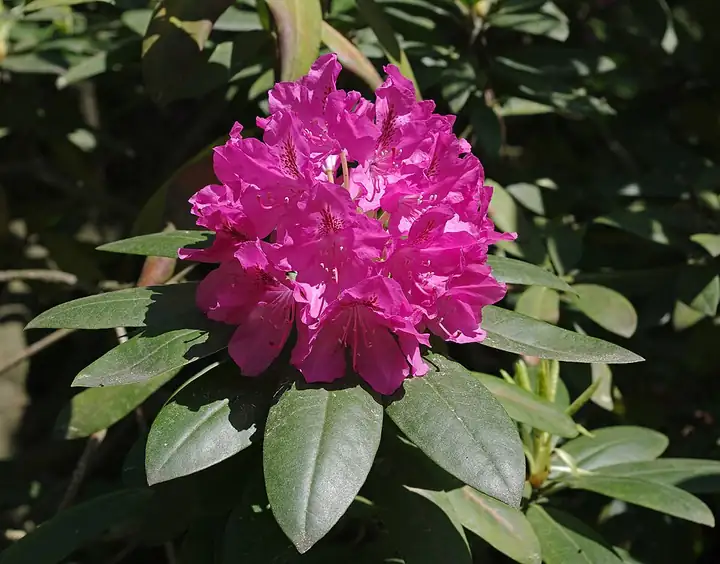
Rhododendron
Rhododendron catawbiense (Catawba), R. maximum (rosebay), R. carolinianum, R. minus and their hybrids (large-leaved evergreen rhododendrons) · Heath family (Ericaceae)
| Hardiness zones | 4 to 8 |
|---|---|
| Sun | part shade |
| Water | moderate |
| Life cycle | perennial |
| Frost | Hardy: takes frost |
| Soil pH | 4.5–6.0 |
About Rhododendron
Rhododendrons are broadleaf evergreen shrubs with big, bell-shaped flower clusters in mid to late spring. All azaleas are rhododendrons, but the big-leaved evergreen kinds on this page differ from azaleas (which have their own page) by their thick, leathery leaves and flowers with 10 stamens (NC State). Catawba and rosebay rhododendron are native to the Appalachians, and 'ironclad' hybrids descended from Catawba handle cold and heat best (Clemson).
Hardy in zones 4-8 (NC State). They prefer cool summers; in South Carolina, Clemson recommends them mainly for the mountains and Piedmont, in part shade.
When to plant
Timing is counted from your average last spring frost (and first fall frost). Sow & Tell works out the actual dates for your ZIP code.
Fall is the best time to plant (Clemson). Choose a spot out of the wind on the north or east side of a building. Newly planted shrubs need plenty of water the first years.
Soil
Excellent drainage and lots of organic matter: Clemson suggests mixing 4 inches of pine bark into the top 6-8 inches of soil over an area two to three times the shrub's width. NC State advises setting the root ball a little high and amending heavy clay.
Mix 4 inches of pine bark into the top 6-8 inches of soil over an area two to three times the shrub's width; aim for pH 4.5-6.0 and test the soil (Clemson).
Feeding
- Late spring to early fall when soil is moist, preferably right after flowering, and only for slow growth or a known deficiency: complete fertilizer in a 3:1:2 or 3:1:3 ratio, such as 12-4-8 or 15-5-15, or what a soil test recommends. Clemson gives no set rate; follow the soil test and label, spread under the canopy and water in. Organic mulch alone may supply enough.
Plants in warm areas on sandy soil may need water at least twice a week the first year; water 8-12 inches deep when the soil under the canopy is dry, but never keep it soggy, which invites root rot (Clemson). Don't feed during summer drought.
Harvest
Blooms in mid to late spring (April-June for Catawba). Snap off spent flower clusters so the plant doesn't make seed, and do any shaping right after flowering, since next year's buds form on the old growth (Clemson, NC State).
Varieties (15)
| Variety | Type | Days | Notes |
|---|---|---|---|
| Album | Catawba hybrid | Vigorous, up to 6 ft; white or pale violet flowers. | |
| English Roseum | Catawba hybrid | Upright, up to 6 ft; lavender to pale pink; takes heat and cold. | |
| Roseum Elegans | Catawba hybrid ('ironclad') | Vigorous, fast, up to 6 ft; pink to violet flowers; tolerates extreme heat. | |
| Ginny Gee | Dwarf hybrid | About 2 ft; dense pink-to-white bloom. | |
| Anna Rose Whitney | Hybrid | Large, needs space; intense pink flowers; heat tolerant. | |
| Caroline | Hybrid | Up to 6 ft; fragrant lavender flowers; heat tolerant and resistant to root disease. | |
| Cynthia | Hybrid | Up to 6 ft; pink; heat tolerant. | |
| Janet Blair | Hybrid | Vigorous, up to 6 ft; lavender-pink with a green throat. | |
| Lee's Dark Purple | Hybrid | Up to 6 ft; dark violet flowers. | |
| Nova Zembla | Hybrid | Up to 5 ft; red flowers; tolerates heat and cold. | |
| Scintillation | Hybrid | Rounded, vigorous, up to 6 ft; pink with a brown-to-gold throat. | |
| Vulcan's Flame | Hybrid | Up to 5 ft; bright red; heat resistant. | |
| Carolina rhododendron (R. carolinianum) | Native species | 3-6 ft; pale violet, white or pink flowers; one of the strongest natives. | |
| Chapman's rhododendron (R. minus var. chapmanii) | Native species | 3-5 ft; pale pink flowers; heat tolerant, suits all South Carolina regions. | |
| PJM hybrids | Small-leaved hybrid | Up to 6 ft; early lavender to pink flowers; tolerates heat and cold. |
Pests to watch for
Lace bugs (azalea and chrysanthemum lace bugs), Scale insects, Twospotted spider mite, Whiteflies, Deer
Diseases and problems
Phytophthora root rot, Canker, Dieback, Leaf spot, Rust, Powdery mildew, Leaf scorch, Winter injury, Black walnut toxicity, Soil pH problems
In the kitchen
Safety: NC State lists every part as poisonous (grayanotoxins): eating leaves, flowers or nectar, or honey made from the flowers, can cause drooling, watery eyes, stomach pain, vomiting, weakness, trouble breathing and a slow or irregular heartbeat, so don't let children chew on them.
Pets: Toxic to dogs, cats and horses (ASPCA, listed under azalea): grayanotoxin can cause vomiting (not in horses), diarrhea, weakness and heart failure.
Sources
- hgic.clemson.edu
- plants.ces.ncsu.edu
- plants.ces.ncsu.edu
- aspca.org
- extension.rutgers.edu
- extension.rutgers.edu
- hgic.clemson.edu
- extension.umn.edu
Photo: Photo: Chrumps / Wikimedia Commons, CC BY-SA 3.0 (CC BY-SA 3.0). Photo resized for the web.

Planting dates and advice are general guidance; check with your local Cooperative Extension office for your area.