
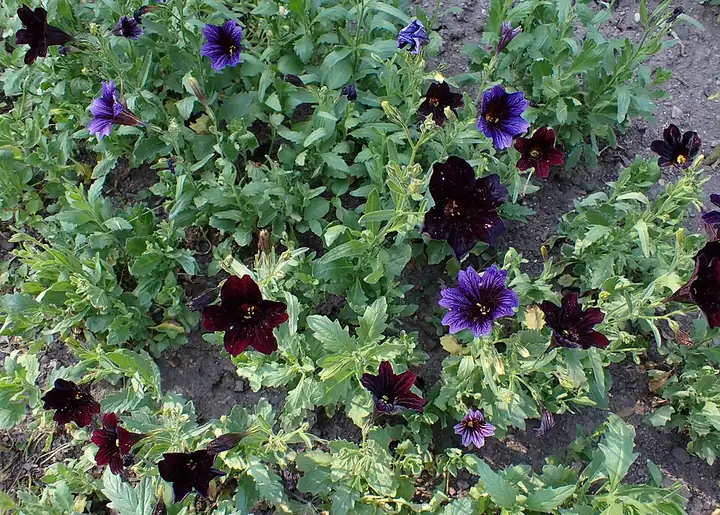
Salpiglossis (painted tongue)
Salpiglossis sinuata · Nightshade family (Solanaceae)
| Hardiness zones | 2 to 11 |
|---|---|
| Sun | full sun to part shade |
| Water | moderate |
| Life cycle | annual |
| Frost | Tender: killed by frost |
About Salpiglossis (painted tongue)
Painted tongue is an annual from Chile and Argentina with velvety, funnel-shaped flowers 1-3 inches across, veined in contrasting colors such as gold on purple or red (NC State). It's a showy cut flower, but it is a cool-weather plant that can fade in hot summers, so it does best where nights are cool or with afternoon shade (NC State, Purdue).
Grown as a summer annual in every zone; it performs best where summers are cool and may decline in high heat (NC State).
When to plant
Timing is counted from your average last spring frost (and first fall frost). Sow & Tell works out the actual dates for your ZIP code.
- Start seeds indoors: 8 to 10 weeks before the last frost
- Set out plants: up to 2 weeks after the last frost
Start seed indoors about 8 weeks before the last frost (Purdue), or up to about 10 weeks ahead as in a University of Alaska chart. The fine seed sprouts in about 8-20 days; the Alaska chart germinates it in darkness at 70-75 F, so sow it very shallow and keep the tray dark until sprouts appear (Montana State, UAF). Set plants out after the last frost; it has no frost tolerance (Purdue). No sourced count from sowing to first bloom.
Soil
Moderately fertile, humus-rich, well-drained soil kept evenly moist; it dislikes wet feet, and mulch helps keep the roots cool (NC State, Purdue).
Work in organic matter for a moderately fertile, humus-rich bed that drains well (NC State, Purdue).
Feeding
- During the season, only if growth looks weak: light feeding of a balanced fertilizer. NC State says painted tongue is sensitive to nitrogen and Montana State warns against over-fertilizing, so use a light hand and follow a soil test.
Too much nitrogen, soggy soil and letting the soil dry out all set it back (NC State, Montana State).
Harvest
Blooms from summer into fall, longest where summers are cool. Deadhead spent flowers for more blooms, pinch the tips of young plants for more flowers, and stake taller plants (NC State, Montana State). It's a good cut flower.
Varieties (1)
Extension sources we found name only 'Bolero' (in an NC State photo caption); no other trustworthy cultivar list.
| Variety | Type | Days | Notes |
|---|---|---|---|
| Bolero | Painted tongue (S. sinuata) |
In the kitchen
Safety: We found no poisoning information for painted tongue; NC State lists none. The leaves and stems are hairy and sticky. It isn't a food plant, so don't eat it.
Pets: Not listed by the ASPCA.
Sources
Photo: Photo: Krzysztof Ziarnek, Kenraiz, CC BY-SA 4.0, via Wikimedia Commons (CC BY-SA 4.0). Photo resized for the web.

Planting dates and advice are general guidance; check with your local Cooperative Extension office for your area.