
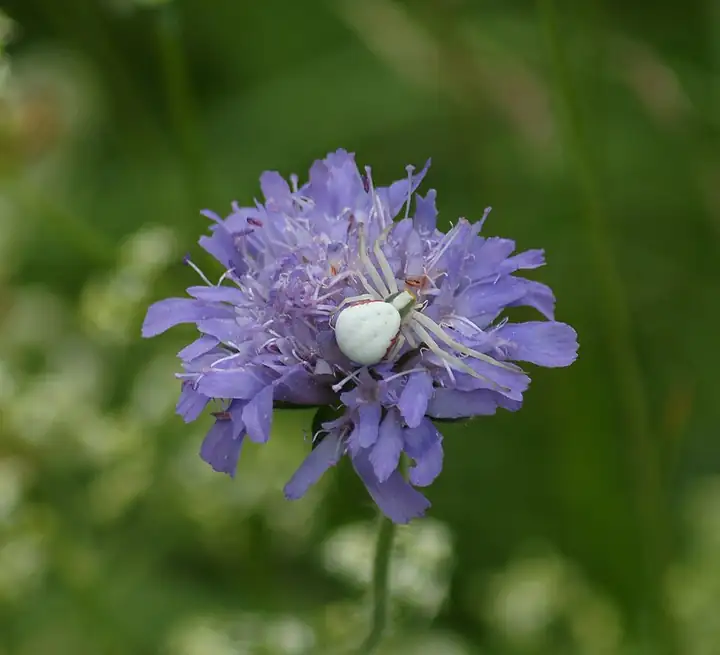
Scabiosa (pincushion flower)
Scabiosa columbaria and Lomelosia (Scabiosa) caucasica (perennial); Scabiosa atropurpurea (annual) · Honeysuckle family (Caprifoliaceae)
| Hardiness zones | 3 to 9 |
|---|---|
| Sun | full sun |
| Water | low |
| Life cycle | perennial |
| Frost | Hardy: takes frost |
| Spacing | 12 to 36 inches |
About Scabiosa (pincushion flower)
Pincushion flowers have round, frilly blooms with a 'pincushion' of stamens on wiry stems, blooming from late spring to frost. Perennial types like 'Butterfly Blue' draw butterflies, hummingbirds and predatory insects, and the annual sweet scabious (S. atropurpurea) is a favorite cut flower. The annual species has escaped into California grasslands and is on Cal-IPC's and PlantRight's watch lists there.
Perennial types are hardy in zones 3-8 (Caucasian scabious) or 5-9 ('Butterfly Blue') and dislike heat plus humidity; annual S. atropurpurea is grown from seed anywhere. In California, S. atropurpurea is on Cal-IPC's 'Watch' list and PlantRight's watch list for spreading into grasslands.
When to plant
Timing is counted from your average last spring frost (and first fall frost). Sow & Tell works out the actual dates for your ZIP code.
Set out perennial plants or divide them in spring; seed can be sown in spring or summer (NC State). Sow annual S. atropurpurea outdoors in spring or start it indoors. Give plants a light, dry winter mulch in cold areas.
Soil
Sharply drained loam or sandy soil, neutral to limy; plants rot in wet soil, especially in winter (NC State).
Choose sharply drained loam or sandy soil, neutral to limy; plants rot in wet soil (NC State).
Feeding
Wet or poorly drained soil causes root rot, and heat with humidity shortens the life of perennial types (NC State).
Harvest
Deadhead spent flowers to keep blooms coming, and cut back large stems to push new growth from the base (NC State). For vases, cut stems when flowers open; the annual types make long-stemmed cut flowers (NC State trials).
Varieties (11)
NC State Extension (plant pages and cut-flower trials) documents 11 scabiosa varieties.
| Variety | Type | Days | Notes |
|---|---|---|---|
| Ace of Spades | Annual (Scabiosa atropurpurea) | Fragrant double flowers on 3 ft plants. | |
| Beaujolais Bonnets | Annual (Scabiosa atropurpurea) | Burgundy flowers with white stamens; about 24 in tall. | |
| Black Knight | Annual (Scabiosa atropurpurea) | Very dark red flowers. | |
| Olympia | Annual (Scabiosa atropurpurea) | Productive cut flower: about 43 stems per plant with 22-in stems in a 1994 NC State trial. | |
| QIS Deep Red | Annual (Scabiosa atropurpurea) | Deep red-violet flowers on about 20-in stems with long vase life. | |
| QIS Formula Mix | Annual (Scabiosa atropurpurea) | Mixed colors including pastels on less rangy plants that need less staking. | |
| Pink Mist | Perennial | Pink (some say lavender-pink) flowers on wiry stems; stems about 12 in the first year and 21 in the second in NC State trials. | |
| Clive Greaves | Perennial (Lomelosia/Scabiosa caucasica) | Large lavender-blue flowers. | |
| Fama | Perennial (Lomelosia/Scabiosa caucasica) | Very large blue flowers on stems about 18 in long; about 26 stems per plant in a 1996 NC State trial. | |
| Miss Willmott | Perennial (Lomelosia/Scabiosa caucasica) | White flowers on tall stems. | |
| Butterfly Blue | Perennial (Scabiosa columbaria) | Lavender-blue pincushions on a compact 1-1.5 ft clump; draws butterflies and hummingbirds. |
Pests to watch for
Aphids, Twospotted spider mite
Diseases and problems
Root and crown rot, Powdery mildew, Downy mildew
In the kitchen
Pets: Not listed by the ASPCA (its 'pincushion flower' entry is a different plant, Leucospermum).
Sources
- plants.ces.ncsu.edu
- plants.ces.ncsu.edu
- plants.ces.ncsu.edu
- cal-ipc.org
- plantright.org
- cutflowers.ces.ncsu.edu
- aspca.org
Photo: Photo: Böhringer Friedrich, CC BY-SA 2.5, via Wikimedia Commons (CC BY-SA 2.5). Photo resized for the web.

Planting dates and advice are general guidance; check with your local Cooperative Extension office for your area.