
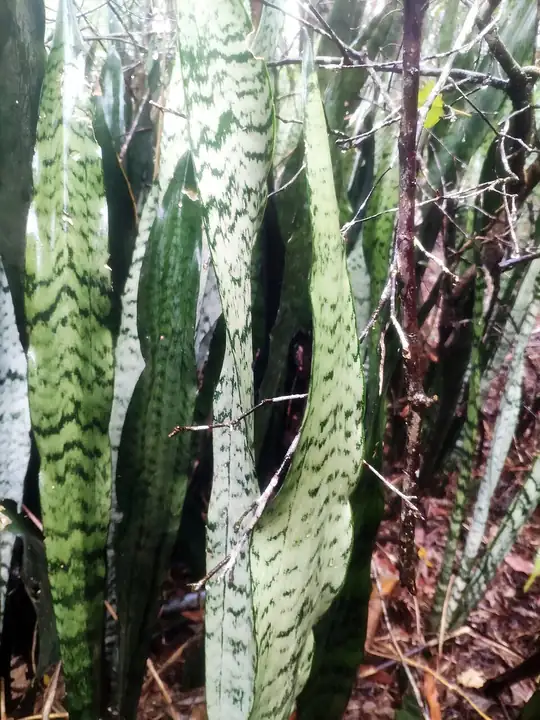
Snake plant
Dracaena trifasciata (formerly Sansevieria trifasciata) · Asparagus family (Asparagaceae)
| Hardiness zones | 10 to 12 |
|---|---|
| Sun | part shade |
| Water | low |
| Life cycle | perennial |
| Frost | Tender: killed by frost |
About Snake plant
The snake plant, or mother-in-law's tongue, is a stiff, upright succulent from West and Central Africa with sword-shaped leaves banded in gray-green and often edged in yellow (NC State). It was long called Sansevieria until genetic work moved it into Dracaena (Penn State). It shrugs off low light, dry air and weeks without water, which makes it about the hardest houseplant to kill; the one thing that does it in is wet soil. Its tough leaf fibers were once grown in Florida for rope and bowstrings.
Hardy outdoors only in zones 10-12 (NC State); it is grown indoors everywhere and can summer outdoors in shade once nights stay above about 50 F.
When to plant
Timing is counted from your average last spring frost (and first fall frost). Sow & Tell works out the actual dates for your ZIP code.
Usually bought as a nursery plant or started from a division of an older clump; leaf cuttings also root (Penn State).
Growing it indoors
- Light: Tolerates very low light and heavy shade, though it grows faster in medium to bright light; keep it out of hot direct sun, which can burn the leaves (NC State, Penn State).
- Water: Water only when the mix is dry all the way through, then drain the saucer; it can go a month without water, and overwatering is the one thing that kills it (Penn State). Spring through fall let it dry between waterings; in winter NC State says water only every one to two months.
- Humidity: Tolerates the driest indoor air (NC State).
- Temperature: Tolerates cool rooms down to about 50 F (NC State); MU Extension suggests 65 F nights for best growth, and it must never freeze.
- Feeding: An all-purpose houseplant fertilizer at half strength once a month during the growing season, none in winter (Penn State).
- Repotting: Only about every 5 years with fresh potting mix, or every 3 years for the dwarf 'Hahnii' types; it likes a snug pot, but a badly rootbound plant can crack a clay pot, and tall kinds need a heavy pot so the leaves don't tip it over (Penn State).
Soil
A fast-draining cactus mix or potting mix cut with perlite, in a pot with drainage holes; it tolerates neutral to alkaline soil (Penn State, NC State).
Pot in a fast-draining cactus mix, or a potting mix with extra perlite, in a heavy pot with drainage holes (Penn State).
Feeding
- Spring through early fall (growing season): all-purpose houseplant fertilizer at half strength. Once a month, watered in on a day the plant is due for water (Penn State).
- Winter: none. No fertilizer while growth has stopped; water only every month or two (NC State).
Overwatering kills more snake plants than anything else; feeding a wet, dark plant only makes rot more likely (Penn State, MU Extension).
Varieties (15)
| Variety | Type | Days | Notes |
|---|---|---|---|
| Black Jack | Compact | Compact plant with dark green leaves and yellow-green margins. | |
| Whitney | Compact | Dark green leaves with pale and dark green variegation along the margins. | |
| Fernwood Mikado (D. bacularis) | Cylindrical-leaved relative | Narrow upright cylindrical leaves that fill in densely with age. | |
| Starfish (D. angolensis 'Boncel') | Cylindrical-leaved relative | A related species with round, pointed leaves that fan out flat like a starfish. | |
| Golden Hahnii | Dwarf rosette | Dwarf rosette with golden leaf margins, up to 7 in. | |
| Hahnii (bird's nest) | Dwarf rosette | A low funnel-shaped rosette of 6-12 short leaves banded in creamy white, about 6 in tall. | |
| Black Robusta | Tall, dark | Dark green leaves mottled with silver stripes. | |
| Futura Robusta | Tall, silver | Dark green leaves with silvery-green blotches. | |
| Moonshine (Moonglow) | Tall, silver | Broad silvery-gray-green leaves with a narrow dark green margin. | |
| Silver Queen | Tall, silver | Silver-green leaves with light green horizontal bands. | |
| Twisted Sister | Tall, variegated | Twisting leaves with yellow-gold and green variegation. | |
| Bantel's Sensation | Tall, white-striped | Narrow dark green leaves 1-2 in wide with white vertical stripes, up to 36 in tall. | |
| Black Gold | Tall, yellow-edged | Very dark green leaves with a bright gold edge. | |
| Futura Superba | Tall, yellow-edged | Shorter, broader gray-green leaves with a yellow margin. | |
| Laurentii | Tall, yellow-edged | The classic snake plant: dark green leaves with lighter zigzag bands and golden-yellow margins. |
Pests to watch for
Thrips, Scale insects, Mealybugs, Twospotted spider mite
Diseases and problems
Root and crown rot
In the kitchen
Safety: All parts contain saponins; eating it can cause nausea, vomiting and diarrhea, and the sap may irritate skin (NC State rates it low severity). The leaf tips are sharp enough to poke an eye, so set tall plants away from walkways.
Pets: Toxic to dogs and cats (ASPCA): saponins cause nausea, vomiting and diarrhea. NC State also lists it as a problem for horses.
Sources
Photo: Photo: 四角銅鑼, CC BY 4.0, via Wikimedia Commons (CC BY 4.0). Photo resized for the web.

Planting dates and advice are general guidance; check with your local Cooperative Extension office for your area.